 lop News
Dr. Peter Stafford could barely stand. Clad in full protective gear, the American surgeon leaned on handlers as he boarded a flight from Congo to Berlin on Wednesday — the clearest signal yet that the Ebola outbreak tearing through Central Africa is no longer a regional crisis.
Stafford, a missionary surgeon at Nyankunde Hospital in Congo’s Ituri province, unknowingly operated on a patient who later died of Ebola, according to his sending agency, Serge. He tested positive on Sunday. His wife, Dr. Rebekah Stafford, also a physician, and their four children are being monitored for symptoms at a facility in Germany.
The optics are impossible to ignore: an American doctor, evacuated to a world-class isolation ward at Berlin’s Charité hospital, while Congolese patients lie in overcrowded wards with no protective equipment and no approved treatment for the strain that’s killing them.
A virus that outran detection
The culprit is the Bundibugyo ebolavirus — a rare strain first identified in Uganda in 2007 with no licensed vaccines or therapeutics. Unlike the Zaire strain responsible for most previous outbreaks, including the 2014–2016 West Africa epidemic that killed more than 11,000 people, Bundibugyo evades standard Ebola tests. Health workers initially tested for Zaire and came up negative, allowing the virus to spread undetected for weeks.
By the time African health officials confirmed the outbreak on Friday, May 15, WHO Director-General Tedros Adhanom Ghebreyesus had seen enough. He declared a public health emergency of international concern without waiting for the usual expert committee — the first time that has ever happened, according to STAT News. The International Panel for Pandemic Preparedness and Response called the move prudent.
As of Wednesday, the WHO reported 139 suspected deaths and more than 600 suspected cases across Congo’s Ituri and North Kivu provinces, with two cases confirmed in Uganda. The London-based MRC Centre for Global Infectious Disease Analysis estimates the true case count may already exceed 1,000.
“We know that the scale of the epidemic in DRC is much larger,” Tedros said.
The politics of delay
US Secretary of State Marco Rubio told reporters Tuesday that the WHO was “a little late to identify this thing unfortunately.” He said the US had set aside funds for 50 emergency clinics in affected areas.
Tedros pushed back in Geneva, saying “maybe what the secretary said … could be from lack of understanding of how IHR [International Health Regulations] work, and the responsibilities of WHO and other entities.”
The finger-pointing obscures an uncomfortable context. The Trump administration’s dismantling of USAID in early 2025 gutted the rapid-deployment infrastructure that epidemiologists say could have caught this outbreak sooner. Elon Musk, then heading the Department of Government Efficiency, admitted he had “accidentally” terminated Ebola containment programs. The New York Times later reported not all were restored.
The CDC, which has over 30 staff currently in Congo according to Deutsche Welle, has itself lost 25 percent of its workforce under Health Secretary Robert Kennedy Jr. Key Ebola specialists were reportedly fired and then rehired. The US has also formally withdrawn from the WHO.
No vaccine, no rooms, no time
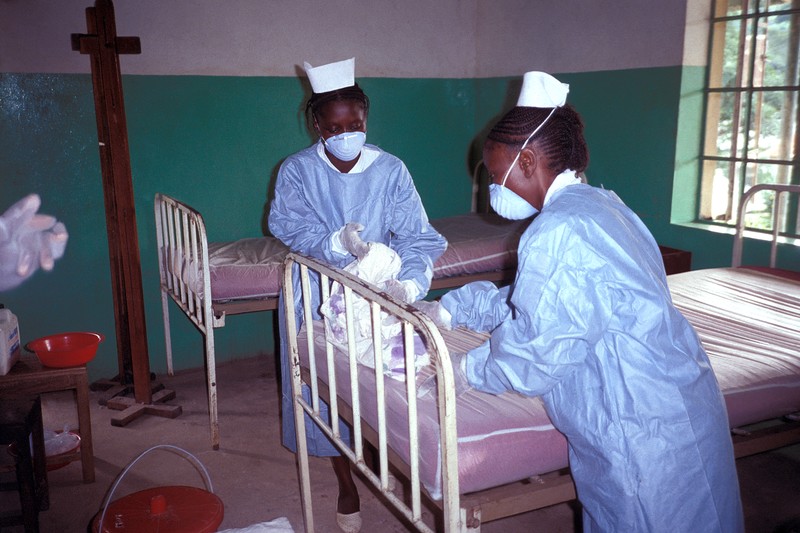
On the ground, the picture is stark. At Bambu General Hospital in Ituri, suspected Ebola patients share wards with other sick and injured people. A Doctors Without Borders team found no available isolation beds in the entire Bunia area. In Mongbwalu, there were around 30 Ebola patients at the general hospital, according to Dr. Didier Pay. The patients are “scattered here and there” while staff wait for triage facilities, said Dr. Richard Lokudu, the hospital’s medical director.
A Bundibugyo vaccine is at least six to nine months away, according to WHO special adviser Dr. Vasee Moorthy. The virus is spreading through a conflict zone where Islamic State-linked militants killed at least 17 people on Tuesday alone. Cases have reached Goma, a city controlled by Rwanda-backed M23 rebels.
Dr. Lievin Bangali of the International Rescue Committee described eastern Congo as under “immense pressure from conflict, displacement and a collapsing health system” — compounded by years of underfunding that preceded the latest American cuts.
One missionary who survived the 2014 outbreak, Nancy Writebol, recalled the guilt of evacuation: “I’m being evacuated, but the people I’m serving cannot be.” Stafford is now experiencing that same painful calculation — saved by his passport, while his Congolese colleagues and patients face a virus the world is struggling to contain.
Sources
- Ebola fears surge on the ground in Congo over rapid spread of a rare type — NPR
- US doctor who contracted Ebola in DRC flown to Germany for treatment — The Guardian
- WHO declares Ebola outbreak an international public health emergency — STAT News
- American Missionary Doctor Contracts Ebola as Congo Outbreak Intensifies — Christianity Today
- American who contracted Ebola in DR Congo being treated in Germany — BBC News
Discussion (11)