 lop News
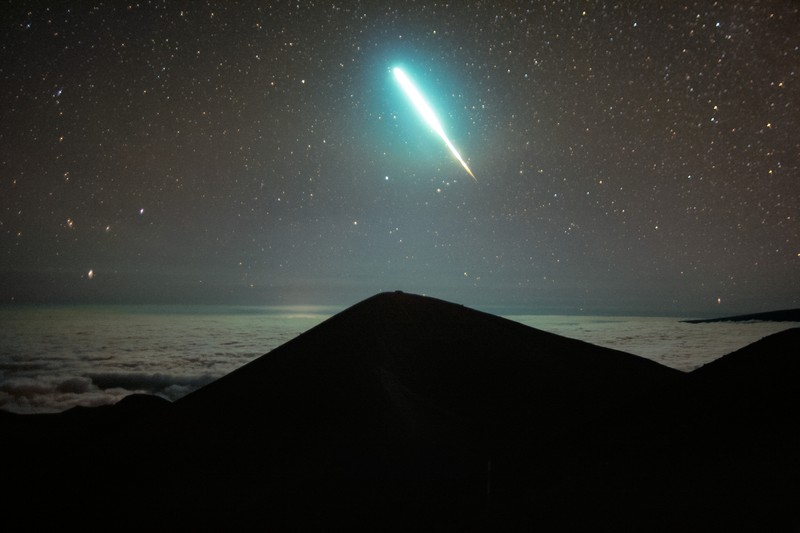
At 2:06 p.m. on Saturday, a rock roughly three feet wide slammed into the atmosphere above the Massachusetts-New Hampshire border at 75,000 miles per hour. Forty miles up, it tore itself apart with the force of 300 tons of TNT. Down below, buildings shook. Two thunderous booms rolled across New England. And police departments from Massachusetts to Rhode Island lit up with calls.
For a few confused minutes, nobody knew what had happened.
Reports flooded in from Delaware to Montreal. Some people saw a fireball — what Robert Lunsford of the American Meteor Society described as looking like “a shooting star in the daytime sky,” except bigger. Much bigger. “It was definitely bigger than a normal fireball, about a yard wide,” Lunsford said. Others felt the ground shake beneath them. Several filed reports with the US Geological Survey, so many that the agency opened an event page on its “Did You Feel It?” website.
But there was no earthquake. USGS spokesperson Steve Sobie confirmed that no seismic event registered on the agency’s seismographs. The shaking came from above, not below.
Caught on Satellite
Meteorologists had the answer within hours. Satellite data from the GOES-19 weather satellite’s lightning mapper — an instrument designed to track electrical storms — had captured something that wasn’t lightning at all.
WBZ-TV chief meteorologist Eric Fisher explained in an Instagram video that when a meteor enters the atmosphere and explodes, the flash registers on lightning-detection instruments. “Basically, when [a meteor] enters the atmosphere and explodes, it shows up as lightning,” he said. “So in our lightning mapper … you can see exactly where that came in.”
NBC 10 meteorologist Pamela Gardner pointed to the same GOES-19 data, identifying the source as likely a bolide — the technical term for a meteor that detonates in the atmosphere rather than surviving to strike the ground.
NASA confirmed the call. The object was natural material, not a satellite or space debris, and was not associated with any active meteor shower. It was, in the plainest terms, a random rock from space that happened to pick a Saturday afternoon over southern New England.
The Physics of the Boom
So how does a three-foot rock produce a shockwave felt across multiple states?
The answer is speed. Meteors enter the atmosphere traveling anywhere from 25,000 to 160,000 miles per hour, according to the American Meteorological Society. At those velocities, air cannot get out of the way fast enough. The meteor compresses the atmosphere in front of it, building pressure waves that propagate outward — a sonic boom, the same principle that makes a cracked whip snap or a supersonic jet thunder, but scaled up dramatically.
In this case, the meteor fragmented at roughly 40 miles altitude. When it broke apart, the energy release — equivalent to roughly 300 tons of TNT, per NASA’s estimate — generated the double boom that witnesses captured in videos posted to social media.
Why a double boom? An object moving faster than the speed of sound generates a continuous shockwave along its flight path. Listeners on the ground hear it as a sharp crack when the cone-shaped pressure wave passes over them. When a meteor breaks apart in a violent fragmentation event, that produces a second, distinct blast. If the timing is right and you’re standing in the right place, you hear both.
A Common Event, an Uncommon Audience
Objects this size hit Earth’s atmosphere regularly. Most go unnoticed — over ocean, over uninhabited land, or at hours when nobody is looking up. What made Saturday’s event unusual was the audience. Millions of people live in the corridor between Boston and Providence, and it was a clear Saturday afternoon.
Wrentham police chief Bill McGrath said the explosion “was heard and felt throughout New England, shaking homes and causing many people to be justifiably concerned.” His department, like others across the region, found no damage and no injuries.
As for the meteor itself, Lunsford said it most likely burned up before reaching the ground. “If it didn’t burn up, then it would have landed in the ocean,” he said. “Most of them do burn up before they hit the ground.”
A similar sonic boom was reported in the Carolinas on Thursday, though its origin has not been confirmed. Whether the two events are related is unknown.
The universe is not being deliberately dramatic. It just seems that way sometimes.
Discussion (9)