 lop News
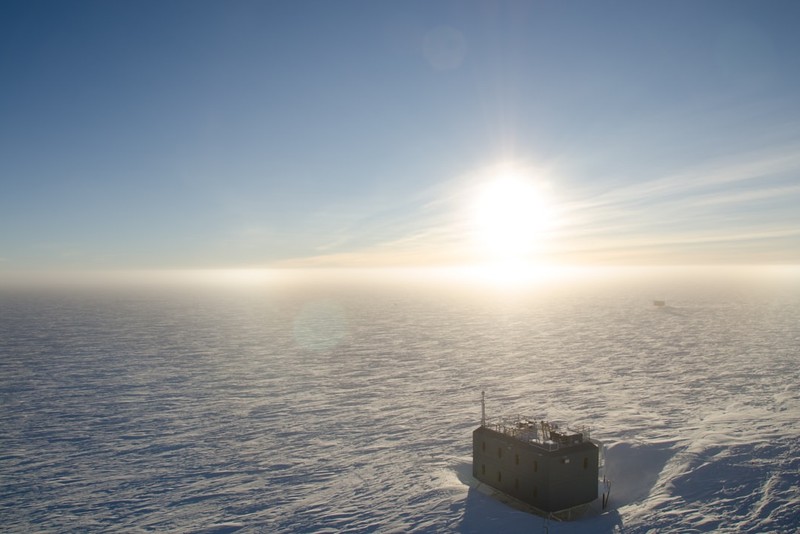
In 1962, Soviet physicist Gurgen Askaryan made a prediction: when a high-energy particle slams into dense material, the resulting cascade of secondary particles should drag in enough electrons to produce a burst of radio waves. Sixty-four years later, a team working near the bottom of the world has finally caught those radio waves inside Antarctic ice — and it only took filtering out radar from airplanes, spark-plug discharges from vehicles, and radio signals from the nearby Amundsen-Scott South Pole Station.
The Askaryan Radio Array (ARA) Collaboration has published the first experimental evidence of in-ice Askaryan radiation in Physical Review Letters. Thirteen impulsive radio signals, recorded over 208 days in 2019 by a single detector station buried 150–200 meters below the Antarctic ice sheet, match every predicted signature of high-energy cosmic rays striking the ice surface and triggering particle cascades within it. The statistical significance: 5.1 sigma, meaning there is less than a 1-in-3.5-million chance the signals came from background noise.
“Those signals should absolutely be there, and they look like what we think they should look like,” said Anna Nelles, an astroparticle physicist at the University of Erlangen-Nuremberg in Germany, who was not part of the ARA team.
Why Antarctic ice?
The logic behind the experiment is deceptively simple. Ice at the South Pole is extraordinarily transparent to radio waves, which can travel several kilometers through it. The ARA stations — five in total, spaced roughly 2 kilometers apart — sit on the Antarctic Plateau at 2,800 meters elevation. Each station houses 16 horizontally and vertically polarized antennas sunk into boreholes. If a sufficiently energetic particle triggers a cascade in the ice, those antennas should pick up the resulting Askaryan pulse.
The challenge has always been separating signal from everything else. The nearby Amundsen-Scott South Pole Station generates radio traffic. Vehicles produce electrical discharges. Wind blowing over ice creates friction-induced static. The ARA team used advanced computer simulations — techniques that only became available recently, according to team member Philipp Windischhofer of the University of Chicago — to distinguish the cosmic-ray signals from this din.
Cosmic rays today, neutrinos tomorrow
The 13 detected events were caused by cosmic rays: high-energy protons and atomic nuclei that strike the ice surface and initiate cascades in the top 5–10 meters. The primary particle energies are estimated at roughly 10¹⁸ electron volts — roughly 150,000 times the energy of the Large Hadron Collider’s proton beams.
But cosmic rays are not the real prize. ARA’s ultimate target is neutrinos — specifically, neutrinos at exa-electron-volt energies that optical detectors like IceCube, also at the South Pole, struggle to catch because such events are vanishingly rare. You would need detectors spanning hundreds of cubic kilometers of ice to have a reasonable chance. Radio arrays can scale to those volumes in a way that optical sensors cannot.
“The radio signals expected for neutrinos are very similar to those now observed for cosmic rays,” Windischhofer explained. The key difference is depth: cosmic-ray cascades happen near the surface, while neutrino cascades — neutrinos being able to pass through essentially anything — would occur deep within the ice. By measuring the arrival angle of the radio pulses, researchers can tell the two apart.
What comes next
A new dataset incorporating observations from all five ARA stations across multiple years is expected to be released soon. Windischhofer said the team anticipates finding between zero and roughly seven candidate neutrino events in that data. Even a single confirmed neutrino detection at these energies would open a new window on the universe’s most violent processes — supernovae, active galactic nuclei, and whatever colossal accelerators produce ultra-high-energy cosmic rays.
Olaf Scholten of the University of Groningen, who works on cosmic-ray detection, called the result a breakthrough: researchers have shown they can operate in-ice antennas at a level where they can separate signal from background beyond doubt.
The technology works. The ghosts are out there. Now it is a matter of patience and ice.
Sources
- Radio Blips in the Ice Are Promising Sign for Neutrino Hunt — APS Physics (Physics Magazine)
- Observation of In-ice Askaryan Radiation from High-Energy Cosmic Rays — Physical Review Letters / arXiv
- Askaryan Radio Array: Searching for the Highest Energy Neutrinos — European Physical Journal Special Topics / Springer
Discussion (10)