 lop News
Thirty days of air strikes have degraded Iran’s air defences, pounded its nuclear sites, and killed civilians across multiple provinces. They have not forced Tehran to surrender. Now the Pentagon is preparing plans that would fundamentally alter the character of this war: limited ground operations inside Iranian territory.
According to US officials quoted by The Washington Post, the plans under consideration include special operations raids and conventional infantry deployments targeting Kharg Island — Iran’s primary oil export hub — and coastal areas near the Strait of Hormuz. The objectives, one official said, would take “weeks, not months” to complete, while another estimated “a couple of months.” The plans fall short of a full-scale invasion. They would nonetheless expose American forces to Iranian drones, missiles, ground fire, and improvised explosives for the first time in this conflict.
Whether President Donald Trump will approve any of it remains uncertain. “It’s the job of the Pentagon to make preparations in order to give the Commander in Chief maximum optionality. It does not mean the president has made a decision,” White House press secretary Karoline Leavitt said in a statement responding to the Post report.
TheEscalation Calculus
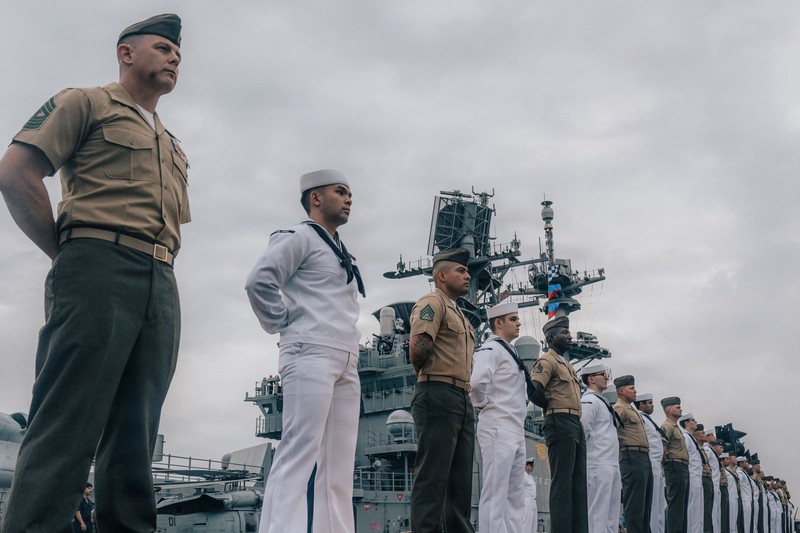
The ground-war deliberations come as the US military continues building up in the region. On March 27, approximately 3,500 sailors and marines from the 31st Marine Expeditionary Unit arrived in the Middle East aboard the USS Tripoli, joined by transport and strike fighter aircraft, according to US Central Command. Thousands of soldiers from the army’s 82nd Airborne are also being readied for deployment.
For 30 days, the United States and Israel have conducted an air campaign that has hit Tehran neighbourhoods, Bushehr province, Khuzestan province, and Iranian universities. Iran has responded with missile and drone strikes on Israel, and — critically — on the Gulf states that host US military infrastructure.
The ground-operations talk marks a threshold. Air campaigns, however devastating, allow political leaders to maintain the fiction that a war is limited. Boots on the ground shatter that illusion. Casualties mount. Territory must be held or abandoned. Exit strategies become demands, not options.
David Ignatius, the veteran foreign-affairs columnist at The Washington Post, drew the parallel explicitly on The Atlantic’s Washington Week programme. “The more I watch this process of a weak enemy being pounded and pounded, I’m reminded of the Gaza war,” Ignatius said. After two years of fighting, “Hamas still controls most of the Palestinians in Gaza. Even with all that power, Israel wasn’t able to win — and I think that’s what we’re all worrying about.”
TheGulf States Under Fire
Iran has already demonstrated that it can punish the countries caught between the belligerents. Saudi Arabia intercepted 10 drones in the early hours of Sunday, according to its Defence Ministry. The UAE’s air defences responded to missile and drone threats; Emirates Global Aluminium reported significant damage to one of its Abu Dhabi sites and six employees wounded. Aluminium Bahrain said two employees were slightly injured when its facility was struck. Kuwait’s National Guard shot down four drones.
The IRGC claimed responsibility for the Bahrain and Abu Dhabi strikes, describing both sites as “industries affiliated with and connected to the US military and aerospace sectors in the region.”
Iranian parliament speaker Mohammad Bagher Ghalibaf warned that any attempt to occupy Iranian islands would trigger targeted attacks on the “vital infrastructure” of whichever regional country assisted the operation. An unnamed military source, quoted by Iran’s Tasnim news agency, raised the possibility of opening a new front at the Bab al-Mandeb Strait — the narrow waterway between Yemen and Djibouti through which much of the world’s container traffic passes.
The Houthis, who fired a barrage of ballistic missiles at Israel on Saturday — their first such strikes since the war began — are reportedly prepared to play a role in controlling that strait if needed, according to an “informed source” cited by Tasnim.
Diplomacyin Islamabad
As the military planners work, a parallel diplomatic track is opening. Foreign ministers from Pakistan, Turkiye, Egypt, and Saudi Arabia are scheduled to hold two days of talks in Islamabad beginning Sunday, aimed at de-escalating the conflict. Pakistan, which shares a 900km border with Iran, has positioned itself as a mediator — securing an agreement for 20 Pakistani-flagged vessels to transit the Strait of Hormuz, through which roughly 20 percent of global oil and gas supplies pass.
Tehran’s response to the diplomatic track has been sceptical. Ghalibaf accused the enemy of sending “messages of negotiation and dialogue” and “secretly plans a ground attack.” Iran’s power was “underestimated,” Al Jazeera’s Mohamed Vall reported from Tehran, noting that the US and Israel had expected capitulation within days.
Meanwhile, Reza Pahlavi, son of the deposed shah, addressed the Conservative Political Action Conference in Texas on Saturday, urging Trump not to cut a deal and to pursue regime change instead.
Trump himself has offered shifting answers on what victory looks like — a point of growing concern even among supporters. The gap between the air campaign’s stated goals and the uncertain outcome of a ground incursion is exactly where this war’s trajectory will be decided.
Discussion (8)