 lop News
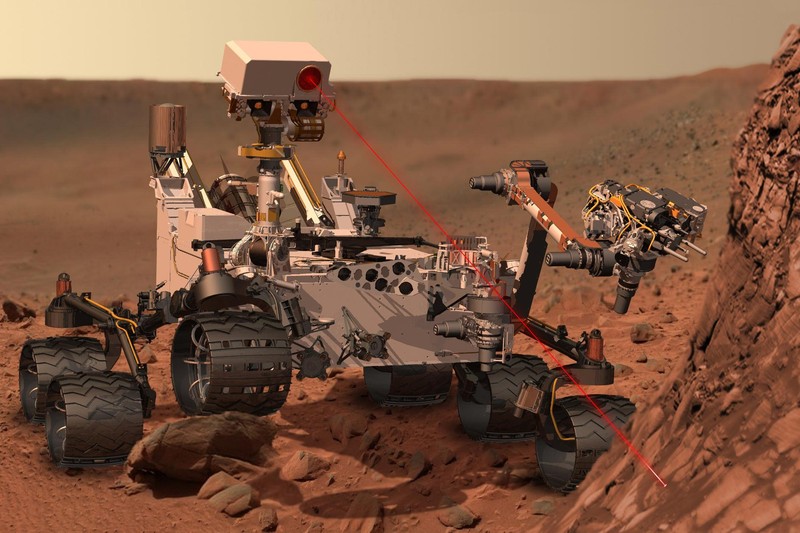
NASA’s Curiosity rover has pulled 21 organic molecules from a 3.5-billion-year-old rock on Mars — including seven never before detected on the planet, and at least one that looks disconcertingly like the molecular scaffolding that gave rise to life on Earth.
The molecules were locked inside a rock nicknamed “Mary Anning 3,” drilled from clay-rich sandstone in Gale crater’s Glen Torridon region in 2020. The results, published Tuesday in Nature Communications, represent the most chemically diverse collection of organics ever found on Mars.
What makes this batch different from previous detections isn’t just the headcount. Among the new molecules is a nitrogen heterocycle — a ring of carbon atoms that includes nitrogen. These ring structures are considered chemical precursors to RNA and DNA. Nitrogen heterocycles have never been found on the Martian surface or confirmed in Martian meteorites, according to Amy Williams, a Curiosity mission scientist at the University of Florida who led the study.
“That detection is pretty profound because these structures can be chemical precursors to more complex nitrogen-bearing molecules,” Williams told NASA’s Jet Propulsion Laboratory.
Another newcomer is benzothiophene, a carbon- and sulfur-bearing molecule also found in meteorites. Scientists believe such compounds may have seeded prebiotic chemistry across the early solar system — including on Earth.
The experiment that cracked the rock open
Curiosity has been detecting organic molecules on Mars since 2014. Chlorobenzene in mudstone. Thiophenes. Long-chain hydrocarbons including decane and dodecane, reported last year. Each discovery widened the inventory, but something was missing: the larger, more complex molecules that might be locked inside ancient macromolecular structures.
The reason is straightforward. Curiosity’s Sample Analysis at Mars (SAM) instrument — a miniaturized chemistry lab in the rover’s belly — works by heating crushed rock powder in an oven and analyzing the released gases. That process works well for small, volatile molecules. Bigger, more fragile structures tend to disintegrate under high heat before they can be identified.
TMAH — tetramethylammonium hydroxide — solves this. Instead of heat alone, SAM drops the sample into a cup of solvent, which breaks large molecules into smaller, identifiable fragments in a controlled process called thermochemolysis. It had never been performed on another planet.
The catch: Curiosity carried only two TMAH cups. Two chances, total. Mary Anning 3 got the first.
To validate the approach, the team ran the same experiment on Earth against a piece of the Murchison meteorite, a 4-billion-year-old rock packed with organics from the early solar system. The TMAH test produced benzothiophene and other compounds matching the Martian results — confirming that what Curiosity detected could be fragments of even more complex molecules still locked in the rock.
What scientists can — and can’t — conclude
“We think we’re looking at organic matter that’s been preserved on Mars for 3.5 billion years,” Williams told The Guardian. “Is it life? We can’t tell, based on this information.”
The researchers are unequivocal on this point. The molecules could have formed through geological processes. They could have been delivered by meteorites — the same way similar compounds likely arrived on early Earth. The detection proves organic material can survive billions of years of radiation exposure beneath the Martian surface, which is significant in itself. But it does not prove biology.
Andrew Coates, a planetary scientist at University College London not involved in the study, framed the stakes plainly: “It had all the conditions for life to start there when life was starting on Earth. There’s no known reason why it shouldn’t have started on Mars as well.”
The result strengthens the case that if microbial life ever existed on Mars, its chemical traces should still be detectable. Finding those traces is a different challenge entirely.
What happens next
Curiosity has already used its second and final TMAH cup on weblike boxwork ridges formed by ancient groundwater. Those results are pending.
The deeper follow-up is less certain. Williams noted that bringing Martian rocks back to Earth for analysis in properly equipped laboratories would be one way to potentially confirm such an extraordinary claim. NASA’s Perseverance rover has already cached samples for exactly that purpose. But the Mars Sample Return mission has been effectively canceled by the Trump administration following a congressional vote in January.
The TMAH technique itself, however, is going interplanetary. NASA Goddard has provided key components, including the mass spectrometer, for a next-generation version of SAM — the Mars Organic Molecular Analyzer — aboard ESA’s Rosalind Franklin rover, now scheduled to launch in late 2028. Rosalind Franklin will drill two meters deep, well below the radiation-blasted surface. A similar instrument will fly on NASA’s Dragonfly rotorcraft to Saturn’s moon Titan.
The Mars Curiosity keeps revealing is not the sterile wasteland scientists once assumed. It is a planet where complex organic chemistry persists in the rock record after three and a half billion years of punishment. Whether that chemistry ever crossed the threshold into biology remains unknown. But the right question is no longer whether the building blocks were there. It is what was built with them.
Sources
- NASA’s Curiosity Finds Organic Molecules Never Seen Before on Mars — NASA/JPL
- Diverse organic molecules on Mars revealed by the first SAM TMAH experiment — Nature Communications
- ‘Is it life? We can’t tell’: Nasa’s Curiosity rover finds organic molecules on Mars — The Guardian
- Mars rover carries out chemistry experiment never done beyond Earth, discovers more building blocks of life — CBS News/AFP
Discussion (9)