 lop News
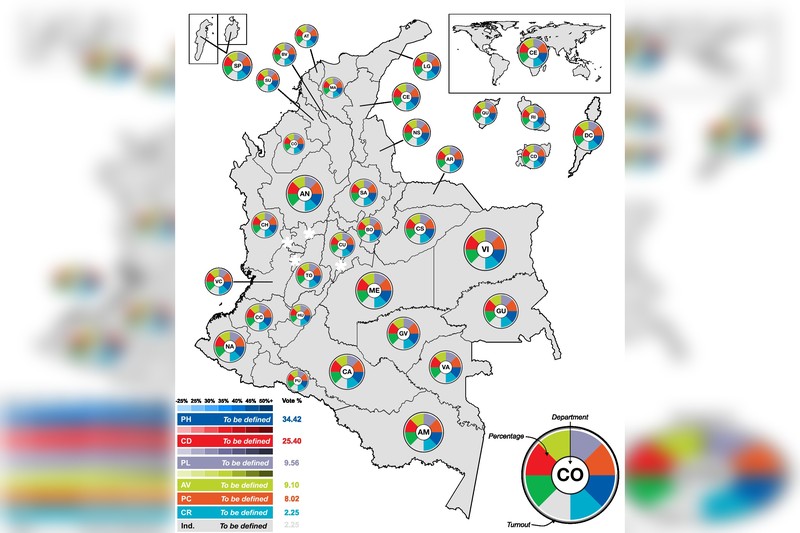
Colombia’s 41 million registered voters head to the polls today in a three-way presidential race that will almost certainly remain undecided until a June 21 runoff.
The contest — between a leftist senator carrying forward outgoing President Gustavo Petro’s reform agenda, a flamboyant lawyer promising Bukele-style security crackdowns, and a conservative senator who could become the country’s first female leader — amounts to a referendum on four years of left-wing governance. No candidate is expected to clear the 50 percent threshold required to win outright.
Polling consistently places Iván Cepeda, a 63-year-old senator and Petro’s designated successor, in the lead. His closest challengers are Abelardo de la Espriella, a 47-year-old criminal lawyer nicknamed “The Tiger” who campaigns as a political outsider, and Paloma Valencia, a 48-year-old senator and protégée of former president Álvaro Uribe. Fourteen names appear on the ballot. Three are competitive.
A Referendum on “Total Peace”
The sharpest fault line is security. Petro’s “Total Peace” initiative — offering negotiations to every armed faction — has defined his presidency, and by most measures it has struggled. Criminal groups expanded from roughly 15,000 to 27,000 fighters during his term, according to the Bogotá-based Ideas for Peace Foundation. Drone-dropped explosives struck 333 targets in 2025, up from 61 the year before, Colombia’s Defense Ministry reported. The Red Cross says the conflict’s humanitarian toll reached its worst level in a decade, with displacement doubling to 225,000 people last year.
Cepeda pledges to continue the talks while expanding Petro’s economic reforms — including a 23 percent minimum wage increase this year — and higher taxes on wealth and corporate revenue. He has also raised the possibility of a constituent assembly to rewrite the constitution, which critics argue would undermine judicial and legislative independence.
De la Espriella and Valencia would suspend peace negotiations and confront armed groups with military force. De la Espriella, who appeared at a recent rally behind bulletproof glass, has pledged to build 10 “mega-prisons” and cut state spending by up to 40 percent. Valencia, backed by most of Colombia’s traditional parties, offers a more conventional conservative platform: lower taxes, renewed oil and gas investment, and restored security cooperation with Washington.
Elizabeth Dickinson, a senior analyst at the International Crisis Group, cautions that a hawkish turn carries its own risks. Armed groups, she said, “will respond to pressure from security forces with terror-style attacks, as they lack the means to respond symmetrically, army-to-army.”
Washington Watches Closely
The election will reshape Colombia’s relationship with the United States, long its most important security partner. Petro broke with predecessors by challenging Washington on drug policy and migration, at one point drawing a threat from Donald Trump, who called him “a sick man who likes selling cocaine to the United States” and suggested he could be “next” for US military intervention. The two leaders later appeared to mend relations at a February White House meeting.
Cocaine production soared to record levels under Petro’s watch, according to the UN World Drug Report 2025 — though Petro disputes the methodology behind those figures. De la Espriella and Valencia both tout their affinity with Trump and promise to restore close security cooperation. Cepeda, like Petro, insists Colombia should not function as a “vassal state” to Washington, though observers note that practical anti-drug cooperation has persisted through even the most heated diplomatic rows.
The regional backdrop tilts right. Center-right and right-wing governments now govern Argentina, Chile, Ecuador, El Salvador, Paraguay, and others across the region. A victory by either De la Espriella or Valencia would extend that trend.
June Will Tell
Whoever faces Cepeda in a runoff will benefit from consolidation. Both right-wing candidates draw from voters frustrated with Petro’s security record, and those voters may coalesce against Cepeda in a second round. Cepeda’s challenge is arithmetic: winning a two-candidate race against an opponent backed by a unified anti-Petro vote.
For some voters, the calculation is painfully immediate. Gladys Marín’s home in the southwestern village of Potrerito sits less than 100 meters from a police station that has become a frequent target for drone-dropped explosives. She is not sure she will make the short walk to the polling station.
“I haven’t lost faith that, someday, one might be able to live in peace,” said Celimo Enrique Aguilar, 89, whose home was destroyed in a December armed attack on a neighboring town. Colombians are voting today on whether peace comes through negotiation or force. The answer will wait until June.
Sources
- Colombians will vote Sunday in a high-stakes test of President Gustavo Petro’s agenda — Associated Press
- Drone attacks raise fears as Colombians vote to elect a new president — Associated Press
- Colombia votes in presidential election that could redefine relations with US — BBC News
- Colombia goes to polls in election pitting outgoing leader’s ally against pro-Trump candidates — The Guardian
- In Colombia’s election, undecided voters weigh leftist vs. right-wing firebrand — NPR
Discussion (9)