 lop News
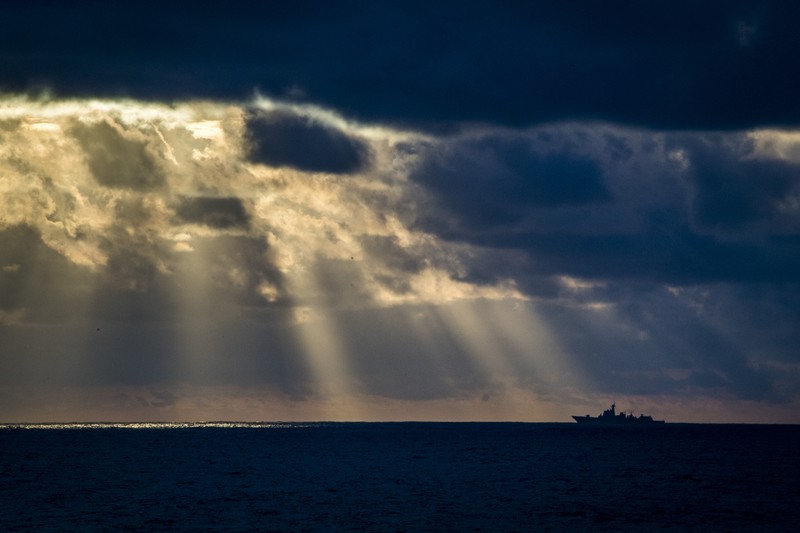
A Chinese naval flotilla transited the narrow Yonaguni-Iriomote Waterway on Wednesday, completing a round-trip to the Western Pacific that began with a passage through Japanese-administered waters last Sunday. The flotilla, designated vessel formation 133, included a Type 052D destroyer — the Baotou — and returned through the 65-kilometer-wide passage that separates two islands in Japan’s Okinawa prefecture, just 110 kilometers from Taiwan’s eastern coast.
The PLA Eastern Theater Command said the drills tested “far-seas operations capabilities” and framed the transit as routine annual training. China claims the passages comply with international law, citing freedom of navigation rights in non-territorial waters.
Tokyo sees it differently. The Yonaguni-Iriomote Waterway has become a flashpoint precisely because of what lies at its center: nothing but open ocean between Chinese naval assets and the Philippine Sea. Each transit — and there have been several — gives Beijing fresh data on Japanese response times, radar coverage, and political patience.
The Tit-for-Tat That Started the Week
The timing of this week’s passage matters. On Friday, the Japanese destroyer JS Ikazuchi transited the Taiwan Strait, remaining in the waterway from 4:02 am until 5:50 pm. China’s Foreign Ministry called it a “deliberate provocation” and lodged a strong protest. Zhang Xiaogang, spokesperson of China’s Ministry of National Defense, said by stirring up trouble in the Taiwan Straits, the SDF vessel has sent the wrong signal to “Taiwan independence” separatist forces. Defense analyst Zhang Junshe said Japan deliberately chose the early morning hours to send the warship into the Taiwan Straits to avoid attention, which also reveals its probing intent. “The Taiwan question bears on China’s sovereignty and territorial integrity, and the political foundation of China-Japan relations. It is a red line that must not be crossed. China urges the Japanese side to do serious soul-searching on its wrongdoings, return to the right track at once, exercise prudence in its words and actions, and stop going further down the wrong path,” Guo said.
The Chinese military tracked the Ikazuchi throughout its passage using naval and air assets, a reminder that the Taiwan Strait remains under continuous surveillance regardless of who sails through it. China’s position holds that the strait is not international waters, citing UNCLOS and domestic maritime law — a stance that has drawn consistent pushback from the US and its allies.
Why Yonaguni Is Getting a Missile Battery
The islands nearest to this disputed corridor are no longer passive geography. In September 2024, the Liaoning — China’s first aircraft carrier — became the first such vessel to transit the Yonaguni-Iriomote Waterway, drawing loud protests from Tokyo. The passage through Japan’s contiguous waters was treated as a milestone by Beijing and an escalation by Japan.
Since then, the Japanese defense ministry has advanced plans to deploy a medium-range surface-to-air missile unit at a military base on Yonaguni itself. The proposal has drawn an unusually sharp response from China, with Beijing calling the move “extremely dangerous.” Yonaguni, once a quiet frontier island with a small civilian population, is becoming a forward garrison.
This investment in hardware reflects a broader shift in Japanese policy. The revised arms export framework, which permits greater transfer of Japanese-manufactured defense equipment to allied nations, signals that Tokyo is moving away from the strict limitations imposed after World War II. The missile deployment on Yonaguni fits that trajectory — not deterrence, but preparation.
Reading the Pattern
Zhang Junshe, the military affairs expert cited by Chinese state media, described Japan’s Taiwan Strait transit as part of a “gradual probing” — noting that Tokyo has now crossed the strait three times since 2024, increasingly sailing alone rather than in allied company. “Japan is currently pushing for constitutional revision and military expansion, accelerating its remilitarization,” Zhang said.
The Chinese framing is explicit: each transit, each statement from Prime Minister Sanae Takaichi — who suggested in November 2025 that an attack on Taiwan could trigger Japanese military action — is seen in Beijing as a systematic erosion of post-war constraints.
For Japan, the calculus runs the other direction: each Chinese passage through waters it considers its own, each military statement from Beijing, justifies deeper investment in defense capability and closer alignment with the US. The Yonaguni missile battery, once theoretical, now has critics from one direction and advocates from another.
No shots have been fired. No rules have been explicitly broken. But the message in each transit — Chinese and Japanese alike — is clear: the water between them is becoming contested space, and both sides are building the infrastructure to prove it.
Sources
- Chinese navy brushes past Okinawa islands as tensions with Japan flare — Channel News Asia
- PLA vessel formation returns following far-sea training — Xinhua
- PLA dispatches vessel formation to conduct training in Western Pacific — State Council Information Office
- China slams transiting of Japanese warship via Taiwan Straits, calls it deliberate provocation — CPEC News
- PLA announces vessel formation transit of Yokoate Waterway for Western Pacific training; move serves as deterrent to hostile forces: Chinese expert — Global Times
Discussion (10)