 lop News
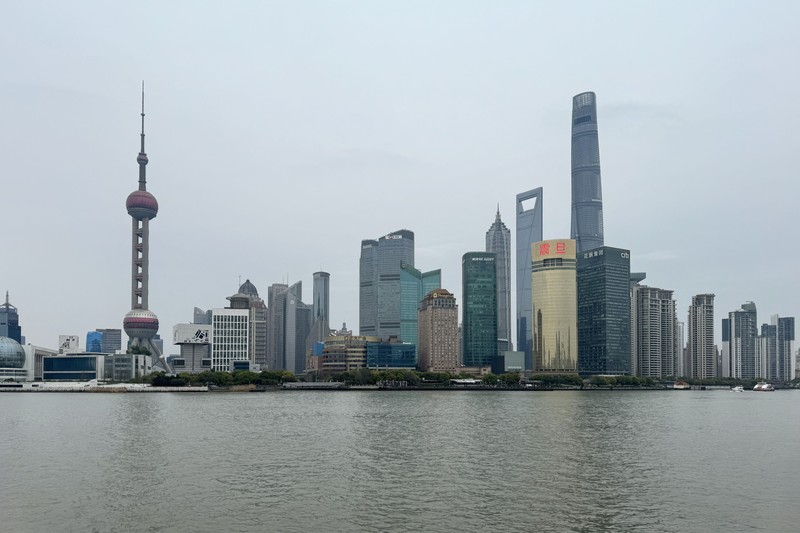
China’s economy grew 5 percent in the first quarter — beating forecasts, outpacing the prior quarter, and describing a world that effectively ended in March.
Infrastructure spending surged nearly 9 percent. Industrial production roared ahead. Exports in January and February grew at the fastest pace since early 2022. Then the US-Israeli military campaign against Iran sent oil prices climbing and disrupted shipping through the Strait of Hormuz, through which roughly a fifth of global oil and gas passes. China’s export growth collapsed from 21.8 percent in January-February to 2.5 percent in March, according to data cited by the Economist Intelligence Unit.
The Q1 numbers are real. They’re also a photograph of a moment that has already passed.
The Stimulus Machine Delivers
Beijing set a growth target of 4.5 to 5 percent for 2026 — the lowest in decades, a quiet admission that the easy growth is gone. For one quarter at least, the numbers cooperated.
GDP reached 33.4 trillion yuan in Q1, according to the National Bureau of Statistics, with quarter-on-quarter growth of 1.3 percent. Infrastructure investment climbed 8.9 percent year-on-year, driven by spending on electricity grids, rail lines, and sewer systems. Industrial production rose 6.1 percent. High-tech manufacturing surged 12.5 percent.
The government also revised down its figures for early 2025, making this year’s comparison slightly more flattering — a detail noted by the New York Times.
Beneath the aggregate, the imbalances are sharp. Retail sales rose just 2.4 percent in Q1 and only 1.7 percent in March, well short of forecasts. Auto sales fell 17 percent in the quarter after Beijing scaled back subsidies. Real estate investment dropped 11.2 percent. Consumer spending remains anemic — held back by years of declining apartment prices that have eroded household wealth.
“Growth remains lopsided towards exports,” said Tianchen Xu, a senior economist at the Economist Intelligence Unit.
The March Inflection
The quarterly figure conceals the turning point. Then war broke out.
Factory-gate prices rose in March for the first time in more than three years — not from surging demand, but from the energy cost spike working through the manufacturing sector. That threatens corporate margins that were already thin.
Mao Shengyong, deputy commissioner of the statistics bureau, told reporters Thursday that the oil price increase had not had a “major impact” on the domestic economy but said he hoped the Middle East situation would stabilize.
Robin Xing, chief China economist at Morgan Stanley, was less reassuring. “The supply shock feeds into weaker aggregate demand,” he said — meaning that even if China captures market share in some sectors, a shrinking global export market could more than offset those gains.
The International Monetary Fund cut its 2026 China forecast to 4.4 percent this week, down from 4.5 percent, citing the conflict. The fund warned the world economy could be “thrown off course.”
What Beijing Has Left
China’s diversified energy supply offers some insulation. Oil shipments through Hormuz account for just 6.6 percent of China’s total energy consumption, according to data cited by CNBC — far less than other Asian economies depend on the Middle East.
The infrastructure playbook also has room to run, in theory. Beijing has relied on roads, bridges, and rail to prop up growth for years. But rising debt among local and provincial governments makes the strategy harder to sustain, and the strong Q1 reduces near-term pressure for additional stimulus — a breathing spell that could become a liability if the oil shock deepens before policymakers act.
Yuhan Zhang, principal economist at The Conference Board, said government subsidy programs helped boost spending on communication equipment and gold jewelry. But auto sales declined as consumers grew cautious amid oil price swings, Zhang added.
A Quarter That Aged Fast
The statistics bureau itself acknowledged the tension. “The external environment is becoming more complex and volatile,” it said in its statement, warning of an “acute” imbalance between “strong supply and weak demand.”
China doesn’t need to import an energy crisis to feel the pain. It just needs its customers to stop buying. March’s trade numbers suggest that process has already started.
Sources
- National Economy Got off to a Good Start in the First Quarter — National Bureau of Statistics of China
- China economic growth accelerates to 5% in first quarter — but Iran war clouds outlook — CNBC
- China’s G.D.P. Stronger Than Expected, Led by Infrastructure Spending — The New York Times
- China’s economy beats forecasts, but war darkens outlook — AFP (via Yahoo Finance)
Discussion (10)