 lop News
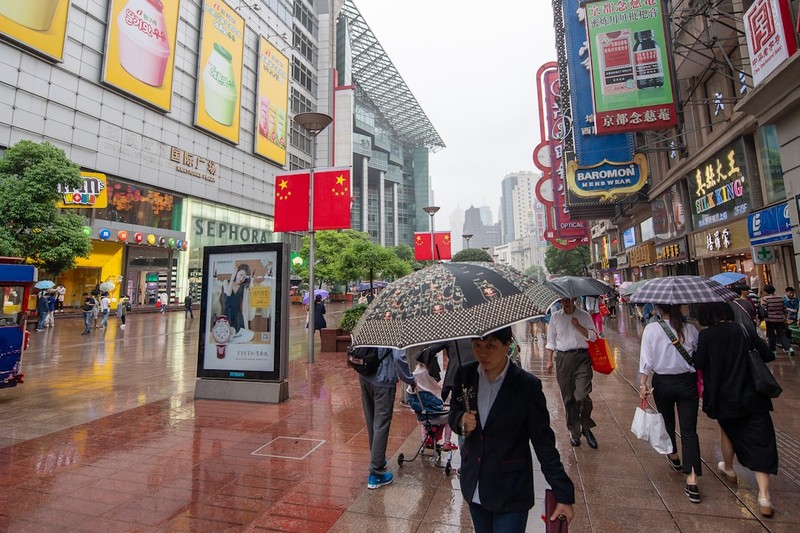
0.2% — that is the number that should concentrate minds in every capital with a trade desk in Beijing.
China’s retail sales grew a barely perceptible 0.2% in April from a year earlier, the National Bureau of Statistics reported Monday. That is the weakest reading since December 2022, when China was still untangling itself from Covid lockdowns. Economists surveyed by Reuters had expected 2%. The miss was not marginal. It was a tenfold shortfall.
Industrial output, investment, and consumption all came in below consensus. Not a single economist in Bloomberg’s survey predicted results this weak across all three indicators. The world’s second-largest economy is slowing, and the slowdown is broadening.
A Two-Speed Economy Running on One Engine
The paradox is that China’s export machine is humming. Exports surged 14.1% in April, thrashing forecasts of 7.9%, as overseas buyers stockpiled goods amid fears the Iran war would drive input costs higher. Electronics production expanded 15.6% — the fastest in two years — driven by global demand for AI chips.
But exports cannot carry an economy of 1.4 billion people.
Car sales plunged 15% year on year, the steepest drop since mid-2022. Purchases of home appliances and furniture — once propped up by government subsidies — fell at double-digit rates. Gold, silver, and jewelry sales collapsed 21%. Chinese households net repaid loans in April at the highest rate since comparable records began in 2010. This is not cautious spending. This is retrenchment.
“China still looks like a two-speed economy,” said Charu Chanana, chief investment strategist at Saxo Markets. “Strong in strategic manufacturing and exports, but weak where household confidence matters most.”
The Property Trap
Fixed-asset investment contracted 1.6% in the first four months of 2026, reversing the 1.7% expansion recorded through March. The driver is real estate: property investment plunged 13.7%, deepening a multi-year downturn that has seen the sector nearly halve from its 2021 peak.
New home prices continued their decline in April. Lizzi Lee, a fellow at the Center for China Analysis, warned that further drops would deepen the damage to household balance sheets already battered by job losses in construction and related industries.
Private investment fell 5.2%. Even excluding real estate, it declined 1.9%.
The Cost Squeeze
The Iran war has achieved what years of deflation could not: pushing Chinese producer prices upward. Factory-gate prices surged 2.8% year on year in April — a three-year high — snapping a years-long deflationary streak. Consumer prices rose 1.2%.
The gap is the problem. Producer prices are now outpacing consumer prices for the first time since July 2022, meaning companies are absorbing higher raw material costs rather than passing them to consumers who will not pay. Tommy Xie of OCBC Bank said firms will eat much of the commodity shock. That margin compression feeds through to hiring, which feeds through to confidence — a loop the data is already capturing.
What Beijing Does Next
Fu Linghui, the statistics bureau spokesman, called the deterioration “a normal fluctuation from month to month.” Analysts disagree. Economists at Nomura said Beijing “has no room for complacency,” while Societe Generale wrote that the figures should keep central bank easing “firmly on the table.”
Beijing has been reluctant to add stimulus, constrained by rising inflation expectations from the oil shock. The People’s Bank of China last cut rates and the reserve requirement ratio a year ago, during peak trade tensions with Washington. HSBC’s Greater China chief economist Jing Liu said her base case remains no extra stimulus “for the time being.” The next policy window opens in July, when the Communist Party’s Politburo convenes to review growth.
The Global Bill
China’s trading partners have a direct stake in what happens next. The Trump-Xi meeting last week produced an agreement for Beijing to purchase at least $17 billion in American agricultural products annually through 2028, plus an initial 200 Boeing jets — a commitment that presupposes Chinese consumers and businesses have the appetite to absorb it.
That appetite is exactly what the April data calls into question. German automakers, Brazilian soybean farmers, South Korean chipmakers, Australian miners — every economy selling into China is watching the same numbers. When the world’s largest trading nation stops buying, the contraction does not stay local.
Sources
- National Economy Maintained the Development Momentum of Steady Progress in the First Four Months — National Bureau of Statistics of China
- China’s Economy Succumbs to Slowdown and Reignites Stimulus Talk — Bloomberg via Financial Post
- China’s economy loses steam in April as retail sales hit 40-month low — CNBC
Discussion (9)