 lop News
For years, Beijing has insisted it is not a party to Russia’s war in Ukraine — neutral, it says, a mediator pursuing peace. A Reuters exclusive published today makes that position considerably harder to sustain.
Three European intelligence agencies and documents reviewed by Reuters reveal that China’s armed forces secretly trained approximately 200 Russian military personnel on Chinese soil in late 2025. Some of those soldiers have since returned to fight on the Ukrainian front. The training, conducted under a formal dual-language agreement signed by senior officers in Beijing on July 2, 2025, focused heavily on drones, electronic warfare, army aviation, and armoured infantry.
This is not the indirect support Beijing has long been accused of — dual-use technology transfers, sanctions evasion, or turning a blind eye to private Chinese firms supplying Russian weapons manufacturers. This is Chinese military territory being used to train combatants heading to an active European war.
‘Objective and Impartial’
China’s foreign ministry did not deny the specific allegations. In a statement to Reuters, it said that on Ukraine, China “has consistently maintained an objective and impartial stance and worked to promote peace talks.” Relevant parties, it added, “should not deliberately stoke confrontation or shift blame.”
That formulation — “shift blame” — has been Beijing’s standard reply to every allegation of complicity in Russia’s war. But the Reuters report is unusually specific. Internal Russian military reports describe four training sessions between November and December 2025, including written accounts by Russian officers. One of the reports included photographs of Russian soldiers in uniform receiving instruction from Chinese counterparts.
One European intelligence official told Reuters that by training Russian personnel at “an operational and tactical level who then participate in Ukraine, China is far more directly involved in the war on the European continent than previously known.”
Skills for the Front
The training programs were not ceremonial.
At the PLA’s Ground Forces Army Infantry Academy in Shijiazhuang, roughly 50 Russian soldiers trained on combined arms warfare — learning to fire 82mm mortars while using drones to spot targets. At a facility in Zhengzhou, troops practiced air defense techniques including electronic warfare rifles designed to jam incoming drones and net-throwing devices to physically ensnare them. At Yibin’s PLA Training Centre for Military Aviation, a Russian major described a course centred around multimedia presentations and involving flight simulators as well as training on several types of FPV drone and other drone systems. At Nanjing’s University of Military Engineering, the curriculum covered explosives, mine construction, demining, and disposal of improvised explosive devices.
Every one of those skills maps directly onto the current reality of the Ukraine battlefield, where drones dominate the sky and mine warfare has defined the grinding ground campaign.
A significant number of those trained were ranking military instructors, positioned to disseminate their new expertise throughout the Russian chain of command, according to two of the intelligence agencies. One agency confirmed the identities of personnel — ranging from junior sergeant to lieutenant colonel — who trained in China and were subsequently involved in combat operations in occupied Crimea and Zaporizhzhia. The same agency said it was highly probable that many more of those trained in China had also deployed to Ukraine.
The Timing Is Not Subtle
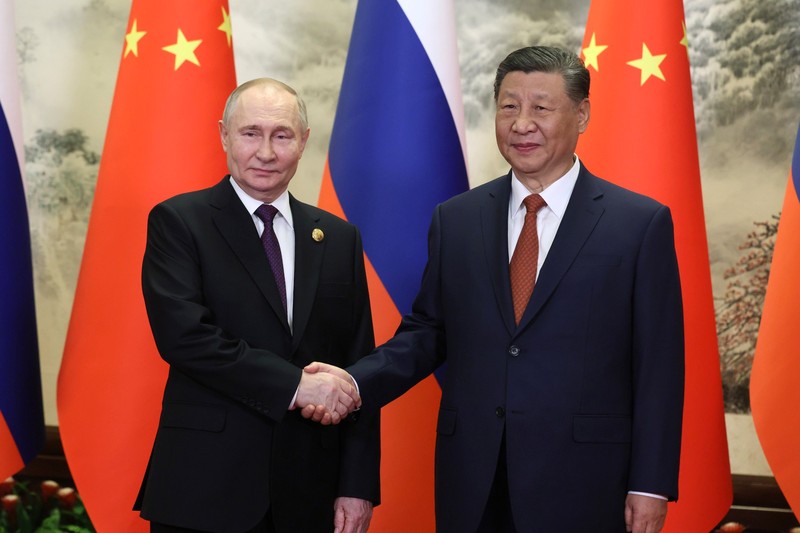
The revelations arrive at a diplomatically delicate moment. Russian President Vladimir Putin is due in Beijing on Tuesday and Wednesday for his 25th visit to China, less than a week after US President Donald Trump’s own summit with Xi Jinping. Putin described bilateral ties as at “a truly unprecedented level” in a video address before the visit, according to China’s official Xinhua News Agency.
Presidential aide Yuri Ushakov said there was “no connection” between the two visits. In practice, Beijing is attempting to manage two relationships simultaneously: stable ties with Washington and an ever-deepening partnership with Moscow. As Wang Zichen of the Beijing-based Center for China and Globalization told the Associated Press: “Beijing wants stable relations with the West, continued strategic trust with Moscow, and enough diplomatic room to present itself as an unbiased major power capable of talking to all sides.”
The Reuters report threatens to collapse the diplomatic distance between those ambitions.
A Widening Pattern of Support
The training program is the most direct evidence yet of Chinese involvement in Russia’s war, but it fits a well-documented pattern. According to Bloomberg, over 90 percent of Russia’s imports of sanctioned technology that could be used for weapons now come through China, up from roughly 80 percent in 2025. Chinese drone components — fiber-optic cables, lithium-ion batteries — have surged into Russia, offsetting declines in ready-made drone exports, according to the Council on Foreign Relations. In March, a report by two Ukrainian organizations found that Chinese banks and technology firms were expanding into occupied Ukrainian territories, integrating Chinese equipment into critical infrastructure.
In February, Foreign Minister Wang Yi told the Munich Security Conference that the “door to dialogue” on Ukraine had finally been opened and encouraged all parties toward a “comprehensive, lasting, and binding peace agreement that eliminates the root of the conflict.” A country simultaneously training its ally’s soldiers for the front lines is not mediating a conflict. It has chosen a side — and the evidence is no longer deniable.
The Russian and Chinese defense ministries did not respond to Reuters’ requests for comment.
Sources
- Exclusive: Russians covertly trained by China return to fight in Ukraine, sources say — Reuters (via Internazionale)
- Putin visits China to reaffirm Russia ties as Xi also seeks stable US relations after Trump summit — Associated Press
- China in Russia and Ukraine: October 2025 — Council on Foreign Relations
- China’s Position on Russia’s Invasion of Ukraine — US-China Economic and Security Review Commission
Discussion (9)