 lop News
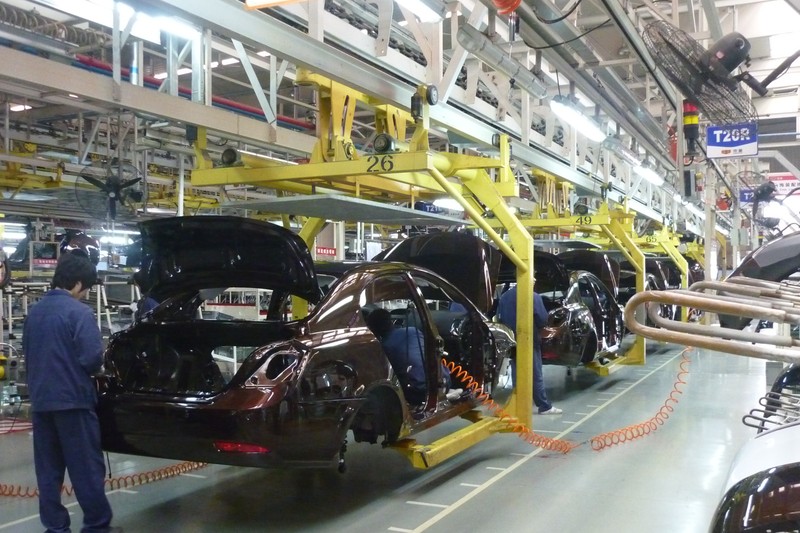
Three months of sliding numbers, and now China’s factories have stopped growing entirely.
The country’s manufacturing purchasing managers’ index landed at exactly 50.0 in May, according to data released Sunday by the National Bureau of Statistics. That is the line between expansion and contraction — a reading of zero growth. The figure dropped from 50.3 in April and 50.4 in March, marking a steady erosion of industrial momentum that economists polled by Bloomberg had expected but policymakers were hoping to avoid.
In plain terms: the world’s factory floor has gone flat.
The Cost of Conflict
The culprit is a double hit. Domestic demand in China has been weakening for years, dragged down by a protracted property slump and cautious consumer spending. But the fresh pressure is coming from outside — specifically, the Middle East.
The ongoing war has effectively shut down shipping through the Strait of Hormuz, a chokepoint for global oil and gas flows. That has driven up energy prices worldwide, and Chinese manufacturers are feeling the squeeze. Raw material costs are climbing, particularly in the energy and chemical sectors, eating into margins at factories that were already operating on thin profits.
NBS statistician Huo Lihui said supply and demand in industries including petroleum, rubber, and plastics showed “continued weakness” in May. Overall business production remained stable, Huo said, but with “a slight slowdown in market demand” for new orders.
“Slight slowdown” is doing a lot of work in that sentence. When your purchasing index is perched right at the break-even line, any further erosion tips the sector into outright contraction.
Why This Matters Beyond China
China accounts for roughly 30% of global manufacturing output. When its factories slow down, the effects do not stay within its borders. Commodity-exporting nations — from Australia’s iron ore miners to Brazil’s soybean farmers — watch China’s PMI releases closely because weaker factory demand translates directly into lower commodity prices and thinner export revenues.
Global supply chains feel it too. Slower Chinese production can mean longer lead times and tighter inventories for electronics, automotive parts, and consumer goods shipped to markets in Europe, North America, and Southeast Asia. The link is not always immediate, but it is reliable: when China’s industrial engine coughs, the rest of the world catches a cold.
Growth forecasts are already being revisited. China’s economy has been the primary engine of global growth for much of the past two decades. A sustained manufacturing slowdown would weigh on worldwide GDP projections just as other major economies — the US and EU among them — are navigating their own fragilities.
A Two-Speed Economy
The picture is not uniformly grim. China’s non-manufacturing PMI, which covers services and construction, crept up to 50.1 in May from 49.4 in April. That nudges the services sector just barely back into expansion territory after a month of contraction.
The split tells a story Beijing knows well. Consumer-facing services and domestic infrastructure spending are holding up better than export-dependent manufacturing. Government stimulus has been aimed at propping up demand at home — infrastructure projects, consumer incentives, and credit easing — but those measures have not offset the external pressures bearing down on factories.
China is effectively running a two-speed economy: services sputtering forward, manufacturing stalling out. Neither engine is firing at full capacity, and the gap between them is narrowing in the wrong direction.
What Comes Next
The question facing Beijing is whether May’s flat reading is a pause or the start of a deeper slide. Much depends on variables the government cannot control: the trajectory of the Middle East conflict, the path of global energy prices, and the willingness of foreign buyers to keep placing orders amid their own economic uncertainty.
For the rest of the world, the May PMI reading is an early warning. China’s factories are the connective tissue of global trade, and right now that tissue is not growing.
Sources
- China’s May factory activity flat as weak demand slows growth — Channel News Asia
- China Factory Activity Worsens in Warning Sign for Economy — Bloomberg
- China factory activity stalls in May as demand weakens — Reuters
Discussion (10)