 lop News
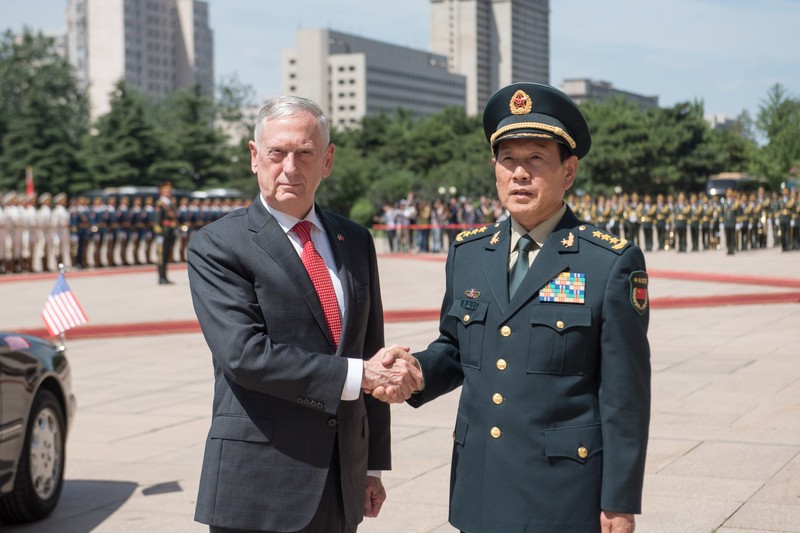
Two former defense ministers. One Xinhua dispatch. Death sentences for both.
China’s military courts handed suspended death sentences to Wei Fenghe and Li Shangfu on Thursday — men who, until recently, sat at the apex of the People’s Liberation Army and answered directly to Xi Jinping. The announcement, delivered in a terse two-paragraph statement by the state news agency, represents the most severe punishment of senior military officers since Xi launched his anti-corruption campaign in 2012, according to the South China Morning Post.
The scale is without precedent in the Xi era. Never before have two former defense ministers been sentenced in the same dispatch. Never before has punishment climbed this high up the military ladder — and involved two men who, within the last three years, were the public face of China’s armed forces on the world stage.
What the Court Found
A military court found Wei guilty of accepting bribes, while Li was convicted of both accepting and offering bribes, according to Xinhua. The statement did not specify the amounts involved.
Both men received identical sentences: death with a two-year reprieve, lifetime deprivation of political rights, and confiscation of all personal property. After the reprieve period expires, their sentences will be commuted to life imprisonment — without the possibility of further commutation or parole.
That formula — “death with reprieve” — is a fixture of China’s judicial system that carries particular weight at this level. The condemned are not executed. Instead, the death sentence hangs over them as a permanent instrument of control. Good behavior earns a reduction to life without parole. Any further infractions can trigger execution. It functions less as a traditional punishment than as a lifetime leash — ensuring permanent compliance without the political complications of carrying out a death sentence against a former senior official.
From Power to Purge
The trajectories of both men follow a pattern of dizzying ascent and sudden collapse.
Wei Fenghe served as defense minister from 2018 to 2023, a five-year tenure that made him one of the most visible figures in Chinese military diplomacy. He accompanied Xi on overseas visits, represented the PLA at international security forums, and helped project the image of a modernizing Chinese military.
Li Shangfu succeeded him in March 2023 — and lasted just seven months, becoming China’s shortest-serving defense minister before vanishing from public view. Beijing announced a formal investigation into Li in August 2023 and into Wei the following month. By June 2024, both had been expelled from the Communist Party and stripped of all military ranks and positions.
The speed was remarkable even by the standards of Xi’s anti-corruption campaign, which has consumed thousands of officials since 2012. But what makes these cases singular is not the pace — it is the rank. Defense ministers are not mid-level functionaries. They are the officers who meet foreign counterparts, attend the Shangri-La Dialogue in Singapore, and serve as the public face of PLA discipline and competence.
That both men were appointed during Xi’s own tenure adds a layer of political significance that the Xinhua statement does not address. These were not holdovers from a previous leadership era. They rose under Xi. They fell under Xi. The message to every senior officer in the PLA is difficult to misread: proximity to the chairman offers no protection, and past loyalty is not a down payment on future security.
The Loyalty Calculus
Xi’s anti-corruption campaign has always served dual purposes. On its surface, it is a clean-government initiative — an effort to root out the graft that pervades Chinese officialdom and is a genuine source of public anger. Beneath that surface, it functions as a mechanism for consolidating power, removing potential rivals, and ensuring that loyalty flows upward through personal dependence rather than institutional routine.
The simultaneous sentencing of two former defense ministers sharpens that function to a fine point. The PLA is not merely a military force; it is the Communist Party’s ultimate guarantor of regime security. Xi has spent years restructuring its command architecture, creating theater commands answerable directly to the Central Military Commission — which Xi himself chairs. The purge of his own appointees at the defense ministry level signals that no position in that structure is safe, no relationship is permanent, and no past service inoculates against present suspicion.
This matters beyond Beijing’s internal politics. A military leadership purged repeatedly at the top is one where institutional memory thins with each cycle, where senior officers calculate political survival alongside operational strategy, and where professional military judgment may be distorted by the overriding imperative of political safety.
A Military in Transition
The sentencing comes amid a period of elevated military tension across the Indo-Pacific. China’s PLA Navy has expanded its presence in the South China Sea and around Taiwan. The United States has deepened security partnerships with Japan, the Philippines, and Australia through the AUKUS framework and bilateral defense agreements. Both sides are navigating a fragile but consequential military equilibrium.
A defense establishment that has lost two former ministers to death sentences raises questions about readiness — not because the individuals are irreplaceable, but because the pattern of purge and replacement carries institutional costs. New commanders need time to develop working relationships with subordinates. Disruption at the top compounds down the chain of command. The PLA is simultaneously modernizing its capabilities and rotating through leadership at a pace that would challenge any military.
None of this is lost on China’s neighbors. Japan, which monitors PLA personnel changes closely, will note the severity of the sentences and what they imply about internal dynamics. So will governments in Southeast Asia, where military-to-military diplomacy with China has served as a channel for managing territorial disputes.
Xi’s Longest Campaign
Since 2012, Xi Jinping’s anti-corruption drive has ensnared officials at every level of the Chinese state. The campaign has been popular domestically — graft is a genuine and deep-seated grievance for Chinese citizens — and politically indispensable for a leader who has used it to remove competitors and centralize authority to a degree unmatched since Deng Xiaoping.
The Wei and Li sentences suggest the campaign is not winding down. If anything, it is reaching further into the military’s upper echelons. The decision to announce both sentences simultaneously, in the same brief dispatch, was itself a deliberate choice — one designed for maximum impact within the PLA and across the broader party apparatus.
For the two men at the center of it, the future is confinement and the permanent threat of execution. For the officers who remain, the future is vigilance. And for anyone watching China’s military from the outside, the calculation is straightforward: a fighting force whose top echelon knows that promotion and a death sentence can be delivered by the same hand is one worth watching carefully.
Sources
- 2 former Chinese defence ministers handed suspended death sentences — South China Morning Post
Discussion (15)