 lop News
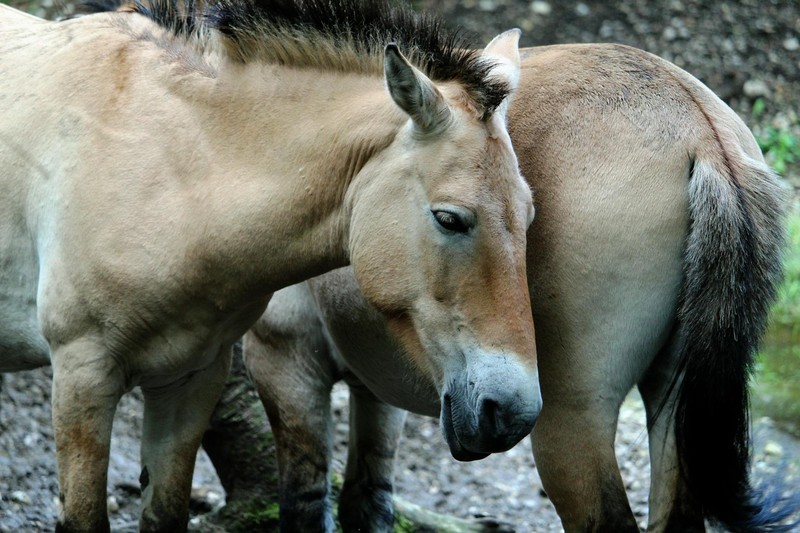
The men who cleaned up the world’s worst nuclear disaster came back this week to find horses living in the houses.
Przewalski’s horses — stocky, sand-coloured, almost toy-like — graze where 48,000 people once lived in the city of Pripyat. They shelter in crumbling barns and deserted homes, bedding down inside structures never built for them. Forty years after reactor four exploded at the Chornobyl Nuclear Power Plant, the exclusion zone has become something no one planned: one of Europe’s largest wildlife sanctuaries.
At 1:23am on 26 April 1986, a botched safety test triggered a catastrophic blast that sent radioactive smoke across Europe. About 600,000 “liquidators” — soldiers, firefighters, engineers, miners, medics — were mobilised to contain the disaster. Many worked in hastily issued uniforms with little understanding of the dangers they faced.
This week, surviving liquidators from Ukraine’s Poltava region returned to the site. They spoke of duty carried out without hesitation, of loss endured. The official death toll was approximately 30, mostly firefighters and plant workers, though estimates vary wildly. The National Academy of Medical Sciences of Ukraine recognised 41,000 fatalities in 2022; a 2006 study by outside experts estimated 4,000 to 16,000.
What they found was a landscape transformed. Trees pierce abandoned buildings. Roads dissolve into forest. Soviet-era signs stand beside leaning wooden crosses in overgrown cemeteries.
A Factory Reset
The exclusion zone — 2,800 square kilometres in Ukraine, plus 2,170 in neighbouring Belarus — spans an area larger than Luxembourg. More than 300,000 people were evacuated. What they left behind has become, in the words of Denys Vyshnevskyi, the zone’s lead nature scientist, a place where “nature has effectively performed a factory reset.”
Wolf populations are now seven times higher than before the accident, according to Jim Smith, an environmental scientist at the University of Portsmouth who has studied the region for three decades. Elk, roe deer, wild boar, and rabbit populations are flourishing. Brown bears, absent for more than a century, were caught on camera traps in 2014. Eurasian lynx have returned. Przewalski’s horses, introduced in 1998 after being declared extinct in the wild in 1969, bed down in abandoned buildings and thrive in partly forested terrain unlike their native steppe.
“The ecosystem in the exclusion zone is much better than it was before the accident,” Smith said. “It’s been a very powerful demonstration of the relative impact of the world’s worst nuclear accident, which is not so big, and the impact of human habitation, which is devastating.”
Not a Simple Story
This is not nature triumphant. Scientists have documented darker-skinned frogs in contaminated areas, possibly linked to melanin offering radiation protection — though the hypothesis remains contested. Birds in higher-radiation zones develop more cataracts. Barn swallows and great tits show lower reproductive success linked to sperm abnormalities and oxidative stress. Pine forests died en masse; birch replaced them, creating entirely different woodland.
The debate over what drives these changes remains fierce. As geographer Jonathon Turnbull of Durham University put it: “There’s the spectacular story of ‘Chernobyl changed everything’ — that doesn’t go very deep.” The more accurate picture is subtle effects layered across an ecosystem that experienced catastrophe and kept living.
The key variable may not be radiation. The most significant factor, researchers argue, is the absence of humans. Similar patterns have emerged at Fukushima and in Korea’s demilitarised zone, where human exclusion created accidental sanctuaries for endangered species.
A Wilderness Under Threat
The zone is no longer simply an accidental refuge. Russia’s 2022 invasion brought fighting through contaminated ground. The giant containment structure around the most radioactive area needs €500m in repairs after a Russian drone strike. Inside sits an estimated four tonnes of radioactive dust.
Forest fires, many caused by downed drones, sweep the zone. Fires can send radioactive particles back into the air. The area has been closed to tourists since the invasion.
For the liquidators who returned this week, the contrast was stark. They came back to a place defined by human failure and found it full of life — not because the disaster wasn’t catastrophic, but because what humans do to landscapes in the ordinary course of things is, according to three decades of ecological research, more devastating than the world’s worst nuclear accident.
Chornobyl will remain off-limits for generations. The horses, the wolves, the bears don’t know this. They only know the people are gone, and the land is theirs.
Sources
- Surviving in a poisoned land: Chernobyl’s wildlife is different, but not in the ways you might think — BBC Future
- ‘Nature has performed a factory reset’: Chernobyl has flourished into an unlikely wildlife refuge — Euronews
- The no-go zone paradox: Chornobyl’s wildlife thrives amid pro-nuclear shift — The Guardian
- Chernobyl’s wildlife: the real story isn’t the presence of radiation – it’s the absence of humans — The Conversation
Discussion (8)