 lop News
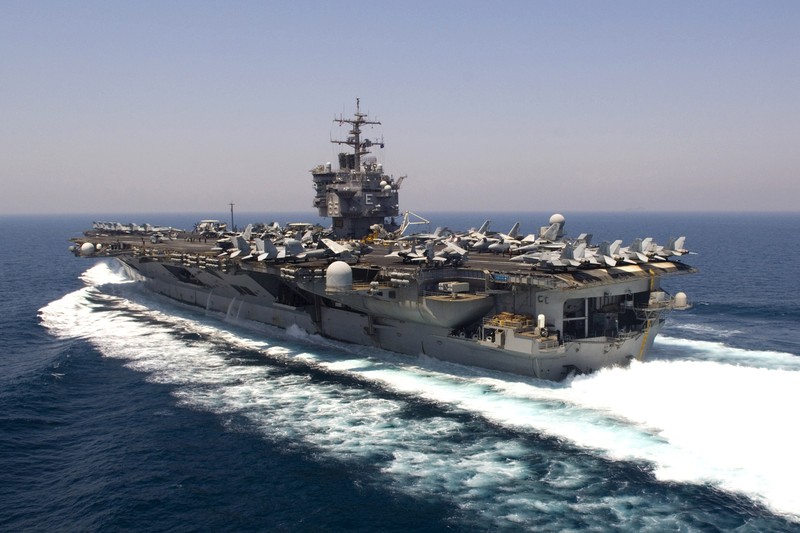
On Sunday, behind closed doors, American, Iranian and regional mediators were working out terms for a 45-day ceasefire that could lead to a permanent end to the five-week Iran war. On the same day, in public, US President Donald Trump posted an expletive-laden threat to destroy Iran’s power plants and bridges if the Strait of Hormuz was not reopened by Tuesday night.
These are not opposing factions within the US government. They are the same administration, running parallel tracks — one diplomatic, one escalatory — with no guarantee which one prevails.
A Two-Phase Deal, Quietly Taking Shape
According to Axios, citing four US, Israeli and regional sources with knowledge of the talks, the mediators are discussing a two-phased agreement. The first phase would establish a 45-day ceasefire during which negotiators would work toward a permanent settlement. The second phase would be that permanent end to the war. The ceasefire could be extended if more time was needed.
Reuters could not immediately verify the report. The White House and the State Department did not immediately respond to requests for comment.
Trump himself told Fox News on Sunday that there was a “good chance” of reaching an agreement with Iran on Monday. “I think there is a good chance tomorrow, they are negotiating now,” he said. He claimed Tehran had conceded it would not develop nuclear weapons, telling Fox that point was “already been conceded.”
Iran has not confirmed direct negotiations. Tehran has acknowledged messages passed between the two sides through intermediaries including Pakistan, but insists it has not entered formal peace talks. Iranian officials also fear they will be targeted when they break cover to travel to any negotiations, according to diplomatic intermediaries.
The Threat Track
While those diplomatic channels were active, Trump’s public posture was unrelenting. On Truth Social, he posted: “Tuesday will be Power Plant Day, and Bridge Day, all wrapped up in one, in Iran. There will be nothing like it!!! Open the Fuckin’ Strait, you crazy bastards, or you’ll be living in Hell — JUST WATCH! Praise be to Allah. President DONALD J. TRUMP.”
He later clarified the deadline: “Tuesday, 8:00 PM Eastern Time!” — shifting from the Monday date he had previously set. This is at least the third extension since he first threatened on March 21 to “obliterate” Iran’s power plants within 48 hours.
He told the Wall Street Journal: “We are in a position that’s very strong, and that country will take 20 years to rebuild, if they’re lucky, if they have a country.”
Iran responded with defiance. General Ali Abdollahi Aliabadi of Iran’s central military command called Trump’s threat a “helpless, nervous, unbalanced and stupid action.” Parliament speaker Mohammad-Bagher Ghalibaf warned that Trump’s “reckless moves” meant “our whole region is going to burn.” A spokesman for Iran’s president’s office said the Strait of Hormuz “will be reopened” when “a portion of transit tolls is used to compensate for all the damage caused” by the war — a signal that Tehran views the waterway as leverage, not merely a military position.
Legal experts have raised alarms about the threatened infrastructure strikes. Oona Hathaway, a professor of international law at Yale University, said Trump had offered no explanation that would make civilian infrastructure into lawful military objectives. “If these threatened attacks were to be carried out, they would constitute war crimes,” she told The Guardian. “Immiserating the civilian population for bargaining leverage is not lawful.”
The Strait and the Worst Oil Crisis in History
The Strait of Hormuz is the chokepoint at the center of this war. Roughly one-fifth of the world’s oil and gas normally transits through it. Since the US-Israeli bombing campaign began on February 28, Iran has effectively blocked the passage by threatening and attacking shipping.
The consequences are already severe and accelerating. Fatih Birol, executive director of the International Energy Agency, said the crisis surpasses the oil shocks of 1973 and 1979 combined, as well as the disruption from Russia’s 2022 invasion of Ukraine. Those earlier crises each removed roughly 5 million barrels per day from the market. This one has removed 12 million.
“The next month, April, will be much worse than March,” Birol told the “In Good Company” podcast. In March, some pre-war cargoes were still arriving at ports. “In April, there is nothing.”
Brent crude has climbed above $110 a barrel. West Texas Intermediate rose above $112. Over March alone, Brent surged more than 60 percent — the biggest monthly gain since records began in the 1980s. The IEA’s 32 member countries have released a record 400 million barrels from strategic reserves, but Birol was blunt: “This is only helping to reduce the pain, it will not be a cure. The cure is opening up the Strait of Hormuz.”
Jet fuel and diesel shortages are already hitting Asia, Birol said, and are expected to reach Europe by late April or early May. The ripple effects through petrochemicals, fertilizers, and other commodities have yet to be fully felt.
Gold Drops as Markets Price Prolonged Conflict
Gold prices fell 0.9 percent to $4,631.69 per ounce on Monday — a counterintuitive move during a major geopolitical crisis. The explanation lies in the complex interplay of inflation and interest rates. Oil-driven inflation has strengthened the dollar and pushed up Treasury yields. Robust US jobs data — 178,000 new nonfarm payrolls in March, unemployment at 4.3 percent — has led traders to all but price out any Federal Reserve rate cut this year. Higher rates hurt gold, a non-yielding asset.
Tim Waterer, chief market analyst at KCM Trade, said “persistent oil-driven inflation fears continue to crowd out gold’s traditional safe-haven sparkle.” The gold market is pricing in a prolonged conflict with inflationary fallout, not a quick diplomatic resolution.
A War Already Devastating Civilians
The backdrop to this weekend’s diplomacy is a war that has escalated steadily. US and Israeli strikes have hit Iranian steel plants, petrochemical facilities, airports, universities, and medical centers. Iranian authorities say 81,000 civilian sites have been damaged, including 61,000 homes, 275 medical centers, and nearly 500 schools.
On Thursday, US forces destroyed the B1 suspension bridge — a $400 million, 136-metre-high structure between Tehran and Karaj that had not yet opened. Trump posted video of the destruction and later told Axios he ordered the strike because Iranian negotiators wanted to delay talks by five days. “So I said, ‘Why five days?’ I felt they were not being serious. So I attacked the bridge.”
Iran has retaliated across the Gulf. Drones and missiles struck petrochemical facilities in Bahrain and Abu Dhabi. Kuwait reported significant damage to oil facilities, power plants, and water desalination infrastructure. A ballistic missile hit a residential building in Haifa on Sunday, injuring four.
What the Next 48 Hours Hold
The diplomatic landscape is crowded but fragmented.
The gap between the two tracks — ceasefire diplomacy and infrastructure annihilation — could widen or close within hours. Trump’s Tuesday deadline gives negotiators roughly 40 hours to produce something tangible.
If the ceasefire takes hold, even temporarily, it would not end the crisis. The Strait of Hormuz would need to reopen. The 12 million barrels per day currently off the market would need to flow again. The inflation, the shortages, the rationing — already baked into the global economy — will persist for months regardless.
If the talks collapse and the promised strikes begin, the war enters a phase that international legal scholars describe in terms of war crimes, and that the IEA describes as the worst energy disruption in history.
Two tracks, one deadline.
Sources
- Trump issues expletive-laden threat to Iran over Hormuz Strait blockage — BBC News
- Trump warns Iran to reopen strait of Hormuz by Tuesday or face ‘hell’ — The Guardian
- Trump appears to extend Iran deadline in cryptic post — Le Monde
- Oil supply crunch will worsen in April, IEA warns — CNBC
- Gold falls as Iran war, robust US jobs data dim Fed rate-cut hopes — Reuters
Discussion (14)