 lop News
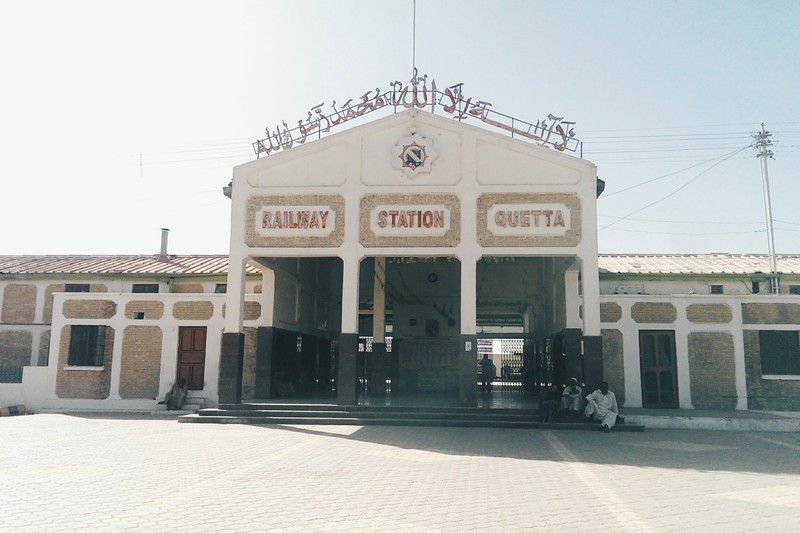
A suicide bomber drove an explosives-laden vehicle into a passenger train carrying military personnel through Quetta on Sunday morning, killing at least 24 people and wounding more than 50 in one of the deadliest attacks in Pakistan’s Balochistan province in recent years.
The blast overturned two carriages and set them alight, sending thick black smoke over the neighborhood. More than a dozen vehicles parked along the road were destroyed, and nearby buildings had windows blown out and walls cracked. Images from the scene showed a mangled carriage lying on its side as civilians and rescue workers climbed over twisted metal searching for survivors. Armed security forces stood guard as ambulances ferried blood-soaked casualties away on stretchers.
Army servicemen were among the dead, a senior official told AFP on condition of anonymity. The train was traveling from Quetta to Peshawar in Pakistan’s northwest, carrying military personnel and their families ahead of the Eid holiday expected to begin Tuesday. At least 20 of the wounded were in critical condition, according to doctors at local hospitals.
The Baloch Liberation Army, or BLA, claimed responsibility in a statement sent to reporters. The group, which demands independence for Balochistan from Pakistan’s central government, said it had deliberately targeted a train carrying security forces. Government officials disputed that characterization, saying women and children were among the casualties.
Casualty figures varied across agencies in the immediate aftermath. The Associated Press, citing three security officials, reported at least 19 dead. Pakistan’s Dawn newspaper, citing a provincial government spokesman, reported 14. The AFP figure of 24 came from a senior official speaking on condition of anonymity.
The explosion struck shortly after 8 am local time as the train passed a railway signal near Chaman Phatak in Quetta. The force derailed three coaches — including the locomotive — and the blast was loud enough to be heard across distant parts of the city, according to Pakistan’s state-run APP news agency. Firefighters battled blazes in nearby vehicles for hours before bringing them under control. Pakistan Railways dispatched rescue trucks and a relief train to assist.
A medical emergency was declared across Quetta’s hospitals, with all doctors, paramedics, and medical staff summoned to duty, said Shahid Rind, a spokesman for the Balochistan provincial government. The police, Counter-Terrorism Department, and bomb disposal squad reached the site to collect evidence.
An insurgency gaining momentum
Balochistan is Pakistan’s largest province by area and its poorest. Rich in natural gas and minerals, it lags behind the rest of the country on nearly every development index — education, employment, economic output. Separatist groups including the BLA have waged a low-level insurgency for decades, accusing Islamabad of extracting the province’s wealth while leaving its people impoverished.
The BLA has grown increasingly brazen. A 2024 suicide bombing at a train station in Balochistan killed at least 26 people, including soldiers. Sunday’s attack in the provincial capital — a heavily militarized city that hosts a substantial Pakistani Army garrison — demonstrates the group’s capacity to strike at the center of the state’s security apparatus, not just at its periphery.
Pakistan’s government routinely accuses India of backing Baloch separatists, a charge New Delhi denies. Chief Minister Sarfraz Bugti condemned Sunday’s attack as the work of “Fitna al-Hindustan,” a phrase Pakistani officials use to implicate India in the violence. Railways Minister Hanif Abbasi said “anti-Pakistan elements operating from India and Afghanistan” were sponsoring terrorism to destabilize the country.
Prime Minister Shehbaz Sharif called the bombing a “cowardly act of terrorism,” vowing that Pakistan would remain “steadfast in our determination to eliminate terrorism in all its forms and manifestations.”
Stakes beyond the province
The implications reach well beyond Balochistan. China has invested tens of billions of dollars in the China-Pakistan Economic Corridor, or CPEC — a network of roads, ports, and energy projects running directly through the province. The deep-water port at Gwadar, on Balochistan’s coast, is a project centerpiece.
Those investments depend on a stability that has never materialized. Baloch separatists accuse Islamabad of exploiting the province’s natural gas and mineral wealth without benefiting its people — a charge that gives CPEC’s presence a combustible quality. While Sunday’s bombing did not directly target Chinese assets, the attack highlights the persistent insecurity that shadows Beijing’s biggest overseas infrastructure bet.
Despite repeated Pakistani military operations that officials say have quelled the insurgency, the violence has only persisted. The BLA’s capacity to detonate a car bomb against a military target in a provincial capital, during a period of heavy holiday travel, signals operational reach that years of counterinsurgency have failed to dismantle.
Bugti vowed there would be “no safe haven left for terrorists in Balochistan.” Similar pledges have followed every major attack in recent years. The insurgency grinds on.
Discussion (9)