 lop News
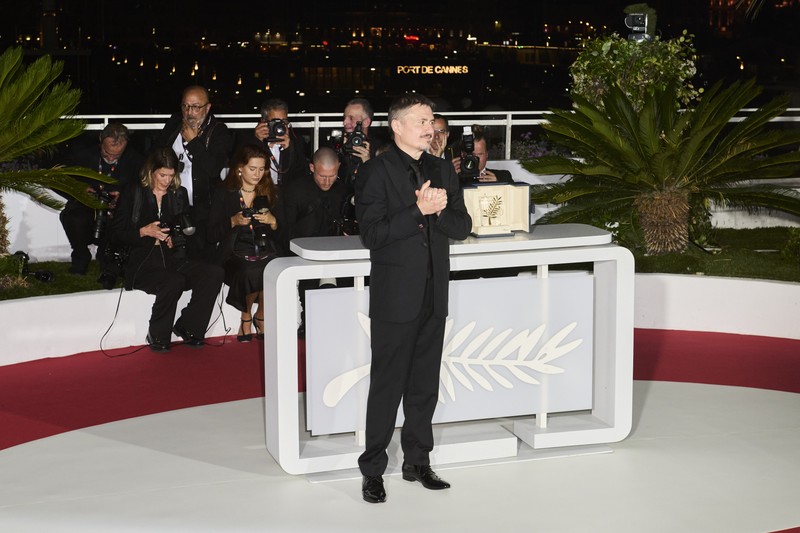
A Romanian Evangelical couple moves to a Norwegian fjord town. They spank their children. The state takes them away. On Saturday night, this was the story that the Cannes Film Festival decided mattered most.
Cristian Mungiu’s “Fjord” won the Palme d’Or at the 79th Cannes Film Festival, making the Romanian director just the 10th filmmaker to claim the prize twice — his first came in 2007 for “4 Months, 3 Weeks and 2 Days,” a searing drama about illegal abortion in communist Romania. In both cases, Mungiu takes a politically charged subject and refuses to let either side claim victory.
“Fjord” stars Sebastian Stan as Mihai Gheorghiu, a Romanian aeronautical engineer who moves with his Norwegian wife Lisbet (Renate Reinsve) to her native country. They join a local evangelical community, raise their five children with strict religious discipline, and are initially welcomed by neighbors and institutions. Then a teacher notices bruises on one of their daughters, and the Norwegian child welfare system intervenes.
Mungiu has described the film as an exploration of “left-wing fundamentalism” — a phrase that barely needs unpacking in 2026. The film draws on several real-life cases, and its power lies in what it refuses to simplify. The parents are neither martyrs nor monsters. The Norwegian state is neither villain nor savior. The audience is left to sit with the discomfort.
Stan, fresh from his turn as Donald Trump in “The Apprentice” (2024), brings a quietly ferocious intensity to a man whose certainty in his faith curdles into something more brittle. Reinsve, who starred in last year’s Oscar-winning “Sentimental Value,” matches him beat for beat as a woman caught between her husband’s convictions and the country she thought she knew.
A Festival of Fault Lines
“Fjord” didn’t win in a vacuum. This was a Cannes defined by ideological fracture.
Andrey Zvyagintsev’s “Minotaur,” which took the Grand Prix, follows a Russian businessman tasked with conscripting 150 workers for Vladimir Putin’s war machine while suspecting his wife of infidelity. Accepting the award, the exiled director addressed Putin directly: “Millions of people on both sides of the line of contact now dream of only one thing: that the massacres finally stop.” He called on the Russian president to put an end to the carnage.
Pawel Pawlikowski, sharing the best director prize for his postwar drama “Fatherland,” used his moment to argue that “cinema must reflect the political situation, but not according to dictated conditions.” Ryusuke Hamaguchi’s “All of a Sudden,” which shared the best actress prize between Virginie Efira and Tao Okamoto, traces an unlikely friendship rooted in mutual care — a gentler kind of resistance.
Even the ceremony itself carried political weight. Quebecois filmmaker Xavier Dolan quoted Palestinian poet Mahmoud Darwish before announcing a prize. Rwandan filmmaker Marie Clémentine Dusabejambo won the Camera d’Or for “Ben’Imana,” the first Rwandan film ever selected for the festival, dedicated to “the women of my country.”
What Resonates Now
In a festival where Hollywood studios were conspicuously absent — no major US studio launched a blockbuster at Cannes this year — the emphasis fell heavily on arthouse cinema and politically charged storytelling. War, exile, displacement, and identity were the dominant themes. The films that broke through were the ones that refused easy allegiances.
Mungiu’s victory is a case in point. “Fjord” isn’t a film about Norway, or about Evangelicals, or about child welfare — though it is all of those things. It’s a film about what happens when two systems of moral certainty collide, and neither has the language to understand the other. In 2026, that collision is playing out in school board meetings, immigration courts, social media feeds, and legislative chambers around the world.
The Cannes jury, led by South Korean director Park Chan-wook, selected 22 films for competition. Only five were directed by women. Geena Davis, presenting a prize, noted that “Thelma & Louise” was meant to be a breakthrough for women in 1991. “All these years later, we have to acknowledge that the change is happening slowly.”
Mungiu himself kept his acceptance speech brief. “This is a message about tolerance, inclusion and empathy,” he told the audience. “These are wonderful values that we all cherish, but we need to put them into practice more often.”
It was the kind of gentle, almost unremarkable statement that sounds different after you’ve spent two and a half hours watching what happens when those values fail.
Discussion (9)