 lop News
The state railway cited a bomb threat. Nobody believed it.
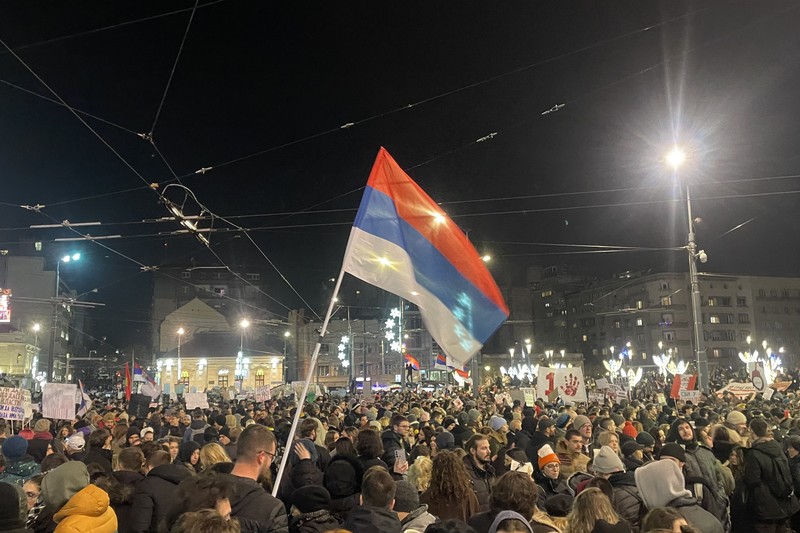
On Saturday, tens of thousands of protesters converged on Belgrade’s Slavija Square anyway — by bus, by car, on foot — to demand the resignation of President Aleksandar Vucic and the early elections he has refused to call. The main rally was largely peaceful. But as the afternoon wore on, groups of young demonstrators split off and clashed with police, throwing flares, rocks, and bottles. Riot police responded by charging forward, firing tear gas and stun grenades to disperse the crowds.
The demonstration was the latest eruption in a student-led movement that began 18 months ago, sparked by a catastrophe that laid bare what critics describe as the corruption at the heart of Vucic’s 12-year grip on Serbian politics.
The Collapse That Changed Everything
In November 2024, a 48-meter concrete canopy collapsed at the railway station in Novi Sad, Serbia’s second-largest city. Sixteen people died. The station had recently undergone renovation as part of a major Chinese-funded infrastructure project. The disaster was attributed to poor workmanship and inadequate oversight — shorthand, for many Serbians, for the systemic corruption that has defined the Vucic era.
The political fallout was swift. Then-Prime Minister Milos Vucevic was forced to resign. But Vucic himself chose confrontation over reform, launching a crackdown on the protest movement after some rallies turned violent.
The students did not back down.
A Movement That Keeps Returning
Saturday’s rally drew people from across Serbia, many wearing T-shirts bearing the slogan “Students win” and carrying Serbian flags alongside banners with the names of their hometowns, according to Deutsche Welle. The crowd called for early parliamentary elections, accused the government of crime and corruption, and demanded the restoration of the rule of law.
The location carried its own history. In March 2025, an estimated 300,000 people filled Slavija Square in the movement’s largest demonstration to date — an event that ended in controversy after the government denied deploying a sonic weapon against the crowd. Independent experts could not fully confirm the denial.
This time, the state tried a different approach to crowd control: prevention. Serbia’s state rail operator cancelled all trains to and from Belgrade on the day of the protest, citing a bomb threat. Organizers accused the government of fabricating the scare to keep out-of-town demonstrators from reaching the capital, according to media reports.
Trains or no trains, they found their way to Slavija Square.
A Government Running Short of Options
While protesters filled the square, Vucic’s loyalists maintained a camp in a park outside the Serbian presidency building — a vigil the president himself established last March as what he described as a human shield against demonstrators.
Vucic and pro-government media outlets have intensified their rhetoric in recent weeks, branding critics as terrorists and foreign agents intent on destroying the country, according to Deutsche Welle. The language serves a purpose: casting political opponents as existential threats to the nation creates room for the kind of force deployed on Saturday night.
The strategy carries growing costs beyond Belgrade. Serbia is formally seeking European Union membership, but Vucic’s democratic backsliding could cost the country roughly €1.5 billion ($1.8 billion) in EU funding, according to the bloc’s top enlargement official, who issued the warning last month. Serbia also maintains close ties with Russia and China — a balancing act that grows more precarious as the domestic crisis deepens.
On Friday, the Council of Europe’s human rights commissioner publicly raised “serious concerns” about Serbia’s deteriorating human rights situation, citing increasing attacks on journalists and activists, shrinking civic space, and reports of police violence during protests.
When Institutions Fail, the Streets Fill
Serbia’s crisis follows a pattern recognizable far beyond the Balkans. When institutional accountability collapses — when buildings fall and no one answers, when elections are demanded and denied, when a government treats its own citizens as adversaries — people take to the streets. The question is never whether they will. It is how many times they can return before something gives.
Eighteen months after Novi Sad, the students of Serbia are still returning.
Discussion (10)