 lop News
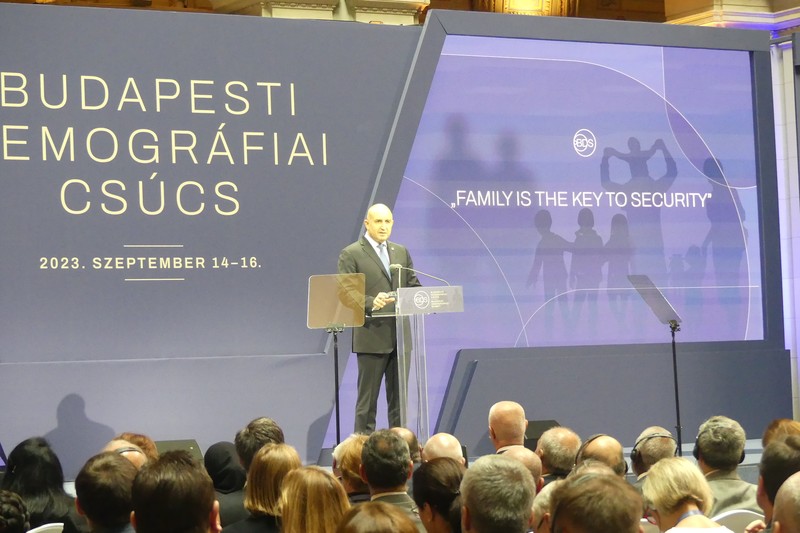
Bulgaria has elected a government that opposes arming Ukraine and wants to reopen channels to Moscow — and it wasn’t close.
Former president Rumen Radev’s Progressive Bulgaria party secured 44.7 percent of the vote in Sunday’s parliamentary election, according to official results with 91.7 percent of ballots counted. That translates to roughly 130 seats in the 240-seat chamber: an outright majority, the first for a single Bulgarian party since 1997.
A mandate built on exhaustion
Radev did not win on foreign policy. He won by promising to end the political chaos that has consumed Bulgaria since anti-graft protests brought down the conservative government of Boyko Borissov in 2021 — eight elections in five years, a revolving door of weak coalitions, and pervasive corruption that has eroded public trust to near-zero.
Turnout was the highest since 2021. Police seized more than one million euros in raids against vote buying in the weeks before the ballot.
“People rejected the self-satisfaction and arrogance of old parties and did not fall prey to lies and manipulation,” Radev told supporters Sunday night, calling it a “victory of hope over distrust, a victory of freedom over fear.”
His coalition of left-leaning rural voters, citizens nostalgic for the socialist era, and Bulgarians simply exhausted by instability proved enough to crush the established parties. Borissov’s GERB collapsed to 13.4 percent. The liberal PP-DB coalition managed 13.2 percent. The result exceeded every opinion poll forecast.
Radev, 62, stepped down from the presidency in January after nine years to form Progressive Bulgaria. A former MiG-29 fighter pilot who once commanded the Bulgarian Air Force, he presented himself as a champion of the EU’s poorest citizens — a country of 6.5 million people where the rising cost of living, particularly after adopting the euro, has become a major concern.
“The country’s main challenge is the economic crisis and the demographic crisis,” said Tihomir Bezlov, a senior fellow at the Centre for the Study of Democracy in Sofia. “There do not seem to be many ideas in the winning camp on either of these issues.”
The Russia question
Radev has consistently opposed Bulgaria sending arms to Ukraine, arguing that Bulgarian weapons deliveries would not alter the outcome on the battlefield. He criticized a 10-year defence agreement signed between Bulgaria and Ukraine last month by the interim government. He has called for “practical relations with Russia, based on mutual respect and equal treatment.”
The Kremlin noticed. Spokesman Dmitry Peskov told reporters Monday that Russia was “encouraged by the words of Mr Radev” and other European leaders who have expressed readiness to “resolve problems through dialogue.” He cautioned against reading the result as a broader European shift, but the satisfaction in Moscow was unmistakable.
Western media have described Radev as “Putin’s Trojan horse.” Peskov deflected the label, saying Moscow was focused instead on Radev’s declared openness to “pragmatic dialogue.”
Radev himself has pushed back, pointing out that French President Emmanuel Macron and others have also called for pragmatic engagement with Moscow. “Europe has fallen victim to its own ambition to be a moral leader in a world with new rules,” he said Sunday.
Pragmatist or disruptor?
The critical question for NATO and the EU is how far Radev will actually go. Analysts do not expect him to replicate Hungarian Prime Minister Viktor Orbán’s role as a full-throated spoiler of EU support for Kyiv. He has said he would not use Bulgaria’s veto to block EU decisions on Ukraine. He is not expected to reverse euro adoption or oppose broader EU aid packages.
His track record as president suggests tactical flexibility. In October 2022, he refused to sign a joint declaration at the Bucharest Nine summit over language on Ukraine’s future NATO membership — but his administration clarified he supported every other clause, including Ukraine’s sovereignty and territorial integrity. In December that year, he threatened to veto an EU sanctions package over nuclear fuel restrictions, then supported the final text.
Bulgaria is also deeply embedded in Europe’s defence supply chain. The VMZ factory in Sopot produces NATO-grade 155mm artillery shells through a €1 billion joint venture with Germany’s Rheinmetall, capable of producing up to 100,000 shells annually. Radev himself invited Rheinmetall’s CEO to Bulgaria and declared the country was “becoming part of the European defence ecosystem.” His position will likely mirror that of Slovak Prime Minister Robert Fico — publicly critical of EU military support for Ukraine, but unwilling to block private arms production that flows to Kyiv through third countries, particularly neighbouring Romania.
What comes next
Radev can govern alone on most legislation. But judicial and constitutional reforms — the anti-corruption measures that motivated many of his voters — require a two-thirds majority, meaning he will need coalition partners. He has already signaled willingness to work with PP-DB on judicial reform.
European Council President Antonio Costa was among the first senior EU officials to congratulate Radev. Borissov, the man Radev replaced as Bulgaria’s dominant political figure, offered a terser assessment: “Winning elections is one thing, governing is another.”
A NATO state with a 44.7 percent mandate for a leader who opposes arming Ukraine and wants to reopen dialogue with Moscow is not the alliance Moscow’s war was supposed to produce. Bulgaria’s institutional anchors — NATO membership, EU accession, the euro — remain firmly in place. The question is how much strain a single government can put on them, and whether Radev’s pragmatism extends to the alliances his country depends on.
Sources
- Bulgaria’s Kremlin-friendly former president Radev wins parliamentary election — France 24
- Rumen Radev’s party wins Bulgarian election — BBC News
- Radev Wins Bulgaria in Landslide as Pro-Russian Turn Sparks EU Questions — Kyiv Post
- Kremlin on Radev’s Victory: “We Welcome Pragmatic Dialogue” — Novinite
Discussion (9)