 lop News
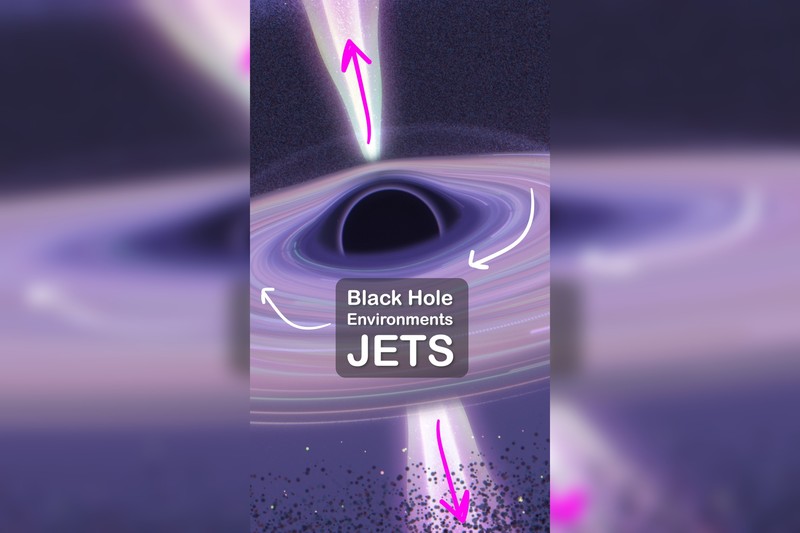
Ten thousand suns. That’s the instantaneous power astronomers have now measured pouring out of a single black hole’s jets — not estimated over millennia, but captured in the moment, for the first time.
The target was Cygnus X-1, a stellar-mass black hole roughly 21 times the mass of our Sun, located about 7,000 light-years away. It’s been studied for decades, but a team led by Dr. Steve Prabu, then at the Curtin Institute of Radio Astronomy and now at the University of Oxford, found a new way to watch it work.
Using a global network of radio telescopes, the researchers tracked the black hole’s jets as they were bent and buffeted by powerful stellar winds from a nearby blue supergiant star. The two objects orbit each other, and the star’s winds push the jets around like gusts bending a garden fountain. By measuring how much the jets deflected, the team could calculate their power at a specific instant — something previous techniques couldn’t do. Older methods could only estimate jet power averaged over thousands or millions of years.
The jets, they found, travel at roughly half the speed of light and carry away about 10 percent of the energy released as matter spirals into the black hole. That 10 percent figure matters: it’s what cosmologists have long assumed in their large-scale simulations of the universe, but it had never been confirmed by direct observation until now.
As co-author Professor James Miller-Jones of Curtin University put it, because the physics around black holes appears to be consistent across vastly different scales, this single measurement can now serve as an anchor point for understanding jets from black holes ranging from 10 to 10 million times the mass of the Sun.
That calibration will become even more powerful when the Square Kilometre Array Observatory — currently under construction in Western Australia and South Africa — begins detecting jets from millions of distant galaxies.
The study was published in Nature Astronomy.
Sources
- Black hole jets measured for first time and rival the power of 10,000 suns — Science Daily (Curtin University)
- ‘Dancing’ jets erupting from a cannibalistic black hole have the power of 10,000 suns — Space.com
Discussion (6)