 lop News
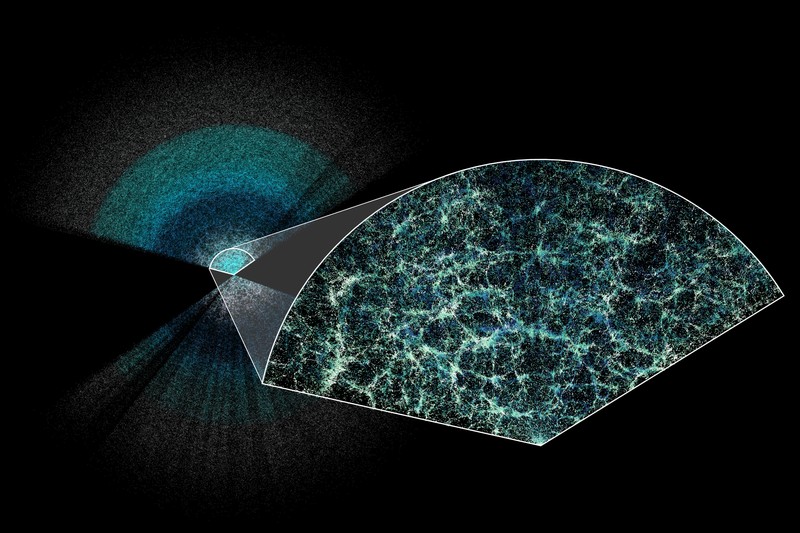
Forty-seven million galaxies. Six times more than every previous measurement combined. Five years of pointing five thousand fiber-optic sensors at the night sky in Arizona.
The Dark Energy Spectroscopic Instrument — DESI — has completed the largest high-resolution three-dimensional map of the universe ever constructed, a sprawling census of cosmic structure stretching back 11 billion years. The final scheduled observations came last week, when the instrument’s robotic sensors locked onto a patch of sky near the Little Dipper and collected photons that had been traveling toward Earth for billions of years.
The map exists to answer a single, maddening question: what is dark energy?
Roughly 70 percent of the universe is made of the stuff. Scientists know it drives the accelerating expansion of the cosmos. They don’t know what it actually is. The leading explanation is the “cosmological constant” — a term Einstein added to his general relativity equations representing the energy of empty space.
But DESI’s first three years of data hinted at something stranger: dark energy’s influence may be changing over time. If the full five-year dataset confirms this, it would reshape how physicists understand the nature and eventual fate of the universe.
“We’re all curious about what new surprises are waiting for us,” said Michael Levi, DESI’s director and a scientist at Lawrence Berkeley National Laboratory, which manages the project.
The instrument was designed to capture 34 million galaxies and quasars over five years. It caught more than 47 million, plus 20 million nearby stars used to study the Milky Way. The project, involving over 900 researchers from more than 70 institutions, performed so efficiently it completed an entire extra pass of the sky.
Definitive dark energy results from the full dataset are expected in 2027. In the meantime, DESI continues observing through 2028, expanding its map by roughly 20 percent into harder-to-reach regions — including areas near the plane of the Milky Way, where bright nearby stars crowd out fainter, more distant objects.
“This moment feels like sitting on the edge of my seat,” said Stéphanie Juneau, a DESI collaborator and astronomer at NSF NOIRLab.
Sources
- DESI Completes Planned 3D Map of the Universe and Continues Exploring — Lawrence Berkeley National Laboratory
- Astronomers Just Finished the Biggest, Sharpest 3D Map of the Universe—It’s Beautiful — Scientific American
Discussion (5)