 lop News
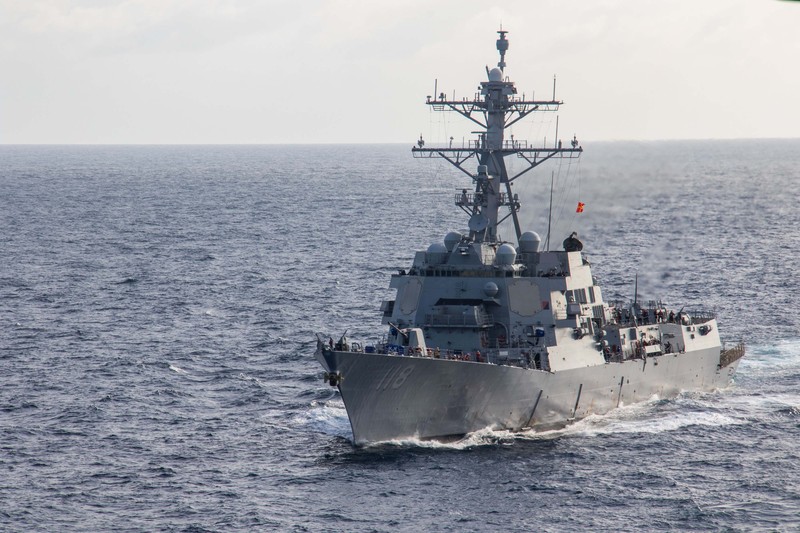
Off the coast of Malaysia, a partially loaded supertanker went dark on maritime tracking systems. South of India, another was taken under armed escort by a US Navy destroyer. Neither encounter happened anywhere near the Persian Gulf.
For nearly two months, the world’s attention has been fixed on the Strait of Hormuz, where Iran has blocked, fired on, and seized commercial vessels in a campaign to choke off shipping through one of the planet’s most critical waterways. But the American response — a naval blockade of Iranian ports — is no longer a regional operation. It now stretches across the Indian Ocean and into Southeast Asia, creating two parallel sieges on global maritime trade: one denying ships entry to the Gulf, the other denying Iranian vessels exit from it.
The Asian Interdictions
According to shipping and Western maritime security sources who spoke to Reuters, at least three Iranian-flagged tankers have been intercepted in recent days across a vast arc of Asian waters.
The Dorena, a fully loaded supertanker carrying 2 million barrels of crude, was last detected off southern India on April 20. US Central Command confirmed the vessel is now under escort by a Navy destroyer in the Indian Ocean “after attempting to violate the blockade.”
The Deep Sea, another supertanker part-loaded with crude, was last seen transmitting off Malaysia’s coast around April 15.
The Sevin, a smaller tanker with a 1 million-barrel capacity carrying 65 percent of its load, was also intercepted. It had last broadcast its position off Malaysia roughly a month ago.
A fourth vessel, the Derya, may also have been intercepted, shipping sources said. The tanker had failed to discharge its Iranian oil cargo in India before a US waiver on Iranian crude purchases expired on April 19. It was last tracked off India’s western coast on Friday.
None of these seizures occurred in the confined waters near the Persian Gulf. The choice of location was deliberate. A third maritime security source told Reuters the US military was targeting Iranian vessels in open waters specifically to avoid the floating mines Iran has deployed near the Strait of Hormuz.
Two Blockades, Running in Parallel
The confrontation is now architecturally symmetrical — and mutually suffocating.
Iran’s closure of the Strait of Hormuz — where roughly 20 percent of the world’s traded oil and liquefied natural gas normally transits — has effectively sealed the Persian Gulf to commercial traffic. On Wednesday, Iranian forces fired on three ships in the strait and seized two: the MSC Francesca, flagged to Panama, and the Epaminondas, a Greek-owned vessel registered in Liberia. The IRGC said the vessels were endangering maritime security “by operating without the necessary permits and tampering with navigation systems.”
Technomar, the management company behind the Epaminondas, said the ship was “approached and fired upon by a manned gunboat” off the coast of Oman and that its bridge was damaged. No crew injuries were reported.
On the other side, the US blockade — imposed April 13 after negotiations in Islamabad collapsed — has become a global dragnet. Central Command reported that as of April 23, 31 vessels had been directed to turn around or return to port. At least two have been seized by force: the cargo vessel Touska, disabled by destroyer gunfire in the Gulf of Oman on April 19 after a six-hour warning period, and the oil tanker Tifani, boarded by US forces in Southeast Asian waters on April 21.
The Pentagon has committed more than 10,000 personnel, over a dozen warships, and dozens of aircraft to the operation. Enforcement is now split across two military commands: Central Command covers the Gulf and Arabian Sea, while the Indo-Pacific Command under Admiral Samuel Paparo conducts interdiction thousands of miles from the war zone.
No Diplomatic Off-Ramp
Neither side considers the current ceasefire — extended by President Donald Trump on Tuesday at Pakistan’s request — to be functioning in any meaningful sense.
Iranian Parliament Speaker Mohammad Bagher Ghalibaf wrote on X that “Reopening the Strait of Hormuz is impossible with such flagrant breach of the ceasefire.” President Masoud Pezeshkian said the blockade and “breach of commitments” were obstacles to “genuine negotiations.” Iran’s state news agency IRNA described reports of a second round of talks as “not true.”
The White House has its own reading of events. Press secretary Karoline Leavitt said the Iranian seizures of the MSC Francesca and the Epaminondas did not violate the ceasefire because “these were not US or Israeli ships, these were two international vessels.” Trump has said the blockade will continue until a deal is reached.
Pakistan, the mediator, has reportedly begun preparing for further discussions in Islamabad. Iran has not confirmed it will attend.
The Economic Toll
Brent crude has topped $100 per barrel — a 35 percent increase from prewar levels. European Union energy commissioner Dan Jørgensen said the disruption is costing Europe roughly €500 million ($600 million) per day and compared it to the major energy crises of the last half-century. An analyst at the Foundation for the Defense of Democracies estimated the blockade costs Iran roughly $400 million in daily lost revenue.
The Pentagon has informed Congress that clearing Iranian mines from the Strait of Hormuz could take six months, according to the Washington Post — meaning the economic consequences could persist long after any political settlement.
A New Kind of Naval Warfare
The US decision to extend blockade enforcement into the Indian Ocean and Southeast Asia represents a significant expansion of the norms governing naval conflict. Traditional blockade enforcement occurs near the coast of the blockaded state. Intercepting vessels in international waters off India, Malaysia, and Sri Lanka — thousands of miles from Iran — tests the boundaries of maritime law and raises questions about how far a belligerent can pursue economic warfare across the world’s shipping lanes.
China condemned the blockade as “irresponsible and dangerous.” Russia warned of an “economic earthquake.” The EU, the UK, and Australia have expressed opposition, favoring de-escalation. France and the UK have promoted an alternative multinational mission to open the Strait — but none of these efforts have gained traction.
For now, the two blockades grind on — one at the mouth of the Persian Gulf, the other spanning an arc from the Gulf of Oman to the approaches of the Malacca Strait. Between them, roughly a fifth of the world’s energy supply sits in limbo.
Sources
- US intercepts three Iranian oil tankers in Asian waters, sources say — Channel News Asia (Reuters)
- Iran fires on 3 ships in the Strait of Hormuz as US maintains blockade and diplomacy stalls — Associated Press
- Iran says it has seized two ships in Strait of Hormuz after vessels attacked — BBC News
- US intercepts and seizes Iranian-flagged cargo ship, Trump says — BBC News
- US Intercepts Three Iranian Oil Tankers Near Asian Waters — Forbes
- 2026 United States naval blockade of Iran — Wikipedia
Discussion (14)