 lop News
$380.2 billion in cash. Fourteen consecutive quarters of net stock sales. Not one major acquisition.
This is Berkshire Hathaway under Greg Abel — not because the new chief executive has broken with his predecessor’s philosophy, but because he appears to be following it to the letter. The man who replaced Warren Buffett in January is running the same playbook at a moment when the market gives him nothing worth buying at prices he’s willing to pay.
Berkshire reported first-quarter operating profit of $11.35 billion on May 2, an 18 percent increase from the same period a year earlier, when the company’s insurance operations absorbed losses from the southern California wildfires. The BNSF railroad posted higher earnings. Several retail businesses struggled under what the company described as uncertain economic conditions and sagging consumer confidence.
The real story, though, is the balance sheet.
The Cash Mountain
Berkshire’s cash pile reached a record $380.2 billion at the end of March, according to the company’s earnings release. The conglomerate has now been a net seller of equities for 14 straight quarters — a streak that began in the second half of 2022 and has continued, without interruption, into Abel’s first months in charge.
The company did find one thing worth buying: its own stock. Berkshire repurchased $234 million of shares in the first quarter, its first buybacks since May 2024. That figure is a rounding error against the cash hoard, but it signals that Abel, like Buffett before him, sees more value in Berkshire’s equity than in most of what the market is offering.
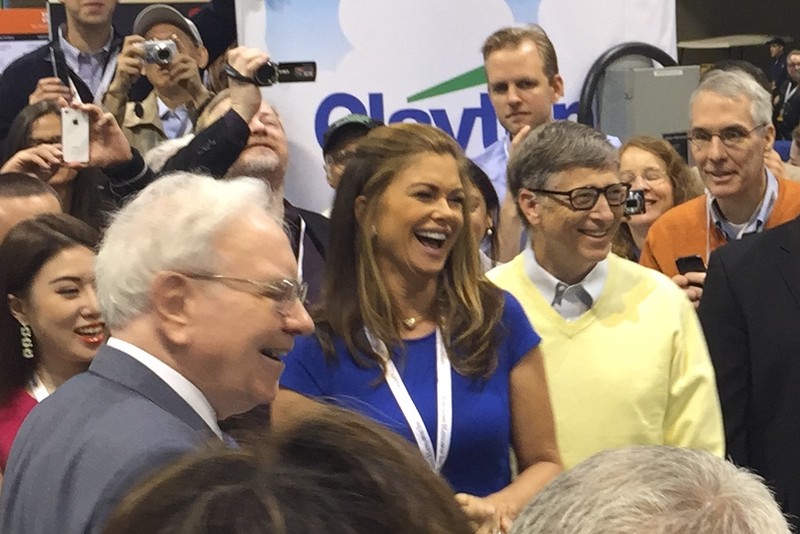
At the annual shareholder meeting in Omaha — the first without Buffett at the helm — Abel took the stage to an arena with thousands of empty seats. He answered a prerecorded question from Buffett himself, who remains chairman, by declaring that the conglomerate “hates bureaucracy” and does “not intend to be beholden to anyone.”
This was an opening argument, not a policy shift. The convictions were familiar. The question is whether conviction alone can justify sitting on more cash than the GDP of Denmark.
Patience or Paralysis?
Buffett built his legend on decisive, counterintuitive bets — American Express during a scandal, Coca-Cola when the market shrugged, Goldman Sachs and General Electric in the depths of the 2008 financial crisis. These were acts of conviction deployed when others flinched.
Abel’s first quarter suggests a different posture, or perhaps the same posture in very different circumstances. He told shareholders he wants to hold investments “forever” and will not commit capital without understanding the economic prospects and risks. “It doesn’t mean you need to deploy all your capital and spend all your money,” he said.
Ajit Jain, Berkshire’s longtime insurance chief, put it more bluntly: “It is very difficult to sit there and do nothing while everyone else is being wined and dined by brokers and taken to London.”
Difficult, but apparently not impossible. The cash keeps growing. The selling continues.
There is a case for patience. US equity markets have surged on the back of technology and artificial intelligence — sectors where Berkshire has limited direct exposure. Valuations are stretched by historical standards. Buffett himself was a net seller in his final quarters as CEO. Abel inherited a strategy of restraint, not a mandate to reverse course.
There is also a case for concern. Berkshire’s shares have lagged the S&P 500 by 39 percentage points since Buffett announced his retirement at last year’s annual meeting, according to Channel News Asia. A $1.02 trillion conglomerate that cannot find productive uses for $380 billion is implicitly telling the market that its best available investment is a Treasury bill.
The Inheritance Problem
Buffett, 95, attended the Omaha meeting and offered a characteristically generous verdict on his successor. “Greg is doing everything I did and then some,” he told the audience. He also praised Apple — one of Berkshire’s most successful investments — and its departing chief executive, Tim Cook.
The endorsement cuts both ways. Shareholders who bought Berkshire for disciplined capital allocation are getting exactly what they paid for. Those who bought for the belief that Buffett would spot the next Coca-Cola before anyone else are adjusting to a reality where the vault stays locked and the cash earns interest.
Abel did notch one meaningful win. He praised a recent Oregon appeals court ruling that, for now, spared Berkshire’s PacifiCorp utility from billions of dollars in potential liabilities tied to 2020 wildfires. “We’re back to first base,” Abel said — meaning the existential legal threat has receded.
Paul Lountzis, a money manager attending his 34th Berkshire annual meeting, framed the challenge plainly: “Greg has a formidable challenge, replacing the greatest investor who ever lived.”
Abel does not need to be Buffett. But at some point, $380 billion stops looking like discipline and starts looking like an admission that the market has outgrown the model. The new CEO has time — and more dry powder than any investor in history. What he does not have is a margin of error that extends forever.
Discussion (8)