 lop News
Yesterday, four NASA astronauts flew past the Moon on Artemis II — the first crewed lunar mission since Apollo 17 in 1972. It was a triumph of engineering and political will. It may also have been a preview of second place.
Half a world away, China is building the hardware to land its own astronauts on the lunar surface by 2030, and the country’s track record suggests it might actually make the deadline. If it does, Beijing won’t just plant a flag. It plans to stay.
Two Programs, Two Philosophies
NASA’s Artemis program is a sprawling enterprise: multiple commercial partners, international contributors from Japan, Canada, and Italy, and an architecture that has already been overhauled several times. The agency has spent roughly $107 billion on return-to-the-moon plans through 2026, according to the Planetary Society, thanks in part to repeated redesigns across presidential administrations.
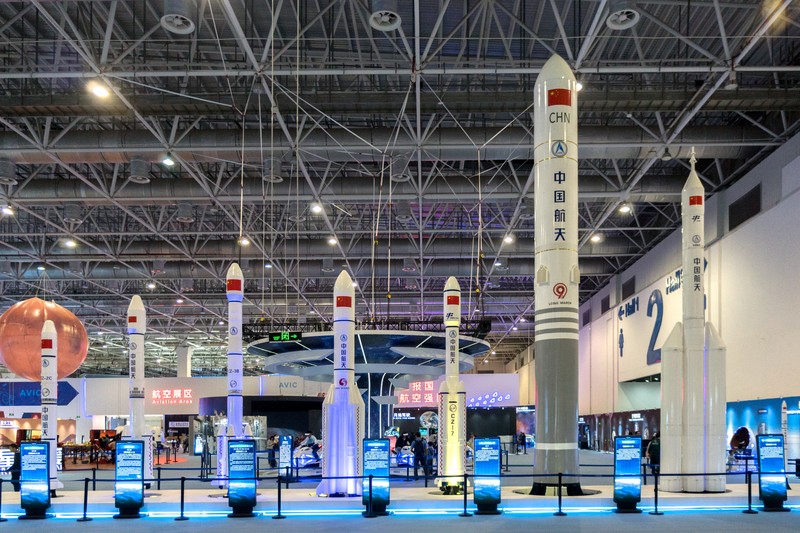
China’s approach is more streamlined. The China Manned Space Agency (CMSA) is developing three core pieces of hardware: the Long March 10 heavy-lift rocket, the Mengzhou crew capsule (meaning “dream vessel”), and the Lanyue lunar lander (“embracing the Moon”). Two rockets launch separately; the spacecraft and lander rendezvous in lunar orbit, echoing the Apollo playbook. The system can carry roughly three astronauts to the surface.
That hardware is already well along. In February, CMSA tested Mengzhou’s abort system and stage separation. The lander’s ascent and descent systems were verified last August at a facility in Hebei province built to simulate lunar terrain — complete with rocks, craters, and special coatings mimicking the reflectivity of lunar soil. An uncrewed Mengzhou is scheduled to fly to China’s Tiangong space station later this year.
“It looks like it’s almost ready to go,” Quentin Parker, director of the Laboratory for Space Research at the University of Hong Kong, told Nature.
The Permanence Play
Both nations say they want more than footprints. The question is whether either can sustain the commitment.
NASA announced a three-phase, $20 billion plan last month to build a lunar base near the south pole, complete with habitats, pressurized rovers, nuclear power, and eventually permanent infrastructure. The plan calls for landings every six months as capabilities mature. But it also depends on commercial landers — SpaceX’s Starship and Blue Origin’s Blue Moon — that are still in development, the same hardware that already pushed NASA’s timeline from 2024 to 2028.
China is pursuing a parallel vision. With Russia as its partner, Beijing plans to build the International Lunar Research Station (ILRS), with a “basic model” operational by 2035 and a full facility — including a lunar orbital station — by 2045. Wu Weiren, chief designer of China’s lunar exploration programme, has said the base could include a nuclear reactor on the surface and would eventually support technical verification for crewed Mars landings.
Both programs are eyeing the Moon’s south pole, where water ice could be split into hydrogen and oxygen — the ingredients for rocket fuel. Whoever establishes reliable access to that resource first gains an enormous advantage for everything that comes after.
The Track Record Problem
China has something NASA does not: a recent history of hitting its spaceflight deadlines. Since 2007, the country has executed a steady cadence of robotic lunar missions — first far-side landing in 2019, first near-side sample return in 2020, first far-side sample return in 2024. Two more robotic missions, Chang’e-7 and Chang’e-8, are scheduled before 2030 to scout south-pole terrain. China is now the only nation to have retrieved samples from both the near and far sides of the Moon.
“China’s pretty good at keeping to its timelines,” Parker said. “There is a possibility that China will get to the Moon first.”
NASA administrator Jared Isaacman acknowledged the pressure in February, saying the agency faced “credible competition from our greatest geopolitical adversary” and needed to “move faster, eliminate delays and achieve our objectives.” At a March event outlining the moon base plan, he was blunter: “Should we fail, and should we look on as our rivals achieve their lunar goals ahead of our own, we are not going to celebrate our adherence to excess requirements, policy or bureaucratic process.”
What ‘First’ Means Now
The original space race was binary: first to the surface wins. This one is different. NASA could land first and still lose the longer game if it can’t sustain surface operations. China could land second and establish the more durable presence. The prize isn’t the moment of touchdown — it’s the infrastructure that remains after the astronauts come home.
The next few years will be defined less by speeches and splashdowns than by testing schedules, hardware deliveries, and whether either nation can keep its political coalitions aligned long enough to follow through. Bhavya Lal, a policy analyst at the RAND School of Public Policy and former NASA associate administrator, writing in The Economist, noted that competition with China may be the political fuel driving lunar ambitions — but questioned whether that fuel can last the decades needed to build something permanent.
For now, the Artemis II crew is on its way home, and China’s next test flight is months away. The race is not decided. But it is very much on.
Sources
- China is planning to land people on the Moon — and might beat the United States to it — Nature
- China’s crewed lunar programme eyes astronaut landing by 2030 — Reuters
- NASA Unveils Initiatives to Achieve America’s National Space Policy — NASA
- NASA outlines ambitious $20 billion plan for moon base — Spaceflight Now
- China unveils 2026 crewed space plan as lunar landing program advances toward 2030 — Global Times
Discussion (10)