 lop News
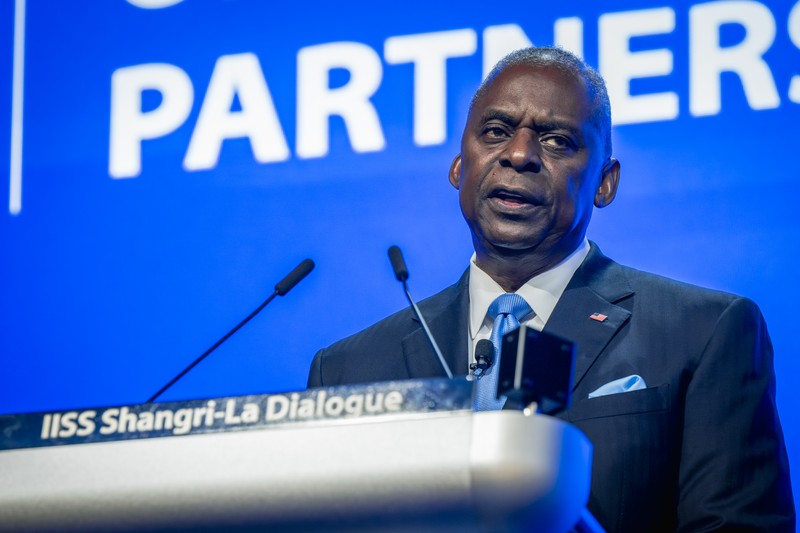
At Asia’s largest defence summit, Australia’s defence minister declared the seabed a battlefield and unveiled new underwater drone technology to guard against critical infrastructure sabotage. The same weekend, his government confirmed it would accept only secondhand American nuclear submarines under the AUKUS pact — abandoning plans for at least one new-build vessel in what was billed as a “streamlined” arrangement.
The twin announcements, delivered at the Shangri-La Dialogue in Singapore, captured the central tension running through Indo-Pacific security: ambitions expanding faster than the industrial base can sustain them.
The New Undersea Frontier
Addressing defence officials from roughly 45 countries, Richard Marles delivered one of the most combative Australian speeches at the forum in years. He cited five undersea internet cables severed in the Taiwan Strait over the past 18 months — attributed to Chinese vessels — and three more in the Baltic Sea, allegedly cut by Russian ships.
“The seabed is becoming a battlefield. The shadow fleet is becoming a weapon,” Marles said. “This is not speculation. This is a documented pattern of behaviour. And we must reckon with it honestly.”
Roughly 99% of Australia’s internet traffic runs through just 15 subsea cables, the minister noted. Financial systems, health infrastructure, intelligence sharing, and “our ability to operate as a modern economy and a functioning state” all depend on infrastructure that “cannot move and […] can be cut with an anchor in the middle of the night.”
Marles pressed Beijing to be more transparent about its maritime operations, arguing that existing “grey zone” activity is inconsistent with a peaceful regional order. He also targeted so-called shadow-fleet vessels — unregistered, flag-of-convenience ships that he said serve as “vectors for sanctions evasion, for the transport of energy that sustains Russia’s war in Europe, for illegal fishing, for human and drug trafficking.”
Drones by 2027
The three AUKUS partners used the summit to announce the first “signature project” under the alliance’s technology-sharing pillar, known as Pillar Two. US Defence Secretary Pete Hegseth described it as “a suite of highly adaptable multi-mission UUV payloads designed to support undersea operations and maintain our collective advantage in the maritime domain.”
UK Defence Secretary John Healey called the technology — advanced sensors and weapons systems for uncrewed underwater vehicles — “ground-breaking”. The new capability is expected to be operational by 2027.
The programme builds on the UK’s Atlantic Bastion initiative, launched in 2025 to deploy autonomous vessels and artificial intelligence alongside warships guarding subsea infrastructure. The concept has been battle-tested in the Black Sea, where Ukraine’s naval drones have effectively gutted Russia’s fleet, demonstrating the asymmetric potential of unmanned maritime systems.
Secondhand Submarines, First-Class Politics
The politically awkward news concerned AUKUS’s centrepiece: the nuclear submarine programme underpinning Australia’s long-term defence strategy.
Under the original 2021 agreement, Canberra was to receive two used Virginia-class submarines and one new-build vessel. That has now changed. All three will be in-service boats drawn from existing US Navy stock.
Marles framed the revision as a pragmatic choice. “In the context of a very complicated endeavour, we need to place a premium on simplicity,” he told reporters, noting that a single submarine model would benefit both crews and maintenance workers. “It is definitely cost-effective. And to be clear, this is a very expensive programme.”
The programme could cost up to $235 billion over three decades, according to government forecasts.
The revision tells its own story about alliance realities. The US Navy operates 24 Virginia-class submarines, but American shipyards are struggling to meet a production target of two new boats per year. Critics in Washington have questioned why the United States would sell nuclear submarines abroad before fulfilling its own requirements. The deal’s “streamlining” may be less about efficiency than acknowledging that US shipyards cannot spare a new-build hull for Canberra.
The Taiwan Silence
Hegseth insisted the Trump administration would not allow China to dominate the Pacific. “We want partners, not protectorates,” he said, invoking Theodore Roosevelt’s big-stick diplomacy. He cited a record $1.5 trillion defence budget request and warned that “a Pacific dominated by any hegemon would unravel the regional balance of power.”
Yet noticeably absent from his remarks was any direct reference to Taiwan. Last year Hegseth warned of a “real” and potentially “imminent” threat of a Chinese invasion of the island. This year, after an underwhelming Trump-Xi summit in Beijing and stalled American arms sales to Taipei, the silence was conspicuous.
Concern is growing in Taipei that the current White House’s commitment to the island is weaker than that of prior administrations.
The Shangri-La weekend laid bare the trajectory. Allies are spending more, developing new technology, and rewriting procurement deals to match what their industrial bases can deliver. The drones arrive by 2027. The secondhand submarines, sometime in the next 15 years. The threats they are meant to counter are already here.
Sources
- New Aukus drone tech to protect critical undersea cables as Marles warns: ‘seabed is a battlefield’ — The Guardian
- US will send only used nuclear submarines to Australia under amended AUKUS defence deal — France 24
- UK, US and Australia to develop ‘cutting-edge’ underwater drone technology — Euronews
Discussion (9)