 lop News
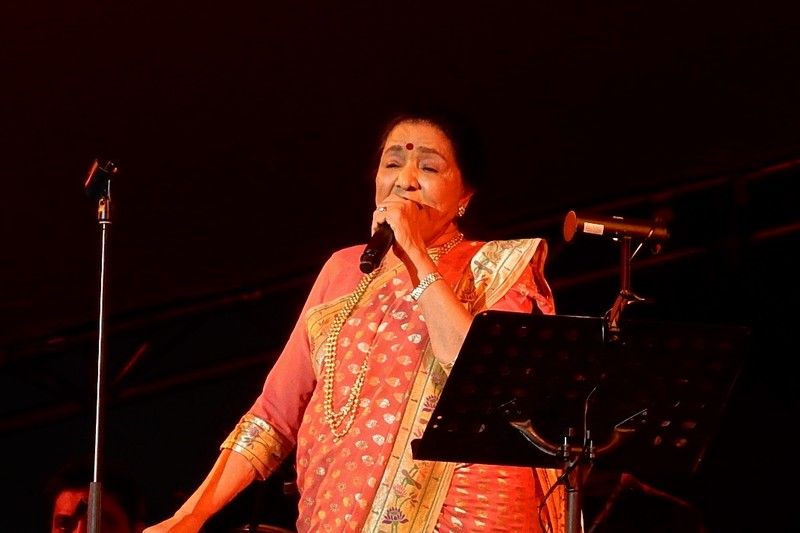
Eleven thousand songs. Seven decades. Twenty languages. One voice.
Asha Bhosle — the most recorded artist in history, a woman whose singing outlasted every shift in taste and outpaced every rival, including her own sister — died Sunday at a Mumbai hospital. She was 92.
Her son, Anand Bhosle, confirmed the death. She had been admitted to Breach Candy Hospital on Saturday after cardiac and respiratory complications. Her doctor, Pratit Samdani, told the Press Trust of India she died of multi-organ failure.
The numbers barely capture what she was, but they are a start. Guinness World Records formally recognized her in 2011 as the most recorded artist in music history, with over 11,000 songs to her name. She sang in 20 languages — Hindi, Marathi, Bengali, and beyond. She won two National Film Awards, the Dadasaheb Phalke Award — India’s highest cinema honor — and the Padma Vibhushan, the nation’s second-highest civilian decoration.
Born in a shadow, determined to catch up
Bhosle was born Asha Mangeshkar on September 8, 1933, in Sangli, Maharashtra, the daughter of classical singer and actor Deenanath Mangeshkar. Her elder sister, Lata Mangeshkar, would become the “Nightingale of India” — a figure so dominant in Indian cinema that Bhosle spent her early career defined almost entirely by the comparison.
She eloped at 16 with Ganpatrao Bhosle, a neighbor. The marriage was controlling; Lata later told film historian Nasrin Munni Kabir that Ganpatrao had isolated Bhosle from her family for years. Bhosle left him in 1960 as a single mother of three.
She had been recording since 1943, when she sang for the Marathi film “Majha Bal.” But the climb was slow. “No doubt didi had a headstart,” she told film writer Raju Bharatan in 1971, using the Hindi word for older sister, “but that only made me more determined to catch up with her.”
She did considerably more than catch up. While Mangeshkar became synonymous with pure, elevated grace, Bhosle grabbed the songs others wouldn’t touch — the smoky cabaret numbers, the Western-inflected pop, the qawwalis and bhangra beats. Where her sister soared, Bhosle swaggered. She became, by broad consensus, the more versatile of the two.
The partnership that rewrote Bollywood
Her creative and romantic partnership with composer Rahul Dev Burman — known as Pancham — reshaped Hindi film music from the 1960s through the 1990s. “Dum Maro Dum,” “Piya Tu Ab To Aaja,” “Chura Liya Hai Tumne,” “Mera Kuchh Saaman” — these weren’t just hits; they became permanent fixtures of South Asian life. They married in 1980. Burman died in 1994, aged 54.
“It is only Pancham who has uncovered my range as a singer,” Bhosle said in a 2023 interview. “Till Pancham made me explore the inner recesses of my own voice… I was totally unaware of the fact that I could sing with such suppleness of throat.”
The Khayyam-composed soundtrack for “Umrao Jaan” (1981), with its classical ghazals, is widely regarded as her career peak — proof that the woman who could fill a dance floor could also deliver aching, devotional stillness.
A voice that crossed every border
Bhosle’s reach extended far beyond the subcontinent. Cornershop’s 1997 tribute “Brimful of Asha” became a global hit after Fatboy Slim remixed it. She recorded with Boy George, R.E.M.’s Michael Stipe, and the Kronos Quartet. The Black Eyed Peas sampled her work. She even cut a track with Australian cricketer Brett Lee for the inaugural Indian Premier League season.
One of her final recordings was characteristically boundary-breaking: a collaboration with the virtual band Gorillaz on “The Shadowy Light,” from their 2026 album “The Mountain” — a song about grief and mortality, released in what turned out to be her final year.
A life on her own terms
Bhosle never stopped working. She sang a three-hour concert in Dubai at 90. She launched a YouTube channel, encouraged by her granddaughter Zanai, that drew over 160,000 subscribers. She started an online talent show during the pandemic. She opened a chain of restaurants called Asha’s, beginning in Dubai in 2002.
“For me, music is my breath,” she said in 2023. “Many times I felt I would not be able to survive, but I did.”
Prime Minister Narendra Modi called her “one of the most iconic and versatile voices India has ever known.” Cricket commentator Harsha Bhogle captured the magnitude of the moment: “The last survivor of the great era of Rafi, Kishore, Mukesh, Manna Dey, Talat, Geeta Dutt, Lata and Asha is gone and while we use the expression loosely, it is really the end of an era.”
Her mortal remains will be kept at her residence in Mumbai’s Lower Parel neighborhood on Monday for public tributes, with last rites at Shivaji Park that afternoon. She is survived by her son and grandchildren.
Sources
- Asha Bhosle: The sound of Bollywood dies aged 92 — BBC News
- India: Legendary playback singer Asha Bhosle dies at 92 — Deutsche Welle
- Asha Bhosle Dead: Prolific Indian Singer Was 92 — Variety
- Asha Bhosle death news live updates: Legendary singer dies at 92 after brief illness — Hindustan Times
Discussion (12)