 lop News
Reid Wiseman has been to space before. He has orbited Earth, spacewalked outside the International Space Station, and endured the routine rigors of re-entry. But what he wanted to talk about, a week after becoming one of the first humans to fly around the Moon in over fifty years, was whether his capsule almost burned up.
“We came in fast, and we came in hot,” the Artemis II mission commander told reporters Thursday at NASA’s Johnson Space Center, in the crew’s first press conference since splashdown. “And I will tell you, that whole way in it was a smooth ride.”
The emphasis on smooth was not accidental.
The Heat Shield Question
The Artemis II mission, which carried Wiseman, pilot Victor Glover, mission specialist Christina Koch, and Canadian astronaut Jeremy Hansen on a nearly 10-day voyage around the Moon and back, splashed down in the Pacific Ocean on April 10. The mission set records: the crew traveled farther from Earth than any humans in history, reaching 252,756 miles and breaking a distance mark held since Apollo 13’s emergency return in 1970.
But the number engineers cared about most was 5,000 — degrees Fahrenheit, the temperature the Orion capsule’s heat shield endures during atmospheric re-entry. And on that front, Artemis I, an uncrewed test flight in 2022, had raised alarms. The heat shield came back pockmarked and gouged, with small cracks and charred layers far beyond what NASA expected. The discovery delayed Artemis II by months, if not years, while engineers investigated.
NASA’s solution was not to rebuild the heat shield. Instead, the agency changed the capsule’s re-entry trajectory to reduce heating. Future Orion capsules will receive an updated design.
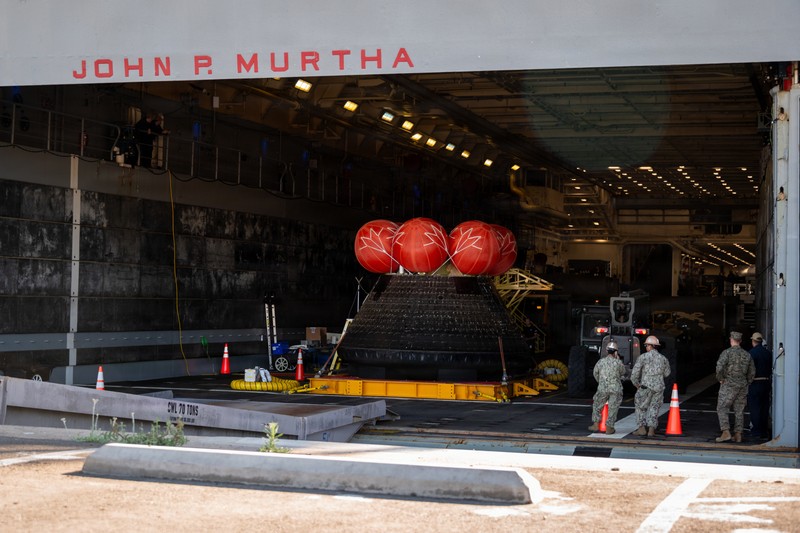
So when Wiseman and Glover peered over the edge of their capsule — named Integrity — aboard the Navy recovery ship, they were looking for trouble.
Wiseman said he and Glover “maybe saw two moments of a touch of char loss” during the descent, referring to small bits of the shield’s outer layer peeling away. Once aboard the ship, they spotted a little charred material missing from what Wiseman called the “shoulder,” where the heat shield curves to meet the capsule body.
“For four humans just looking at the heat shield, it looked wonderful to us,” Wiseman said. “It looked great, and that ride in was really amazing.”
NASA Administrator Jared Isaacman reviewed underwater photos of the heat shield shortly after splashdown and was more blunt: “No chunks missing.”
“The heat shield performed as expected, and I’m thrilled, because now we’re done with this thing,” Isaacman told Reuters.
Detailed inspections will come later, once the capsule is trucked back to Kennedy Space Center. Wiseman promised engineers would “fine-tooth comb every single, not even every molecule, probably every atom on this heat shield.”
Thirteen Minutes and Falling
Glover described re-entry as “a very intense 13 minutes and 36 seconds.”
NASA reported the capsule hit the atmosphere at roughly 24,664 mph, or about Mach 32 — just 130 mph short of the Apollo 10 speed record set in 1969. But Glover said Orion’s onboard screens registered Mach 38.89, roughly 29,839 mph. NASA may release a revised number, he said, because measuring velocity in space is inherently difficult.
After atmospheric friction bled off speed, a first set of parachutes slowed the capsule before detaching ahead of the final chutes. For a few seconds, the crew was in free fall.
“We went back to free fall,” Glover said. “I’ve never been BASE jumping, I’ve never been skydiving, but if you dove off a skyscraper backwards, that’s what it felt like.”
Then the main chutes deployed. The capsule touched down at a gentle 17 mph.
What Comes Next
Artemis II was a test flight — no lunar landing, no boots on regolith. Its purpose was to prove Orion could carry humans to the Moon and bring them home alive. On that measure, the mission succeeded.
The next flight, Artemis III, is planned for next year and will test lunar landers built by SpaceX and Blue Origin in Earth’s orbit. A crewed Moon landing could follow as soon as 2028, though engineering challenges with both landers could push that date back.
Wiseman, for one, sees no reason to wait. In his view, NASA could mount the Artemis III Orion capsule on its Space Launch System rocket “tomorrow” and the crew would be in fine shape.
The View From 250,000 Miles
The engineering story dominated the press conference, but the astronauts also struggled to articulate what they had witnessed. Flying over the Moon’s far side, out of radio contact with Earth for 40 minutes, the crew photographed terrain no human had laid eyes on since 1972.
Then the Moon passed between Orion and the Sun, producing a solar eclipse visible only from deep space — a ghostly corona ringing the lunar horizon.
“I turned to Victor and I said I don’t think humanity has evolved to the point of being able to comprehend what we’re looking at right now,” Wiseman said. “It was otherworldly.”
Hansen, the first Canadian to fly beyond low-Earth orbit, described stars appearing in three dimensions — a depth he had never perceived from the ground. Koch said that in the days since returning, she kept feeling as though she was still floating, gravity notwithstanding.
The crew has spent the past week in medical testing — balance, vision, muscle strength — with no time yet to fully absorb the experience. After splashdown, Wiseman sought out the recovery ship’s chaplain. “I am not really a religious person,” he said, “but there was no other avenue for me to explain anything or to experience anything.”
Fifty-four years after the last Apollo astronauts came home, humanity went back around the Moon. The headline is that the ship held together. That tells you something about how hard this still is.
Sources
- Artemis astronaut describes charring on heat shield during crew’s fiery return to Earth — Channel News Asia / Reuters
- Artemis II astronauts still awed by moonshot experience: “It was otherworldly” — CBS News
- Artemis II astronauts praise their moonship’s performance, especially the heat shield — ABC News Australia
Discussion (10)