 lop News
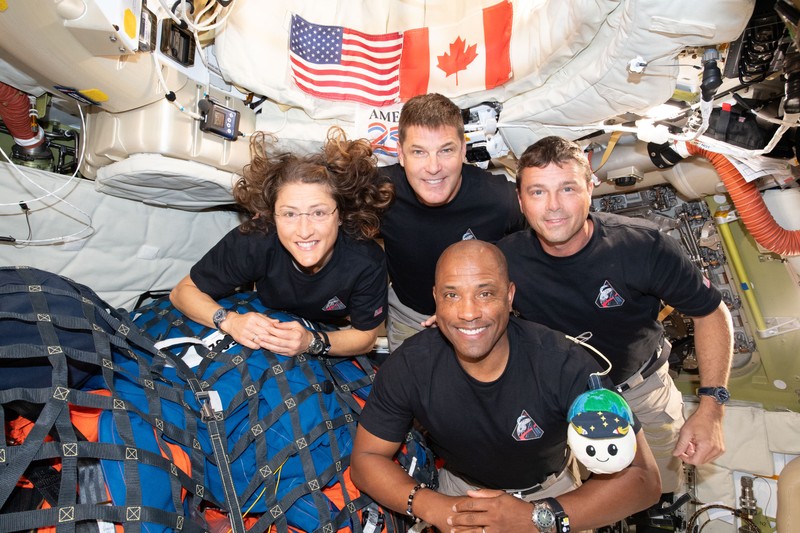
The Pacific Ocean caught them at last. Four astronauts, a capsule named Integrity, and nine days of history — including the farthest any human has ever traveled from Earth — splashed down off the coast of San Diego late on April 10, concluding the first crewed mission beyond low-Earth orbit in over half a century.
Commander Reid Wiseman, pilot Victor Glover, mission specialist Christina Koch, and Canadian Space Agency astronaut Jeremy Hansen were recovered by US Navy divers and flown to a waiting vessel for initial medical checks. From there, they return to NASA’s Johnson Space Center in Houston. The Orion spacecraft, its heat shield still warm from the fastest and hottest crewed reentry since Apollo 13, will be recovered intact for inspection by NASA engineers.
The numbers alone are striking. At their farthest point, the crew reached 406,771 kilometers from Earth — roughly 252,756 miles — surpassing the record set by Apollo 13 in 1970, according to Deutsche Welle. Hansen became the first person not from the United States to travel to deep space. The crew observed parts of the Moon’s far side that no human had ever seen in sunlight.
But the mission’s most important cargo may be invisible. It is the radiation data embedded in four human bodies.
‘Human minds should not go through what these just went through’
For the crew, the lunar encounter was an experience that defied easy description.
“I’m actually getting chills right now just thinking about it. My palms are sweating,” Wiseman told reporters during a long-distance press conference on Wednesday, as quoted by Ars Technica. “But it is amazing to watch your home planet disappear behind the Moon. You can see the atmosphere. You could actually see the terrain on the Moon projected across the Earth as the Earth was eclipsing behind the Moon. It was just an unbelievable sight, and then it was gone. It was out of sight.”
At their closest approach to the Moon, roughly 6,400 kilometers from the surface, the astronauts flew into lunar shadow and a 40-minute radio blackout. Out of contact with Earth, farther from home than any humans had ever been, they paused. They shared maple cookies Hansen had brought from Canada. They reflected. Then they went back to work.
“We took about three or four minutes, just as a crew, to really reflect on where we were, and then it was right back into the science,” Wiseman said. “We still haven’t even begun to reflect on this mission. […] Human minds should not go through what these just went through, and it is a true gift.”
Glover described the shadow of the Moon as one of the “greatest gifts” of the entire mission.
Science in real time
The lunar flyby — a nearly seven-hour stretch of continuous observation — yielded discoveries that had researchers at Johnson Space Center cheering out loud.
According to reporting from Nature, scientists monitoring the flyby let out “audible screams of delight” when Wiseman reported seeing multiple impact flashes: brief bursts of light caused by tiny meteorites striking the lunar surface. The crew confirmed these were distinct from cosmic-ray flashes, which astronauts learn to recognize during prolonged time in orbit. “I definitely see a dozen or two every night when I’m going to sleep,” one crew member told researchers during a follow-up call. “The impact flashes were absolutely different.”
The astronauts also reported seeing green and brown hues on the lunar surface, rather than the expected grays. They described mountains, cliffs, and formations shaped like human handprints and dinosaur footprints. Toward the end of the flyby, they witnessed a total solar eclipse lasting nearly an hour — the Moon passing between their spacecraft and the Sun, an ethereal glow radiating into the surrounding blackness.
“There’s absolutely no words to describe what we are looking at out this window,” Wiseman told mission control.
NASA planetary geologist David Hollibaugh Baker, who helps to lead archiving of the mission’s data, described seeing the first processed photographs. “I opened up the door, and there was the Moon,” he told Nature. “My heart was racing […] I never felt that kind of rush before.”
The data they carry home
Beneath the celebration lies a reality that NASA does not soft-pedal: deep space is hostile to human biology in ways that no spacecraft can fully shield against.
During their transit beyond Earth’s protective magnetosphere, the Artemis II crew was exposed to cosmic radiation at levels significantly higher than what astronauts experience on the International Space Station. NASA is reportedly anxiously awaiting the opportunity to study the crew’s health data, which could shed critical light on the long-term risks of deep-space travel.
This is the bargain at the heart of the Artemis program. The astronauts volunteered not only to travel farther than anyone before them but to serve as living instruments — their cells, chromosomes, and organ systems cataloging the damage that deep-space radiation inflicts on a human body. The data they bring back will shape how NASA plans Artemis III and, eventually, crewed missions to Mars.
Radiation exposure remains one of the primary unsolved obstacles to long-duration spaceflight. Beyond the Van Allen belts, astronauts face elevated risks of cancer, cardiovascular disease, and central nervous system damage. Every crew that ventures beyond low-Earth orbit adds to the dataset. The four astronauts of Artemis II have just contributed the most significant data points in over fifty years.
The road to the surface
A clean splashdown was non-negotiable for NASA’s timeline. Without a successful return, the agency would not have moved forward with Artemis III — the mission intended to land humans on the lunar surface for the first time since Apollo 17 in 1972.
That path is now open. Artemis III is expected to deliver two astronauts to the Moon’s south polar region, where water ice could sustain a permanent human presence.
Before that, though, there are the smaller, stranger details of a nine-day trip around the Moon. There were intermittent problems with the Orion capsule’s toilet — which the British band Glass Animals playfully claimed responsibility for, after a 2024 visit to Kennedy Space Center during which their lead singer apparently lost a vial of his own tears inside the capsule. There was the wake-up playlist the crew assembled with their families: Chappell Roan’s Pink Pony Club, Tokyo Drifting by Glass Animals and Denzel Curry, Under Pressure by Queen and David Bowie. Curry declared himself “the First Rapper Played in Space.”
Koch — who once learned to play a song on the keyboard aboard the International Space Station as an anniversary present for her husband — told Canadian Prime Minister Mark Carney this week that the wake-up songs were “absolute perfection,” though she objected that Pink Pony Club was cut off before the chorus.
Wiseman said Tokyo Drifting reminded him of his daughters and their annual vacation to Florida. A familiar song, a quarter-million miles from home.
The Artemis program is framed as humanity’s return to the Moon. Its deeper purpose is slower and more painstaking: learning, body by body, what space does to the people we send there — and whether we can one day send them farther.
Discussion (15)