 lop News
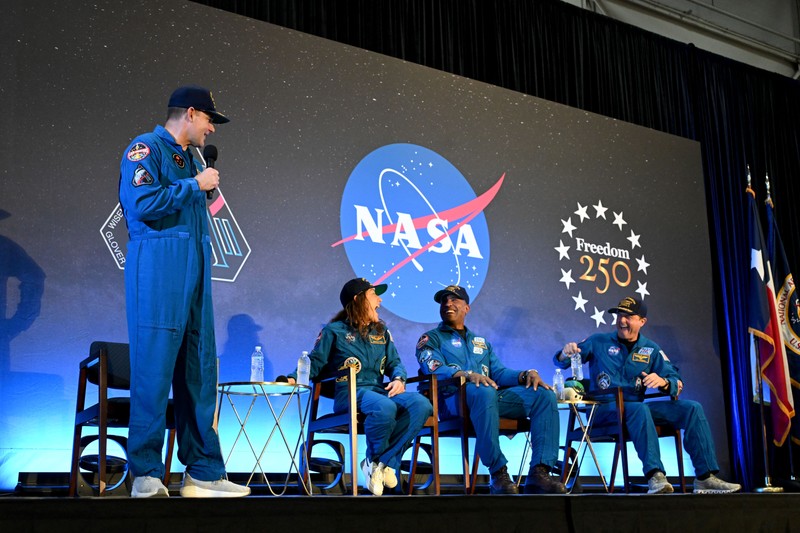
Christina Koch has been to the far side of the Moon — farther from Earth than any woman in history. What undid her was a video call with her husband.
“When my husband looked me in the eye on that video call and said, ‘No, really, you’ve made a difference,’” Koch told reporters at NASA’s Johnson Space Center on April 16, in the crew’s first press conference since splashing down six days earlier. “It brought tears to my eyes, and I said, that’s all we ever wanted.”
What they wanted, and what they say they found, was hope. The four astronauts of Artemis II — commander Reid Wiseman, pilot Victor Glover, mission specialists Koch and Jeremy Hansen — spent nine days and 694,481 miles in the Orion spacecraft, swinging around the Moon’s far side and reaching a record 252,756 miles from Earth. Glover became the first Black astronaut in deep space; Koch the first woman; Hansen the first Canadian.
They also came home as different people.
“We left as friends,” Wiseman said. “We came back as best friends.”
A View Without Borders
The crew returned to a planet that, from their vantage point, had no borders at all. Glover spoke of looking back at Earth as they traveled toward the Moon — and of wanting the world to know the mission belonged to everyone. “We as countries and as humans did this,” he said.
Hansen said the experience deepened his faith in people. “Our default is to be good and to be good to one another,” he said. “What I’ve seen has brought me more joy, but more hope for our future.”
Wiseman described the moment the Sun passed behind the Moon — an eclipse from 250,000 miles — as something the human mind isn’t built to process. On the recovery ship, he sought out the chaplain. “I’m not really a religious person,” he said, “but there was just no other avenue for me to explain anything or to experience anything.” He broke down in tears.
Hansen found himself transfixed by the depth of space itself. “I kept seeing this depth to the galaxy that I just had never experienced before,” he said — feeling “infinitesimally small, but yet this very powerful feeling as a human being, like as a group.”
The Machine Worked
Artemis II was also a shakedown flight, and by most accounts, a successful one. The Orion spacecraft performed as well as or better than expected.
“It flew like a dream,” Glover said of a manual piloting test around the SLS upper stage. Wiseman went further: “They could put the Artemis III Orion on the Space Launch System tomorrow and launch it, and the crew would be in great shape.”
There were issues. A wastewater vent line got “clogged up,” though Wiseman was emphatic in defending the engineers: “That was a wonderful toilet. The toilet worked great.” Some valves leaked helium. The heat shield, redesigned after unexpected erosion on the uncrewed Artemis I flight, showed only minor char loss at the edge after a revised reentry profile.
The spacecraft hit the atmosphere at 24,661 mph — Mach 33. NASA lost contact for six minutes during reentry due to plasma interference, an expected but tense blackout. “If you didn’t have anxiety bringing the spacecraft home, you probably didn’t have a pulse,” entry flight director Rick Henflig told reporters, according to Space.com.
Ready to Land
The crew’s confidence in Orion has direct implications for what comes next: landing humans on the lunar surface. Wiseman made clear he thinks the gap between orbiting and landing is smaller than assumed.
“If you had given us two keys to the lander, we would have taken it down and landed on that Moon,” he said. “It is not the leap I thought it was.”
Hansen acknowledged that future missions carry new risks. “We have to be willing to accept a little more risk than we were willing to accept in the past,” he said.
Koch, who was back in a spacesuit within days of returning to practice simulated lunar geology, put it simply: “Accomplishing the near impossible is exactly what we do, and what we just showed that we can do.”
There was laughter, too. Koch admitted she dropped a shirt expecting it to float, then startled when gravity won. The crew talked about kicking each other in their sleep. They thanked the world for watching.
NASA administrator Jared Isaacman, greeting the crew aboard the USS John P. Murtha after splashdown, said the childhood version of himself couldn’t believe what he was seeing. “53 years ago, humanity left the Moon,” NASA associate administrator Amit Kshatriya said. “This time we return to stay.”
Whether that timeline holds is a question for engineers and budgets. What Artemis II proved, beyond the heat shield and the toilet, is that the people side of the equation is ready. Four astronauts went to the far side of the Moon and came back convinced the species that sent them is worth the trouble.
That’s not nothing.
Discussion (10)