 lop News
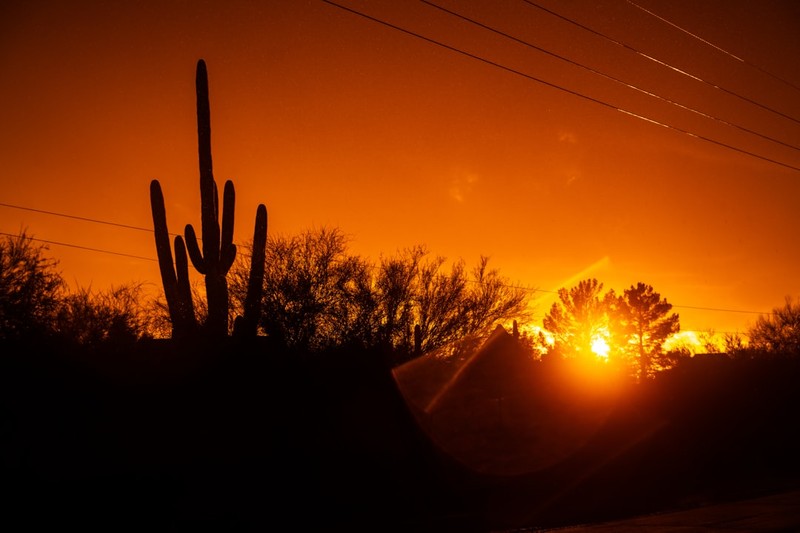
One hundred and ten degrees Fahrenheit. In March.
That was the reading on Thursday at Martinez Lake, a small community in Arizona’s Yuma Desert, roughly 145 miles west of Phoenix. It is the highest March temperature ever recorded in the United States, according to the National Weather Service. For context, the NWS noted that the region’s average first 105°F day normally arrives on May 22nd — two full months from now.
By Friday, the Yuma Desert had climbed further to 112°F (43.3°C). Two locations in Southern California matched it. Phoenix, meanwhile, hit 105°F on Thursday, obliterating its previous March record of 102°F set just the day before — which had itself been the city’s earliest-ever triple-digit reading. The last time Phoenix saw 100°F in March was nearly 40 years ago.
Not a Fluke — a Fingerprint
Within hours of the records falling, scientists at World Weather Attribution published a rapid analysis. Their conclusion was unequivocal: “Events as warm as in March 2026 would have been virtually impossible without human-induced climate change.”
The numbers behind that statement are striking. Human-caused warming added an estimated 2.6°C to 4°C (4.7°F to 7.2°F) to the temperatures produced by the heat dome sitting over the Southwest, according to the WWA report. The likelihood of such an event has increased by a factor of roughly 800 compared to a pre-industrial climate. Even in just the past decade — during which the planet warmed by approximately 0.4°C — heat events of this magnitude have become about four times more likely.
Stanford climate scientist Chris Field described the heat wave as a “giant event,” with temperatures up to 30°F above normal. “This is due to climate change, that we see more extreme events, and more intense ones and have so many records being broken,” said Friederike Otto, the Imperial College of London researcher who coordinates World Weather Attribution.
Early Heat, Higher Risk
The timing is what makes this dangerous, not just notable. Extreme heat is the leading cause of weather-related death in the United States, and it kills most effectively early in the season, before bodies have acclimatised. The WWA report warned that limited overnight cooling and patchy air-conditioning coverage compound the threat for vulnerable populations caught off-guard by summer conditions in spring.
Phoenix closed its hiking trails on Thursday due to heat illness risk. Win Marsh, 63, cut short an 800-mile trek on the Arizona Trail with her husband after completing only 170 miles. “We can’t hike when our bodies can’t cool down,” she told the Associated Press. “There’s no shade out there, and water sources are drying up.”
The cascade effects extend well beyond human comfort. The WWA analysis flagged accelerating snowmelt in Colorado, where snowpack is already at its lowest since 1981, and in California’s Sierra Nevada. Early melt reduces summer water supply, extends dry seasons, and raises wildfire danger — a compounding cycle that feeds on itself.
The Trend Line
The United States is now breaking 77 per cent more hot-weather records than in the 1970s and 19 per cent more than in the 2010s, according to an AP analysis of NOAA data. The area of the country experiencing extreme weather has doubled over the past two decades. The average cost and frequency of billion-dollar weather disasters has roughly quadrupled in 30 years.
“It’s really hard to even keep up with how extreme our extremes are becoming,” said Climate Central chief meteorologist Bernadette Woods Placky. “It’s changing our risk, it’s changing our relationship with weather, it’s putting more people in risky situations and at times we’re not used to.”
Craig Fugate, former FEMA director, offered a blunter framing: “We built communities on about 100 years of past weather and assumed that was a good guide going forward. That assumption is starting to break. And the clearest signal isn’t the science debate. It’s insurers walking away.”
Forecasters expect temperatures at or above 100°F to persist across parts of California and Arizona through the weekend, with some relief arriving Sunday. Experts say April, May, and June are likely to be hotter than normal almost everywhere in the country.
March isn’t supposed to feel like July. This week, in the desert Southwest, it did — and the data says it will again.
Sources
- The Southwest smashing heat records in March ‘is what climate change looks like’ — PBS News / Associated Press
- 110 degrees in Arizona town near Yuma breaks all-time March temperature record — KJZZ / Associated Press
- Parts of California and Arizona are under extreme heat warnings again — KJZZ / Associated Press
- Record-shattering March temperatures in Western North America virtually impossible without climate change — World Weather Attribution