 lop News
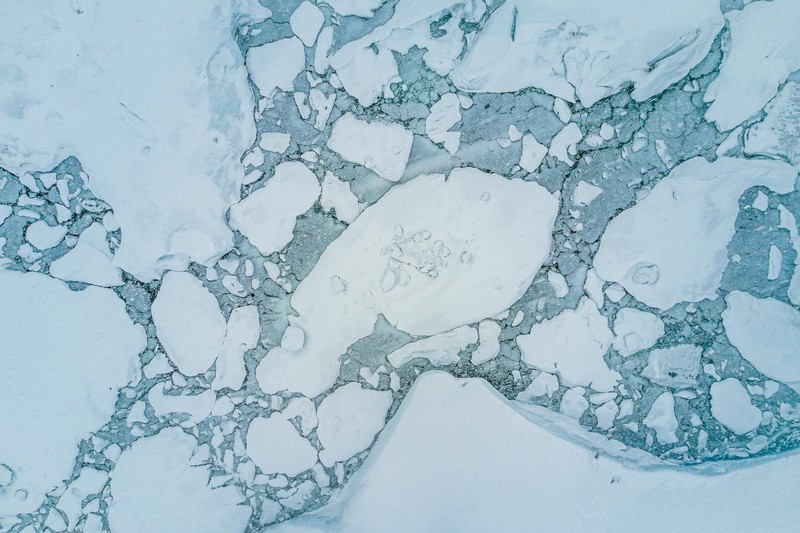
Arctic sea ice reached its winter peak on March 15 at 5.52 million square miles — tying the lowest maximum ever recorded since satellite monitoring began in 1979. The number matters because it sets the starting line for the summer melt season, and this year that line sits roughly half a million square miles below what was considered normal a generation ago.
That gap is roughly twice the size of Texas.
Scientists at NASA and the National Snow and Ice Data Center confirmed the figure this week, noting it is statistically tied with last year’s record low of 5.53 million square miles. The 1981-to-2010 average winter peak was closer to 6.05 million square miles.
“It’s not like we are seeing a regime shift or anything,” said Walt Meier, a senior scientist at the NSIDC. “It’s more of a steady decline in the winter and at the maximum. And it also gives us a head start on the summer melt season. We’re starting from a lower number.”
That steady decline is visible not just in the satellite record of total ice extent but in the ground-level reality of ice that was once locked to Alaska’s coastlines.
The Ice That People Use
Research published in January by the University of Alaska Fairbanks adds specific, measurable weight to the trend. A 27-year analysis of landfast sea ice — the ice that anchors to the coastline rather than drifting with currents — found that the stable-ice season has shortened by 57 days in the Chukchi Sea and 39 days in the Beaufort Sea since 1996.
In the Chukchi, the ice is arriving later and leaving earlier. In the Beaufort, the shrinkage comes entirely from later formation: even after air temperatures drop below freezing in fall, the ocean is staying warm longer, delaying the freeze along the coast.
“Landfast ice is the ice that is used by people,” said Andrew Mahoney, the University of Alaska research professor who led the study. “It has a much more immediate connection with humans.”
Coastal communities travel across the stable ice to hunt and fish. The oil and gas industry uses it to build seasonal ice roads. The ice also shields shorelines from waves. When it retreats, erosion accelerates and hunting conditions become more uncertain.
The percentage of total landfast sea ice on the US Outer Continental Shelf dropped from 3.8 percent in the first nine years of Mahoney’s record to 2 percent in the most recent nine years, 2014 through 2023.
Thinner Ice, Fewer Anchors
The Beaufort Sea had been something of a holdout. While landfast ice retreat had been documented in other parts of the Arctic for decades, the Beaufort remained relatively stable from the 1970s through the early 2000s. That has changed. Mahoney and co-author Andrew Einhorn found that Beaufort landfast ice is no longer extending as far from shore as it once did — previously reaching waters near 20 meters deep annually.
The researchers suspect the cause is the overall thinning of Arctic sea ice. Thinner ice produces fewer grounded ridges — jumbles of ice blocks pushed toward the coast, thick enough to sit on the seafloor and anchor the landfast pack in place.
“We are seeing evidence that grounded ridges are not forming where they used to,” Mahoney said.
NASA’s ICESat-2 satellite data corroborates the thinning trend. Nathan Kurtz, chief of the Cryospheric Sciences Laboratory at NASA’s Goddard Space Flight Center, said much of the Arctic ice is thinner this year, particularly in the Barents Sea northeast of Greenland.
What the Melt Season Inherits
The summer melt season, which culminates in a September minimum, is the period scientists watch most closely. Less ice reflecting sunlight means more heat absorbed by dark ocean water, which in turn warms the Arctic further — a feedback loop that compounds decade over decade.
A low winter maximum does not guarantee a record summer low; winter ice extent is more variable and weather-dependent. But it tilts the odds. As Meier put it, the winter maximum is “a climate change global warming signal.”
The heat has not been limited to the Arctic. March temperature records fell across the United States, Mexico, Australia, Northern Africa, and parts of Northern Europe. Climatologist Maximiliano Herrera, who tracks extreme temperatures, called it “by far the most extreme heat event in world climatic history.” Sixteen US states broke March records in roughly the past week, according to weather historian Chris Burt.
None of this surprised the scientists who study it. The models predicted steady Arctic decline. The data is confirming it — on schedule, and in some respects, ahead of it.
Discussion (9)