 lop News
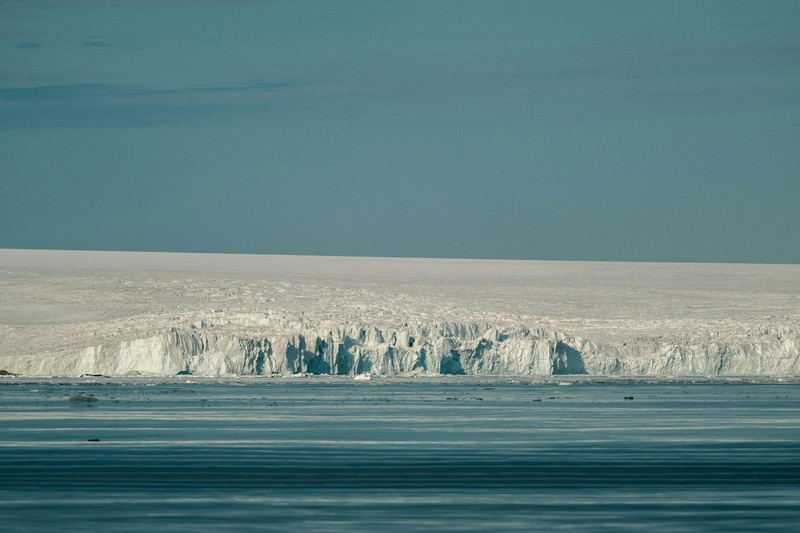
The ocean doesn’t just receive meltwater from Antarctic ice shelves. It digests it, reorganizes itself, and sends warmer water back underneath the ice to start the process again. That feedback loop — absent from the climate models that inform international policy — may be adding as much to sea level rise as the warming atmosphere itself.
A study published today in Nature Geoscience by University of Maryland scientist Madeleine Youngs and colleagues identifies a self-reinforcing cycle that current projections essentially ignore. The finding arrives alongside two other recent studies that, taken together, paint a picture of Antarctic ice loss driven far more by complex ocean dynamics than scientists previously understood.
How the Ocean Eats an Ice Shelf
The mechanics are deceptively simple. Cold, dense water naturally sinks near Antarctica and forms a barrier layer on the ocean floor, blocking warmer deep currents from reaching the base of floating ice shelves. When meltwater pours in from above, it dilutes that cold barrier. Warmer water pushes through. More ice melts from below. More freshwater flows in. The cycle feeds itself.
“It’s a positive feedback loop where more melt leads to warmer water reaching the ice, which causes even more melt,” Youngs said.
In the Weddell Sea, this loop amplifies dangerously. Upstream melt erodes the cold-water barrier and warm water floods through, accelerating further loss.
But the picture is not uniformly dire. In the Amundsen Sea — home to Thwaites Glacier, the so-called Doomsday Glacier — meltwater flowing westward from upstream forms a cold freshwater barrier that temporarily shields the ice. Youngs described this as a negative feedback loop, offering short-term protection that depends on massive upstream melting happening first.
“Our study suggests that these regions—usually regarded as the most at-risk—are actually more protected than we thought, at least in the short term, because of this negative feedback loop,” Youngs said. “But this protection depends on massive upstream melting happening first, and that upstream melt has its own severe consequences on sea levels.”
Hidden Channels, Sharper Measurements
The Youngs study is not the only recent work revealing hidden mechanisms beneath Antarctic ice. A separate study led by Tore Hattermann of Norway’s iC3 Polar Research Hub, published in Nature Communications, found that deep channels carved into the undersides of ice shelves can trap warm water and intensify melting by roughly an order of magnitude in localized areas. The research focused on the Fimbulisen Ice Shelf in East Antarctica — a region generally considered less vulnerable.
“What is striking is that even modest inflows of warmer deep water can have a large effect when the ice shelf base is channeled,” said Qin Zhou, who co-led the study.
A third study, published in Nature Climate Change by researchers at UC San Diego’s Scripps Institution of Oceanography, used 50-meter-resolution satellite mapping to show that channelized melting had been undercounted by 42 to 50 percent — a correction large enough to reshape how scientists think about ice shelf stability.
What This Means for 680 Million People
The IPCC currently estimates that Antarctic ice melt could contribute 28 to 34 centimeters of additional sea level rise by 2100 under high-emissions scenarios. Those numbers, according to Youngs, do not account for the feedback loops her team identified.
“Most current climate models that inform international policy don’t consider this feedback loop at all,” she said. “The Intergovernmental Panel on Climate Change (IPCC) treats melting as a fixed, rather than interactive input.”
Over 680 million people live in low-lying coastal zones vulnerable to sea level rise, according to the study. Even a modest increase beyond current projections would expand the reach of storm surges and permanent flooding in cities from Miami to Mumbai. Antarctica currently contributes roughly 0.3 to 0.5 millimeters per year to global sea level rise, according to recent assessments, but that rate is expected to grow.
The Next IPCC Assessment
The timing matters. The IPCC’s next major assessment cycle will incorporate new climate models, and the Youngs team’s work — along with the Hattermann and Scripps studies — directly challenges the framework those models have used. Treating ice shelf melt as a static input rather than a dynamic process that reshapes ocean circulation means the models have been solving a simpler problem than the one actually unfolding beneath Antarctica.
Youngs’ team is already developing higher-resolution simulations that incorporate meltwater feedback processes, tracing trajectories from today through 2100 with a focus on identifying which ice shelves are closest to tipping points.
“The next step is understanding exactly when and where things tip—and what that means for all of us,” Youngs said.
Sources
- Scientists identify hidden accelerant in Antarctic ice loss — EurekAlert! / University of Maryland
- Antarctica is melting from below and scientists say it’s worse than expected — ScienceDaily / iC3 Polar Research Hub
- Study warns Antarctic ice shelves melt from below as ocean heat pushes in — MSN / Morning Overview
Discussion (10)