 lop News
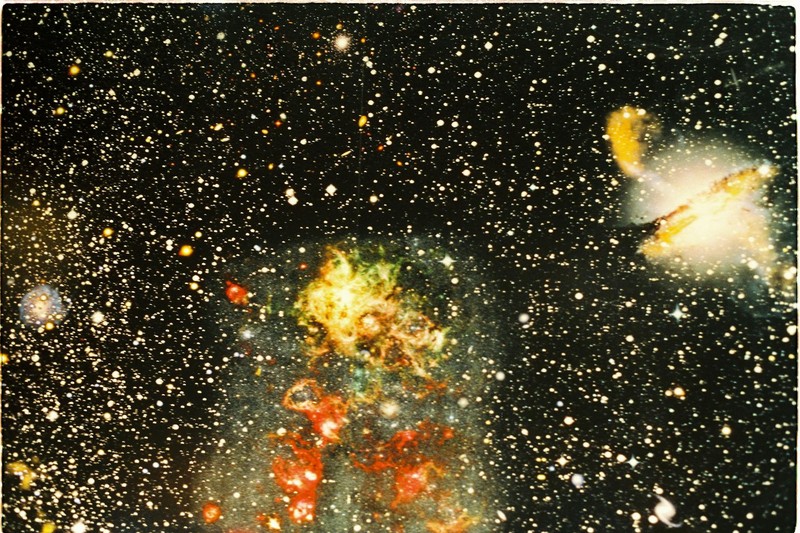
Most galaxies spin. It is one of the first things you learn in astrophysics: as clouds of gas collapse under gravity, conservation of angular momentum sets them rotating, and that orderly spin sticks around for billions of years. So when Ben Forrest and his colleagues pointed the James Webb Space Telescope at a galaxy from when the universe was less than 2 billion years old, they expected to see rotation.
They didn’t.
“This one in particular did not show any evidence of rotation, which was surprising and very interesting,” said Forrest, a research scientist at UC Davis and first author of a paper published May 4 in Nature Astronomy.
The galaxy, catalogued as XMM-VID1-2075, sits at a redshift of 3.449 — meaning we see it as it was when the cosmos was a fraction of its current age. It is already massive, hosting several times as many stars as the Milky Way, and it had already stopped forming new ones. But the clincher is its internal motion: the stars aren’t orbiting in any coordinated way. They’re churning about randomly, a signature called “dispersion-dominated kinematics.”
That is a trait astronomers associate with the most massive, evolved galaxies in the nearby universe — systems that took billions of years and multiple mergers to scramble their spin. Finding it so early suggests something unusual happened.
One possibility: a single head-on collision between two galaxies spinning in roughly opposite directions, cancelling out most of the angular momentum in one dramatic event. The team spotted what looks like a large excess of light off to one side of the galaxy, consistent with a smaller object that recently plowed through it.
Forrest’s team, part of the MAGAZ3NE survey, observed three ancient galaxies in total. One rotates clearly, one is “kind of messy,” and one — XMM-VID1-2075 — stands still. The researchers are now hunting for more slow rotators in the early universe, which would help determine whether this galaxy is a fluke or a clue that galaxy formation happened faster and more chaotically than our models predict.
Sources
- Non-Rotating Early Galaxy Is a Surprise to Astronomers — UC Davis
- A massive and evolved slow-rotating galaxy in the early Universe — Nature Astronomy
Discussion (5)