 lop News
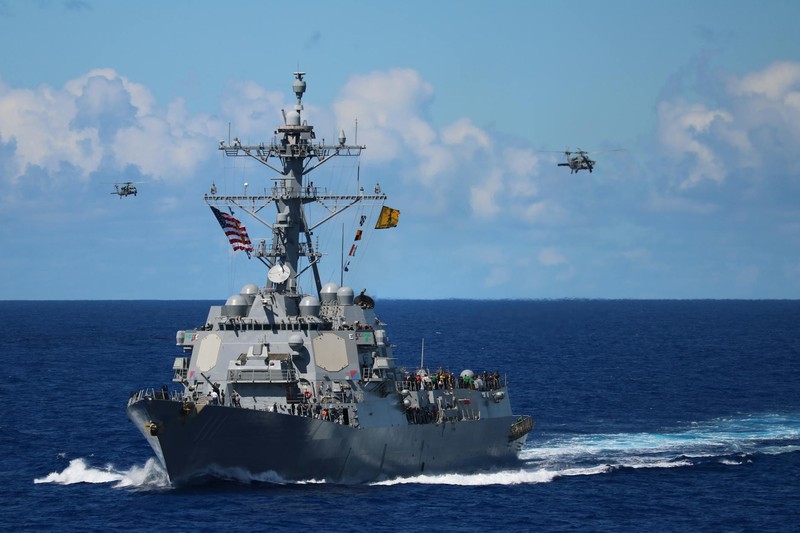
$1.85 billion is what the Pentagon wants to spend — not on warships, but on studying whether the United States can still build enough of its own.
The proposed FY2027 budget includes the sum for a pair of feasibility studies on whether allied shipyards in Japan and South Korea could design and build frigates and destroyers for the US Navy, according to USNI News. If the idea proceeds, it would mark the first time Washington has purchased a major surface combatant from a foreign partner since the late 19th century, when the Navy acquired two cruisers from British shipbuilder Armstrong Whitworth.
The study’s very existence is the story. A superpower allocating $65.8 billion to shipbuilding in a single year is conceding it cannot produce warships fast enough to meet its own strategic requirements.
The Hulls in Question
The studies will examine whether to adopt or co-produce advanced designs already in service with allied navies. Japan’s Mogami-class frigate — a 5,500-tonne stealth hull with a high degree of automation — and South Korea’s Daegu-class, a 3,600-tonne vessel with silent propulsion, are the leading candidates, according to the South China Morning Post. Both carry US-standard systems, including the MK-41 vertical launching system.
South Korea and Japan also field guided-missile destroyers built around the American-designed Aegis combat system and AN/SPY-1 radar — the same backbone powering the Navy’s Arleigh Burke-class destroyers.
The appeal is straightforward. Allied yards in East Asia deliver capable hulls faster and cheaper than American shipbuilders, who face a chronic skilled-labor shortage and persistent schedule overruns. The Constellation-class frigate program, based on an Italian design, was canceled after costly modification overruns showed the difficulty of adapting foreign blueprints to stricter US survivability standards. Every current Navy newbuild class is behind schedule.
The Finland Model
The Pentagon’s working template is what Office of Management and Budget director Russ Vought called the “Finland model” at the Navy League’s Sea-Air-Space symposium on April 22. The Coast Guard recently contracted Finnish shipyards to build the first four hulls in a new class of medium icebreakers, with the remaining seven to be constructed in the US by Bollinger and Davie after those firms invested in modernizing American facilities.
Korean and Canadian shipbuilders have followed Italian and Australian companies in establishing US subsidiaries. Hanwha acquired the Philly Shipyard in Philadelphia and is actively pursuing Navy contracts. HD Hyundai Heavy Industries and Hanwha Ocean have already secured three maintenance and repair deals with the US Navy in 2026, according to The Chosun Daily.
“If we cannot get the ships we need from traditional sources at cost and on time, we will get them from other shipyards,” Vought said.
Political and Legal Headwinds
Federal law restricts warship construction to American yards unless the president grants a national security waiver. Any foreign-build program would need congressional approval — and domestic shipbuilders are pushing back.
“We don’t need to spend millions of taxpayer dollars to study what we already know; the US has the industrial strength, skilled workforce, and technical expertise to build and sustain America’s maritime force,” Shipbuilders Council of America president Matthew Paxton said in a statement.
The study request arrives amid upheaval in Navy leadership. Secretary of the Navy John Phelan was removed from his post on April 22, with The Maritime Executive reporting the dismissal stemmed from frustration over the pace of shipbuilding reform. Days earlier, Phelan had publicly acknowledged the challenge. “Everything’s on the table,” he told reporters. “We just need to look at it, understand it, understand the implications behind it and decide if we think that makes sense or not.”
The Pacific Arithmetic
The Navy’s fleet sits at roughly 300 ships. The stated goal is 381 over the next three decades. The FY2027 budget requests 18 battle force ships and 16 auxiliary vessels under President Donald Trump’s Golden Fleet initiative.
Whether American industry can sustain that production cadence is an open question with direct consequences for the western Pacific, where the strategic rationale for a larger fleet is sharpest. The decision to look to Japan and South Korea is shaped by geography as much as industrial necessity: both nations sit inside the theater where the Navy needs more hulls, and both have proved they can produce them.
The $1.85 billion study does not guarantee a single foreign-built warship will join the fleet. But the direction of travel is unmistakable. Washington is preparing to treat warship construction the way it already treats semiconductor manufacturing and rare-earth processing — as a strategic capability too important to leave entirely in domestic hands.
Sources
- U.S. Considering Foreign Designs, Shipyards for New Navy Frigate, Destroyer Work in $1.85B Study — USNI News
- US Navy Wants to Spend $2B on Foreign Shipbuilding ‘Study and Procurement’ — The Maritime Executive
- Navy ‘going to study’ possibility of building ships outside US, Phelan says — Navy Times
- Pentagon mulls plan to outsource warship design and building to South Korea, Japan — South China Morning Post
Discussion (10)