 lop News
Roughly 425. That is how many JASSM-ER cruise missiles the United States will have available for the entire rest of the globe once the next phase of the Iran campaign begins — out of a prewar inventory of 2,300.
The order to drain Pacific stockpiles of the $1.5 million stealth weapon was issued in late March, according to a person with direct knowledge of the matter. Missiles stored at facilities across the continental US and the Indo-Pacific will be relocated to Central Command bases or RAF Fairford in the United Kingdom.
The United States is, in effect, betting the Pacific will stay quiet while the Middle East burns.
A Missile Built for China, Spent on Iran
The Joint Air-to-Surface Standoff Missile-Extended Range was engineered for the confrontation the Pentagon has spent two decades preparing for: penetrating sophisticated air defenses at ranges exceeding 600 miles. It is the weapon you fire when the adversary can shoot back.
Iran’s air defenses, though degraded by five weeks of US-Israeli strikes, have not been eliminated. An American F-15E Strike Eagle was shot down on Friday. An A-10 was downed shortly afterward, and two combat search-and-rescue helicopters were hit by Iranian fire, the New York Times reported. Iran has destroyed more than 12 MQ-9 Reaper drones since the war began on February 28.
President Donald Trump declared in a Wednesday address that Iran’s radar was “100% annihilated” and that the US was “unstoppable as a military force.” Friday’s losses contradicted that claim.
Through the first four weeks of operations, US forces consumed more than 1,000 JASSM-ERs, according to the same source. Another 47 were fired during the raid to capture Venezuelan President Nicolás Maduro. Including the shorter-range baseline JASSM, roughly two-thirds of total US stockpiles have been committed to the Iran campaign.
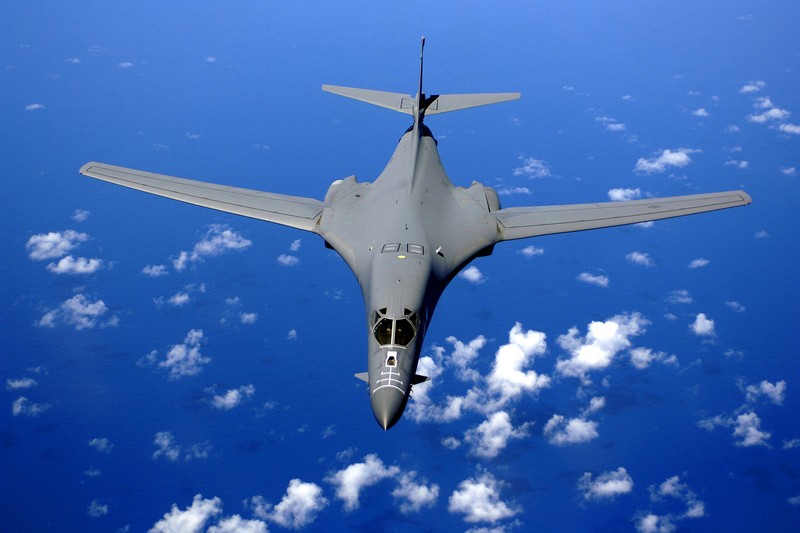
After the transfers, the remaining 425 JASSM-ERs would arm roughly 17 B-1B bombers on a single sortie. Another 75 are unserviceable due to damage or technical faults.
The Production Bottleneck
Replacing what has been spent is not a matter of writing a check. Lockheed Martin’s scheduled JASSM-ER production rate for 2026 is 396 missiles. The manufacturing line can reach 860 if fully dedicated and shifted away from the LRASM anti-ship missile — but even at maximum capacity, replacing 1,000 expended weapons takes over a year.
The shortfall extends across the arsenal. The US has fired hundreds of Tomahawk cruise missiles at Iranian targets. Before the war, total Tomahawk stockpiles stood at roughly 4,000 across all variants. RTX produced about 100 new Tomahawks in 2025 and upgraded 240 older models to the latest standard.
Defensive interceptors are being consumed faster still. Iran has launched more than 1,600 ballistic missiles and approximately 4,000 Shahed-type cruise missiles during the war, according to Gulf state reporting. Defending against the ballistic missiles alone would require at least 3,200 interceptors. Lockheed Martin currently produces about 650 Patriot PAC-3 interceptors per year, with plans to reach 2,000 annually by 2030.
Kelly Grieco, a senior fellow at the Stimson Center, noted that the Pentagon’s belated introduction of B-52 bombers over Iranian airspace “raises questions about the degree to which the US has continued to rely on standoff capabilities” rather than risk aircraft closer to hostile defenses.
What Beijing Is Calculating
For China’s military planners, the arithmetic is not abstract. A January 2026 Heritage Foundation report warned that high-end US interceptors — the SM-3, SM-6, Patriot PAC-3 MSE, and THAAD — would likely be exhausted within days of sustained combat with the People’s Liberation Army. Some systems could be depleted after just two or three major salvos.
Aggregate US vertical launch system inventories, estimated at 17,000 rounds, are insufficient for even one full fleet reload. Pier-side rearming creates multi-week gaps. Transit times of 14 to 21 days, combined with throughput constraints, risk systemic failure within 30 to 60 days of sustained conflict.
Every JASSM-ER launched at Iran is one that cannot be deployed against China. Every Patriot interceptor fired over Tel Aviv or Manama is one that will not protect a carrier strike group in the Western Pacific.
And China is not merely watching. According to analysis by the Asia Times, Iran has transitioned its military navigation from US GPS to China’s Beidou system, gaining access to encrypted military signals resistant to Western jamming. Beijing’s fleet of 500-plus satellites is reportedly providing Tehran with signals intelligence and tracking US naval movements. China has also supplied supersonic anti-ship missiles and anti-stealth radar.
The two adversaries the Pentagon built its arsenal to deter are the very powers sustaining Iran’s ability to fight.
The Taiwan Question
The Pacific depletion introduces an immediate variable into Taiwan contingency planning. Any Chinese assessment of a potential invasion or blockade of Taiwan would factor in US munitions availability — and that availability has shifted substantially since February.
Japan, South Korea, and the Philippines have deepened security ties with Washington in recent years on the assumption that American military capacity would be present when needed. The Iran war has given them reason to question that assumption.
Trump has not publicly addressed the trade-off. In his Wednesday speech, he promised to bring Iran “back to the stone ages” over the next two to three weeks without specifying what that would mean for Iran’s civilians, military, or government.
French President Emmanuel Macron was blunt this week: the United States “can hardly complain afterward that they are not being supported in an operation they chose to undertake alone.”
The operation was chosen alone. The consequences will not be.
Sources
- U.S. deploys bulk of stealthy long-range missile for Iran war — Fortune (Bloomberg)
- Trump’s go-it-alone certainty confronts the uncertainties of war — AP News
- China watching as US missile stocks drain over Iran — Asia Times
Discussion (10)