 lop News
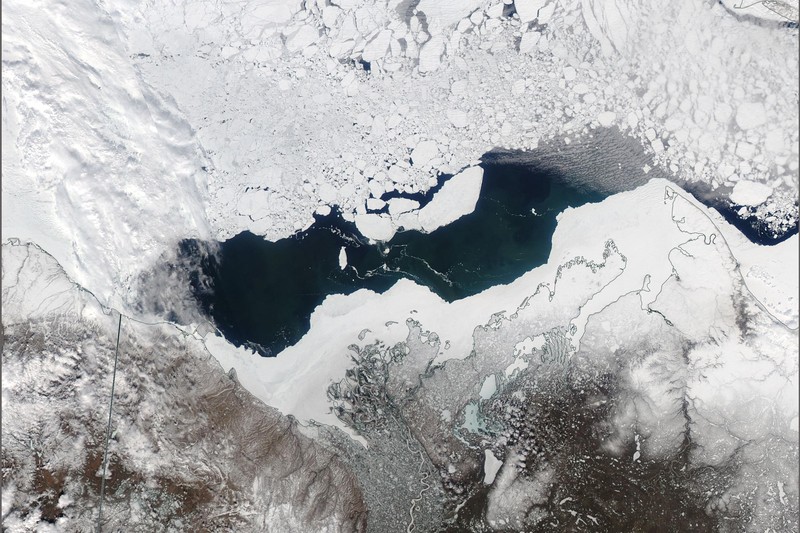
An area of Alaska’s North Slope roughly the size of Wisconsin is thawing, and the rivers running through it are carrying more than water. Dissolved organic carbon locked in permafrost for tens of thousands of years is washing into the Beaufort Sea at accelerating rates, according to a new study published in Global Biogeochemical Cycles — the first to map permafrost thaw across such a vast Arctic region at one-kilometer resolution over 44 continuous years.
The research, led by geoscientist Michael Rawlins at the University of Massachusetts Amherst, draws on daily model simulations spanning 1980 to 2023 across hundreds of rivers and streams on the North Slope. The picture that emerges is one of intensifying hydrological change: subsurface runoff is climbing, the thawing season now stretches into September and October, and previously frozen carbon is being mobilized at scales that current climate models may not fully capture.
Ancient carbon, on the move
The Arctic’s rivers deliver roughly 11% of global river water to an ocean that holds just 1% of the world’s ocean volume, making the region exquisitely sensitive to changes in what that water carries. A related study by the same team, published in The Cryosphere, found that cold-season discharge across the North Slope reached 134% of the long-term average — and spiked to 215% in the Colville River basin. The ratio of subsurface runoff to total runoff increased significantly in 24 of 42 study basins, with the change most prevalent across the northern foothills of the Brooks Range.
These shifts are driven by the deepening of the permafrost’s active layer — the band of soil that freezes and thaws annually. As warming extends deeper into the ground, more groundwater flows through newly thawed soils, picking up dissolved organic carbon, or DOC, along the way. The Arctic already receives a disproportionate share of DOC delivered from rivers to oceans worldwide.
The geography of thaw matters. The largest increases in DOC export are coming from northwestern Alaska, where flat terrain has allowed organic matter to accumulate in permafrost over tens of thousands of years. “It’s flatter over there, which means there’s much more carbon from decaying matter in the permafrost that has been accumulating for tens of thousands of years. This is ancient carbon,” Rawlins said. Further east, where the landscape rises into the Brooks Range and soils become rockier, far less carbon is being released.
A thaw season that won’t stop growing
The active layer’s thawing season has pushed into September and October — weeks beyond historical norms. Meanwhile, the peak spring freshet, the pulse of snowmelt that sends roughly half the year’s freshwater export into the Beaufort Sea in a two-week window, has shifted earlier by approximately 4.5 days.
These changes are likely altering salinity, biogeochemical processes, and food web relationships in the coastal lagoons of the Beaufort Sea, according to the researchers. More than 150 species of migratory birds depend on the region’s food webs, and Indigenous communities in Utqiagvik, Nuiqsut, and Kaktovik rely on the lagoons’ fish populations for subsistence.
Direct observations across the North Slope remain sparse — “nowhere near enough river sample measurements to quantify inputs to estuaries along the entire Alaskan North Slope,” as Rawlins put it. The Permafrost Water Balance Model, which he has developed over 25 years, requires 10 continuous days of supercomputing at the Massachusetts Green High Performance Computing Center for each run to fill in the gaps.
The carbon cycle’s blind spot
The study builds on earlier work by Rawlins and colleagues. In 2024, they modeled 22.45 million square kilometers of Arctic land and projected that over the next 80 years, the region would see up to 25% more runoff and 30% more subsurface runoff, alongside a progressively drier southern Arctic. The new fine-grained analysis suggests those processes are already well underway — and that the land-to-ocean carbon pathway remains a significant gap in climate projections.
“How much DOC finds its way to the ocean via rivers and streams is a part of the carbon cycle we don’t know much about,” Rawlins said. “We desperately need more of these land-to-ocean connection studies if we’re to fully grapple with the problem of global warming and the effects it will have on coastal ecosystems.”
Sources
- A Wisconsin-sized chunk of Alaskan permafrost is thawing; Arctic and global climate may never be the same — EurekAlert! (University of Massachusetts Amherst)
- Thawing Permafrost Affecting Northern Alaska’s Land-to-Ocean River Flows — University of Massachusetts Amherst News
Discussion (8)