 lop News
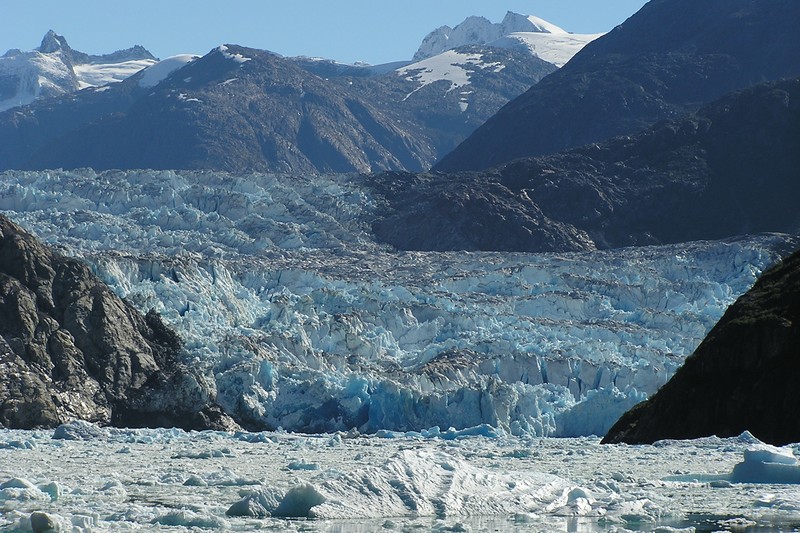
Sixty-four million cubic metres of rock. A one-kilometre freefall. And a wall of water that climbed 481 metres up the opposite cliff face — taller than the Empire State Building, taller than all but 14 of the world’s buildings.
New research published in Science confirms that the tsunami which swept through Tracy Arm Fjord in southeastern Alaska on August 10, 2025, was the second-largest ever recorded. Only the 1958 Lituya Bay megatsunami — also in Alaska, reaching 524 metres — produced a taller wave. The Tracy Arm event holds a further distinction: it is the largest tsunami on record not triggered by an earthquake.
The collapse came with almost no warning. At 5:26 AM local time, a mountainside gave way near the toe of South Sawyer Glacier, sending rock equivalent to roughly 24 Great Pyramids plunging into the fjord. The impact registered on seismic detectors worldwide, producing long-period waves comparable to a magnitude 5.4 earthquake.
A glacier held the door shut
The mechanism behind the collapse took months of forensic work to reconstruct. A team led by Dan Shugar, a geomorphologist at the University of Calgary, combined field observations, seismic data, and satellite imagery to trace the chain of events. Their conclusion: the rapid retreat of South Sawyer Glacier — roughly 500 metres in the spring of 2025 alone — removed the structural support holding the cliff face in place.
“While the glacier is in the fjord, it’s supporting those valley walls, like the buttresses on a cathedral,” Shugar said. Once the ice retreated past the section that failed, the rock was exposed and vulnerable. He offered a simpler analogy: a child who cleans their room by stuffing everything into a closet. Open the door, and everything falls out. The glacier was the door. Warming temperatures pulled it open.
Minutes from catastrophe
Tracy Arm Fjord is a popular stop for Alaska cruise ships. On a typical summer day, roughly three ships pass through. On busy days, more than 20 vessels visit Tracy Arm and the nearby Endicott Arm fjords.
The landslide happened in early-morning darkness. Hours later, a sightseeing vessel from Juneau and a National Geographic tour boat — each capable of carrying more than 100 passengers — were scheduled to enter. The day before, two cruise ships carrying thousands of passengers had visited. Another was due the following day.
Dan Shugar, a geomorphologist at the University of Calgary who led the study, described the potential outcome for a ship at the head of the fjord as “unsurvivable.” Dennis Staley of the US Geological Survey called it “a historic event” and told the Guardian: “I feel like we dodged a bullet.”
The wave’s effects reached far beyond the impact zone. Kayakers camping on Harbor Island, 55 kilometres away, reported water surging past their tents and sweeping away gear. An observer aboard a vessel roughly 50 kilometres distant watched a two-metre wave cresting along the shoreline. The fjord continued to slosh for 36 hours in a standing wave known as a seiche.
A warming threat multiplier
The researchers’ central finding is direct: without the rapid retreat of South Sawyer Glacier, the landslide would either have collapsed onto ice rather than water, or might not have occurred at all. Satellite radar data indicate that many slopes across Alaska are already in motion, most of them above the lower sections of thinning glaciers.
Glaciologist Leigh Stearns of the University of Pennsylvania, who was not involved in the study, described the broader pattern: “We know that steep slopes are very sensitive to the things that climate [change] is exacerbating, whether it’s losing permafrost, glacier retreating, or more water in the soil.” Small slow changes, she noted, can trigger sudden catastrophic events.
Alaska geologist Bretwood Higman, who visited Tracy Arm weeks after the collapse, put the trend in blunt terms: “These are increasing not just a little bit, but increasing a lot. Maybe in the order of 10 times as frequent as they were just a few decades ago.”
The implications reach beyond Alaska. Shugar pointed to communities in British Columbia — Prince Rupert, Port Alberni — that sit at the heads of fjords. Cruise tourism in Alaska has grown from roughly 1 million passengers in 2016 to 1.6 million in 2025, increasing the number of people in harm’s way. Some cruise companies have announced plans to stop sending ships into Tracy Arm.
The researchers are calling for systematic monitoring of unstable slopes, better tsunami modelling, and early warning systems. Fathian noted that small tremors detected in the days before the Tracy Arm collapse could, with the right instrumentation, buy time to evacuate.
“It could change the whole story,” he said.
Sources
- Massive Alaska megatsunami was second largest ever recorded — BBC News
- Alaska’s 2025 mega tsunami highlights risk to cruise lines as glaciers retreat — The Guardian
- The Forensics of a Skyscraper-Sized Tsunami — Eos (AGU)
- Alaska landslide set off CN Tower-sized tsunami last year — and a warning for B.C. — CBC News
Discussion (9)