 lop News
Yuancheng Ryan Lu spent three years trying to turn back time for aging retinal nerve cells. When he finally saw new growth under a microscope, he high-fived his labmates — then immediately worried the celebration might be premature.
Seven years later, his discovery underpins the first clinical trial ever to attempt making old human cells young again.
Boston-based Life Biosciences received FDA clearance in January for ER-100, a gene therapy delivering three reprogramming factors into the eye. The Phase 1 study, now enrolling, tests whether aged retinal cells can be safely rewound to a younger state in patients with optic nerve damage. The technology has attracted billions in investment and Silicon Valley’s elite.
Rewinding the Clock, Safely
The science traces to a Nobel Prize–winning 2006 discovery by Japanese researcher Shinya Yamanaka, who found that four proteins could transform any adult cell into an embryonic stem cell — capable of becoming any tissue. Revolutionary, but dangerous: a cell that forgets its identity can form tumors.
The insight driving this field is to rewind the clock without erasing the cell’s identity. Called “partial epigenetic reprogramming,” it resets the biochemical markers controlling gene expression — markers that degrade over time, corrupting instructions like a smudged recipe. The cell remains a nerve cell or liver cell. It just runs its program more like it did years ago.
Life Biosciences uses three of Yamanaka’s four factors — OCT-4, SOX-2, and KLF-4 (OSK) — delivered by virus into one eye. The fourth, c-Myc, was excluded because it can cause cancer. “Taking the M out makes it impossible to go all the way back,” chief scientific officer Sharon Rosenzweig-Lipson told Lifespan.io.
Inside the Trial
The study will enroll up to 12 patients with open-angle glaucoma and up to six with NAION, a sudden-onset condition called “stroke of the eye.” Both involve irreversible damage to retinal ganglion cells, the neurons connecting eye to brain, which don’t naturally regenerate.
A genetic switch means the reprogramming genes activate only while participants take the antibiotic doxycycline, for roughly eight weeks. Patients are enrolled slowly, with 28-day gaps to monitor safety. Monkey studies found no evidence of tumors. Participants will be followed for at least five years. Rosenzweig-Lipson said the company hopes to have enough data by end of 2026 to decide on advancing to Phase 2.
From Lab Curiosity to $3 Billion Bets
The field’s rise has been swift. The concept was first proposed in 2010 by chromatin biologist Prim Singh and colleague Fred Zacouto. “It was a difficult idea for some researchers to accept,” Singh told Nature — most were focused on exploring iPS cells, not rejuvenation.
A 2016 Salk Institute study changed the conversation, showing cyclic Yamanaka factor activation extended lifespan in mice with accelerated aging. Mouse studies multiplied — improvements in muscle, skin, heart, even memory. Silicon Valley noticed. A 2020 gathering at Yuri Milner’s home led to Altos Labs, which launched with $3 billion, a biotech financing record. Sam Altman backed Retro Biosciences; Coinbase CEO Brian Armstrong co-founded NewLimit. “Reprogramming is like the AI of the bio world,” investor Karl Pfleger told MIT Technology Review. “It’s the thing everyone is funding.”
Caveats as Large as the Promises
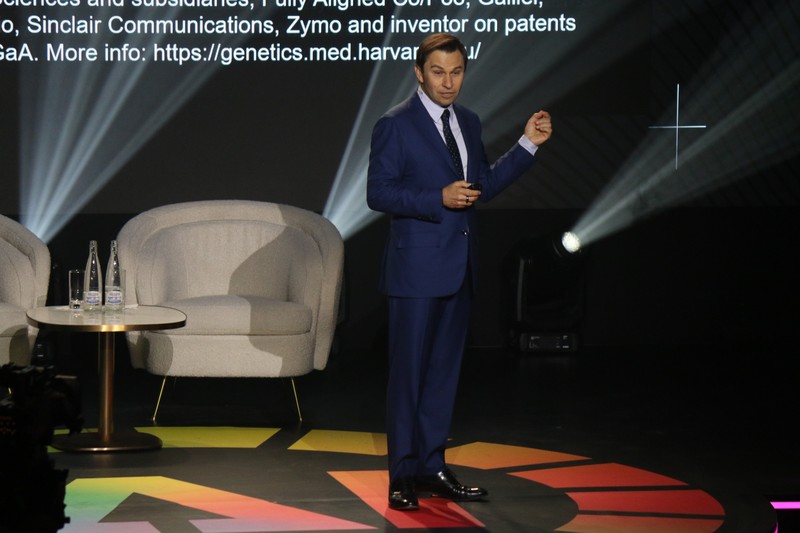
Uncertainty remains substantial. Life Biosciences co-founder David Sinclair, a Harvard aging researcher, has been criticized for bold claims about anti-aging treatments — including past enthusiasm for resveratrol — that critics say have not panned out. A 2024 Wall Street Journal profile dubbed him a “reverse-aging guru” whose companies have struggled.
The technology carries inherent risks. The genetic switch controlling the reprogramming genes is built from E. coli and herpes virus components, which could trigger immune reactions — a mechanism untested in humans. Competitors also question whether OSK is the optimal cocktail. “Are their factors the best version of rejuvenation? We don’t think they are,” Daniel Ives, CEO of rival Shift Bioscience, told MIT Technology Review. But he credits Life Biosciences with reaching human trials first, noting that the eye is “a nice self-contained system. If it goes wrong, you’ve still got one left.”
Phase 1 trials test safety, not efficacy. The optimistic outcome, Pfleger said, is that ER-100 “solves some blindness for certain people and catalyzes work in other indications.” Nobody will be prescribing rejuvenation pills anytime soon.
But for the first time, medicine is asking a question it has never been equipped to answer: can aged human tissue be made functionally younger, in a controlled and reversible way? The data starts arriving this year.
Sources
- This method to reverse cellular ageing is about to be tested in humans — Nature News
- Life Biosciences Announces FDA Clearance of IND Application for ER-100 in Optic Neuropathies — Life Biosciences
- The first human test of a rejuvenation method will begin “shortly” — MIT Technology Review
- First Human Cellular Reprogramming Trial Cleared by the FDA — Lifespan.io
Discussion (8)