 lop News
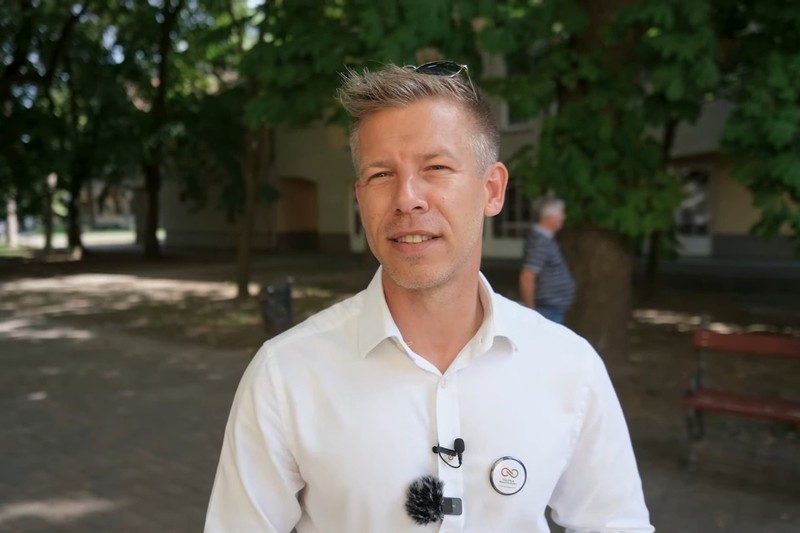
The crowds on the banks of the Danube waved Hungarian flags and EU banners, celebrating the end of Viktor Orbán’s 16-year grip on power. Two days later, the man who engineered that victory was already talking about Beijing.
Péter Magyar, Hungary’s prime minister-elect, secured a two-thirds supermajority in Sunday’s parliamentary elections — 138 of 199 seats on 53.6 percent of the vote, with a record turnout of 79.5 percent. Orbán’s Fidesz party was reduced to 55 seats. The result was, as Orbán himself conceded, “painful but unambiguous.”
On Monday, as European leaders celebrated a democratic renaissance in Budapest, Magyar was signaling his diplomatic intentions beyond the continent.
“We are absolutely, absolutely open [to discussions with Chinese leaders] and China is one of the world’s most important, largest and most powerful countries,” Magyar told a press conference, according to the South China Morning Post. “It is in our interest, and I believe it is in the interest of both countries.”
He said he would like to visit Beijing and that Chinese leaders are welcome in Budapest. He signaled openness to Chinese investment — provided firms comply with EU environmental, health, and safety rules and deliver tangible benefits to the Hungarian economy. He wants Hungarian companies positioned as partners at major Chinese firms like BYD and CATL.
Two Capitals, One Balancing Act
The dual overture — warm toward Brussels, warm toward Beijing — is not the standard playbook for a newly elected European leader claiming a pro-European mandate. Magyar has pledged to “pivot to the West,” implement rule-of-law reforms, and unlock approximately €18 billion in frozen EU funds. His first foreign visits will be to Warsaw, Vienna, and Brussels, according to the Centre for Eastern Studies.
But he has no intention of closing the door on China. He cited the Chinese-sponsored Budapest-Belgrade railway as a bad deal — “built with Chinese money, technology and workers, primarily for Chinese benefit,” funded by “an enormous sum of money that is sorely missing from Hungary’s own railway development.” His message to Beijing appears to be: Hungary is open for business, but on more equitable terms.
That posture may test the EU’s ability to maintain a coordinated stance on China. Hungary under Orbán was already the bloc’s most China-friendly member state, hosting battery plants from CATL and a BYD manufacturing base. Magyar appears to want economic continuity with Beijing even as he realigns Hungary politically with the West — making him both Brussels’s most welcome new partner and a potential complication at the same table.
A Setback for MAGA, Too
The election was also a rebuke to the international populist network Orbán spent a decade building. Trump and Vance invested heavily in the race — Vance flew to Budapest to campaign alongside Orbán at US taxpayer expense, and Trump promised “the full Economic Might of the United States” if Orbán won. According to an analysis by Redpoint Advisors cited by The Atlantic, Trump’s last-minute pledge backfired: negative Hungarian-language mentions of the president spiked 47 percent within an hour.
A Measured Stance on Ukraine
Magyar’s foreign policy breaks from Orbán’s approach without a full reversal. He identified Ukraine as “the victim in this war” and affirmed Kyiv’s right to territorial integrity under the 1994 Budapest Memorandum — a striking departure from Orbán’s Kremlin-friendly rhetoric. Zelensky immediately lifted a travel advisory on Hungary and pledged a diplomatic reset.
But Magyar opposes fast-tracking Ukraine’s EU membership and would submit the question to a binding referendum. Tisza has ruled out sending arms or soldiers. He would take a call from Vladimir Putin but not initiate one: “If we did talk, I could tell him that it would be nice to end the killing after four years and end the war.” His government plans to eliminate dependence on Russian energy by 2035 and review the Rosatom-led nuclear power plant project.
What Comes Next
Brussels is breathing easier. Commission President Ursula von der Leyen said “Europe’s heart is beating stronger in Hungary tonight.” The first practical test comes quickly: EU officials expect Magyar to drop Orbán’s veto on a €90 billion loan package for Ukraine. Julia Pocze, a constitutional law expert at the Centre for European Policy Studies, told Deutsche Welle she expects approval by the end of May.
But frictions will remain. Magyar has said he will not implement the EU’s new migration pact — a stance that puts him alongside Poland’s Donald Tusk rather than Brussels. And his openness to Beijing, however conditional, introduces a complication the EU would rather not manage: a leader who is simultaneously its most welcome new partner and a potential wrinkle in its China strategy.
Sources
- Péter Magyar wins two-thirds parliamentary majority in earthquake Hungary election — Le Monde
- Hungary’s PM-elect Magyar sends warm overture to China, vows fair play for firms — South China Morning Post
- There’s a Message for MAGA in Viktor Orbán’s Defeat — The Atlantic
- ‘We cannot ask any country to give up its territory,’ Magyar says on Ukraine — Euronews
- EU applauds Hungary’s election result — Deutsche Welle
- Elections in Hungary: the triumph of Péter Magyar — Centre for Eastern Studies
Discussion (10)