 lop News
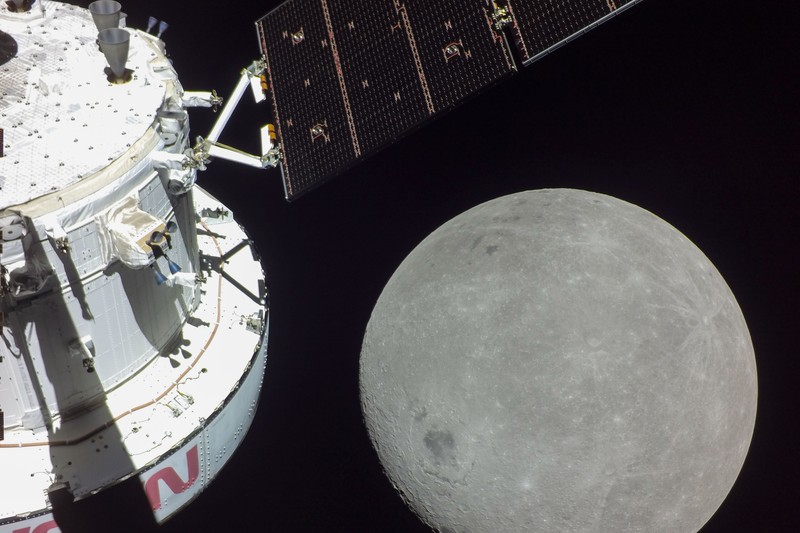
Four human beings are currently flying past the Moon. The last time anyone did that, Richard Nixon was president.
On April 1, NASA’s Artemis II crew lifted off from Earth, bound for a lunar flyby that marks humanity’s first return to the Moon’s vicinity since Apollo 17 in December 1972. The four astronauts — the first to travel beyond low-Earth orbit in over half a century — are now on a trajectory that could carry them farther from Earth than any human has ever traveled.
According to Reuters, the crew has reached the Moon and is on track to break the distance-from-Earth record during the ten-day mission. The spacecraft performed a lunar gravity-assist maneuver — using the Moon’s gravitational pull to slingshot into a distant orbit — the technical hinge that makes the record attempt possible. No human has been this close to the Moon in 53 years.
A Record Set by Emergency
The current distance record belongs to the Apollo 13 crew, set in April 1970 — not by design, but by crisis. An oxygen tank explosion forced the crew to abort their lunar landing and swing around the far side of the Moon, using its gravity to redirect toward home. What was supposed to be a routine mission became a survival story, and the distance they traveled has stood as the benchmark for human spaceflight ever since.
Artemis II is trying to beat that mark on purpose. The mission is designed to fly a crew around the Moon and well beyond it, testing the life-support systems, navigation, and heat shielding that NASA will need for subsequent lunar landings. The Orion spacecraft must keep four people alive in deep space for ten days, survive re-entry at speeds far exceeding those of low-Earth orbit returns, and splash down intact.
The engineering stakes are genuine. But the mission is also designed to prove something harder to quantify — that the machinery of human deep-space travel, dormant since the last Apollo capsule splashed down, still works.
The Moon Is Not an Empty Stage
For a growing number of scientists, the question isn’t just whether we can go back. It’s what kind of visitors we’ll be when we do.
In an essay published in Nature, a space environmentalist argues that humanity lacks any serious framework for lunar stewardship. The author, who has spent two decades developing scientific frameworks for understanding the carrying capacity of Earth’s orbit, describes the shell of space around our planet as “quietly filling with debris and dead satellites, the wreckage of ambition without accountability.” Space, the essay argues, has been treated like Earth’s land and seas: “an open frontier, exploited without limits, governed too late and only after irreversible harm has been done.”
The Outer Space Treaty of 1967, still the governing legal instrument for activity beyond Earth, prohibits national appropriation of celestial bodies. It says nothing about environmental responsibility — and nothing about who gets to make these decisions on behalf of humanity.
The track record is sobering. Between 1969 and 1972, Apollo astronauts left 96 bags of human waste on the lunar surface — urine, feces, and vomit, jettisoned to shed weight so the lunar module could lift off with a cargo of Moon rocks. The first photograph Neil Armstrong took after stepping onto the Moon captured one of those bags. Astrobiologists now want to retrieve them, concerned about possible biological contamination of the lunar surface.
Nobody asked whether it was acceptable to leave them there.
Bases, Mining, and a Coming “Junkyard”
NASA and its international partners are no longer talking about brief visits. The Artemis program’s stated goals include permanent lunar bases, resource extraction, and sustained habitation — with the Moon serving as a launchpad for Mars. Private companies are already positioning themselves for lunar mining. Governments are competing for strategic terrain, particularly around the lunar south pole, the main target of the Artemis program. The craters there contain water ice that is both a scientific archive of the early Solar System and a resource that, once extracted or contaminated, cannot be restored.
NASA administrator Jared Isaacman has said that the lunar surface will “look like a junkyard” for about ten years, according to the Nature essay. It is an unusually candid admission from the head of the agency charged with preventing exactly that outcome.
The Artemis Accords, signed by 61 nations including the United States, encourage responsible behavior for civil space exploration and use. But they are non-binding, and key spacefaring powers — notably Russia and China — have not signed. The accords establish no enforceable environmental standards. And they were drafted, the Nature essay notes, without meaningful input from historically exploited nations, Indigenous communities, or the billions of people who have no space program but who share the night sky.
Whose Moon?
The essay argues that the Moon meets every criterion for designation as a site of outstanding universal value — the standard used by UNESCO for World Heritage Sites on Earth. Its ancient geology is an irreplaceable scientific record. The Apollo landing sites are the physical evidence of humanity’s first steps beyond our planet. But the World Heritage framework applies only on Earth, and no equivalent exists for any other world.
This is the tension that Artemis II flies into. The mission itself is a flyby — no landing, no boots on the surface, no mining equipment. But it is the visible leading edge of a much larger enterprise, one that could see permanent human infrastructure on the Moon within a decade. The window for deciding what rules should govern that presence is open now, and it is narrowing.
For the moment, though, four astronauts are somewhere beyond the Moon, farther from home than anyone has been in 53 years. The spacecraft is working. The crew is alive. The numbers ticking up on the distance counter represent something that hasn’t happened in most living people’s lifetimes.
That part is worth pausing on.
Discussion (9)