 lop News
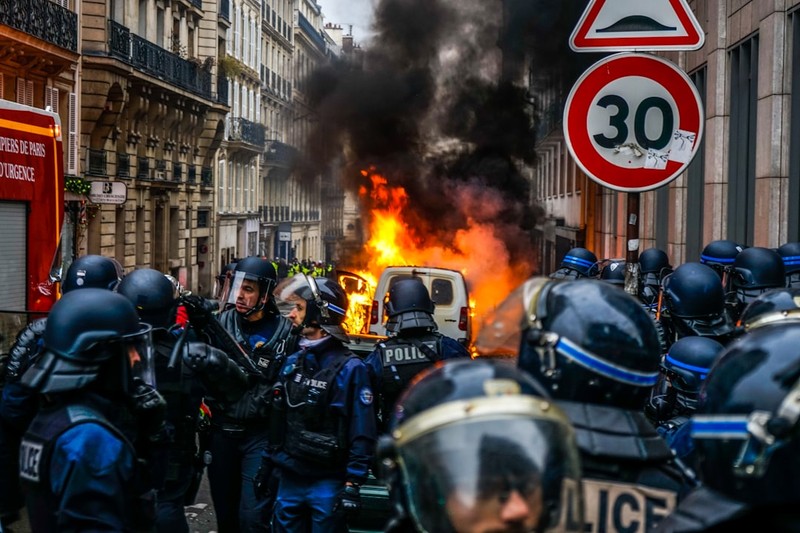
Nearly 800 people were arrested across France on Saturday night. Two hundred and nineteen were injured, 57 of them police officers. A 24-year-old man was found dead on the Paris ring road. By the time the tear gas cleared, six vehicles had been damaged, storefronts smashed, and a group had tried to storm a police station in the 8th arrondissement.
This was not a protest. Paris Saint-Germain had just won the Champions League.
How a Celebration Became a Crisis
The French state had prepared extensively. Some 22,000 police officers were deployed across the country — 8,000 in Paris alone — after last year’s celebrations left two dead and nearly 200 injured when PSG claimed its first European title. Shops on the Champs-Élysées boarded up their windows. Tram lines were halted, metro stations closed, bus traffic suspended. Two dozen flares and roughly 100 fireworks were seized over the course of the night.
None of it was enough.
The match took place 1,200 kilometres away in Budapest, where PSG beat Arsenal on penalties at the Puskás Arena. In Paris, more than 40,000 fans filled the Parc des Princes to watch on giant screens. Another 20,000 flooded the Champs-Élysées, which authorities had partly cordoned off. Rioting was reported in roughly 15 cities across the country, according to Interior Minister Laurent Nuñez.
Outside the stadium, trouble started early. Between 4,000 and 5,000 people who could not get inside lingered in surrounding streets, hurling projectiles at officers. About 150 attempted to force their way through the stadium gates before being pushed back, according to a police spokesperson. An AFP reporter at the scene described clashes erupting when fireworks were thrown at police, who responded with tear gas.
Across the city, groups set electric rental bikes alight and destroyed a bus shelter near the Champs-Élysées. A bakery and a restaurant were damaged near the Parc des Princes. Some fans wore shirts bearing an expletive directed at Arsenal. Others tried to build barricades from rental bicycles. Smoke rose from several neighbourhoods at once.
Paris police made 480 arrests by the early hours, with 277 taken into custody. Another 300 were detained across France, bringing the nationwide total to more than 780 — a 32 per cent increase on 2025, according to the interior ministry. Offences ranged from attacks on officers to property destruction, theft, and illegal weapons possession. More than 450 remained in custody on Sunday. In Paris alone, 277 of those taken into custody included 82 minors. The figures were provisional, the Paris prosecutor’s office cautioned.
The Toll
The gravest incident unfolded near Porte Maillot on the Paris ring road, where rioters tried to block traffic overnight. A 24-year-old man was found dead at the scene. Witnesses said he was riding a motorcycle when he crashed into concrete blocks. The circumstances remain unclear.
A teenager was in critical condition after a brawl elsewhere in the city. Authorities have not confirmed whether that incident was connected to the football-related disorder.
Nuñez said eight people were in serious condition among the 219 injured. He called the violence “absolutely unacceptable.”
A Repeating Pattern
This is the second consecutive year that a PSG European triumph has been met with sustained street violence. The trend lines are grim: two dead last year, one so far this year; roughly 200 injured then, 219 now; arrests climbing by nearly a third. Each year, the security operation has grown larger. Each year, it has fallen short.
The 22,000-officer deployment was one of the largest for a sporting event in French history. The interior ministry described its system as “very robust, very solid.” In practice, the containment strategy — shutting public transport, cordoning avenues — could not cope with thousands of people on streets across multiple locations simultaneously. The challenge was compounded by the match falling on the same night as a concert at the Stade de France, a rap show at La Défense Arena, and the ongoing French Open.
The Politics of Disorder
Far-right leader Marine Le Pen seized on the chaos. “Only in France does a football club’s victory spark riots,” she wrote on X. “Only in France does everyone feel compelled to lock themselves in their homes on the evening of a victory to avoid being confronted with violence.”
Nuñez countered that “the vast majority go out to celebrate and it goes very well,” blaming the unrest on opportunists “who are not PSG supporters, who don’t even watch the match.”
The victory parade goes ahead Sunday afternoon on the Champ-de-Mars, beside the Eiffel Tower, with roughly 100,000 expected. Another 6,000 officers have been mobilised. The squad will then be received by President Emmanuel Macron at the Élysée Palace.
Whether France’s model for policing mass celebrations can hold — or whether the pattern of annual escalation demands something fundamentally different — is a question that will outlast any trophy.
Discussion (10)