 lop News
Nearly 700 civilians killed by drone strikes in three months. Fourteen million people driven from their homes. A $2.9 billion humanitarian appeal sitting at 16 percent funded.
On Wednesday, donors will gather in Berlin to discuss a war most of the world has spent three years successfully ignoring.
That is the ledger of Sudan’s civil war as it enters its fourth year — what the UN’s emergency relief coordinator has called the “world’s largest humanitarian crisis.”
“In the first three months of this year, nearly 700 civilians were reportedly killed in drone strikes,” Tom Fletcher said in a statement released ahead of the April 15 anniversary. “This grim and chastening anniversary marks another year when the world has failed to meet the test of Sudan.”
The war between the Sudanese Armed Forces (SAF) and the paramilitary Rapid Support Forces (RSF) erupted on April 15, 2023, out of a power struggle between the two sides. Three years on, the numbers have grown so large they risk becoming abstract.
A war waged from above
The sharpest escalation in recent months has been the dramatic increase in drone warfare. According to the UN Human Rights Office, more than 500 civilians were killed in drone strikes between January 1 and March 15 — a figure Fletcher’s updated data has since pushed closer to 700.
The vast majority of those deaths were concentrated in the Kordofan region, now the conflict’s primary battleground. But strikes have also hammered RSF-controlled areas in Darfur and crossed international borders. On March 18, a drone attack on the Chadian town of Tiné killed at least 24 civilians and injured around 70 others, according to the OHCHR.
Civilian infrastructure has been systematically targeted. On March 20 — the first day of Eid al-Fitr — a combined air and drone strike hit El Daein Teaching Hospital in East Darfur, killing at least 64 people, including seven women and 13 children. The facility’s emergency, maternity, and paediatric units were rendered fully out of operation. On the same day in Ad Dabbah, in Northern state, drone strikes hit an electricity substation and an engineering college, killing six people and cutting power to the entire locality.
The OHCHR has warned that such attacks “raise serious concerns about compliance with international humanitarian law’s fundamental principles of distinction, proportionality and precaution, and may amount to war crimes.”
A crisis in every direction
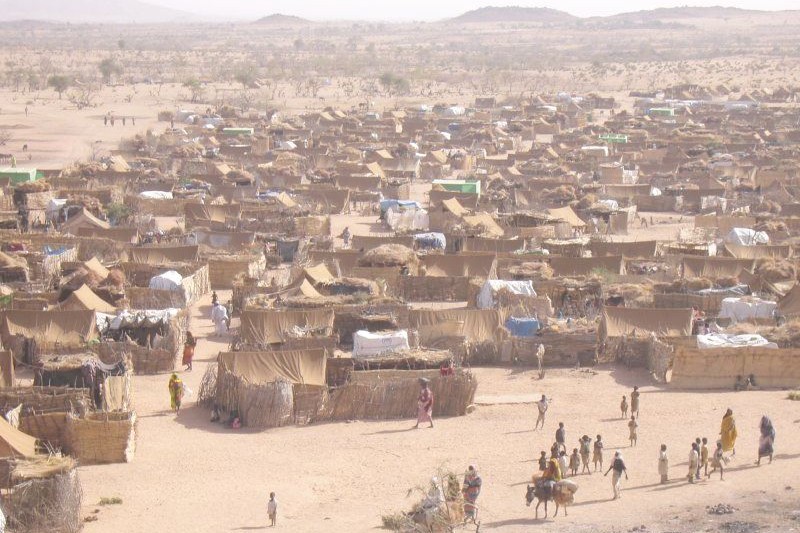
According to UNHCR representative Marie-Helene Verney, 14 million people — roughly a quarter of Sudan’s population — have been forced to flee since the war began, with 9 million displaced internally and 4.4 million crossing into neighbouring countries, primarily Chad, South Sudan, and Egypt.
The Food and Agriculture Organization reports that 21 million Sudanese face acute food insecurity, including 6.3 million at the most severe emergency level. Rural households in Darfur and Kordofan are under particular pressure, with food production capacities largely destroyed.
The health system has been eviscerated. The WHO has documented more than 200 attacks on healthcare facilities in three years, killing 2,052 people. Health workers have been killed, injured, detained, and tortured. Over 40 percent of the population requires urgent health assistance, according to the WHO’s Dr. Shible Sahbani.
Even the supply lines for humanitarian aid have been squeezed by the widening Middle East conflict, which has disrupted logistics routes through the UAE — the main hub for UN operations in Sudan.
Findings of genocide, a vacuum of response
Independent UN and African Union fact-finding missions have concluded that both the SAF and RSF bear responsibility for grave violations, including arbitrary detention, torture, and indiscriminate attacks on populated areas. The RSF in particular has been documented engaging in widespread sexual violence, ethnic targeting, and extermination through deliberate deprivation of food and medicine.
In a finding of particular gravity, the UN Fact-Finding Mission determined that RSF attacks on Zaghawa and Fur communities in El Fasher in October 2025 bore “the hallmarks of genocide.”
The international response tells its own story. The UN’s $2.9 billion appeal for 2026 is only 16 percent funded, according to resident coordinator Denise Brown, with aid contributions from member states continuing to decline. Wednesday’s Berlin conference is the latest attempt to revive diplomatic momentum — though previous efforts have produced little tangible progress.
“We need action now – to stop the violence, protect civilians, ensure access to communities in greatest danger, and fund the response,” Fletcher said.
Three years in, those words have been said before. The drones keep falling.
Sources
- Sudan drone strikes kill nearly 700 in three months as civil war reaches grim milestone — France 24
- Sudan: Sharp increase in civilian deaths as a result of growing drone warfare — OHCHR
- Sudan: On third anniversary of conflict, UN and ACHPR-AU Fact-Finding Missions jointly warn of escalating violence — OHCHR
- Sudan: 14 million displaced; hunger and attacks on health continue as war enters fourth year — UN News
Discussion (9)