 lop News
619 drones. 47 missiles. One night.
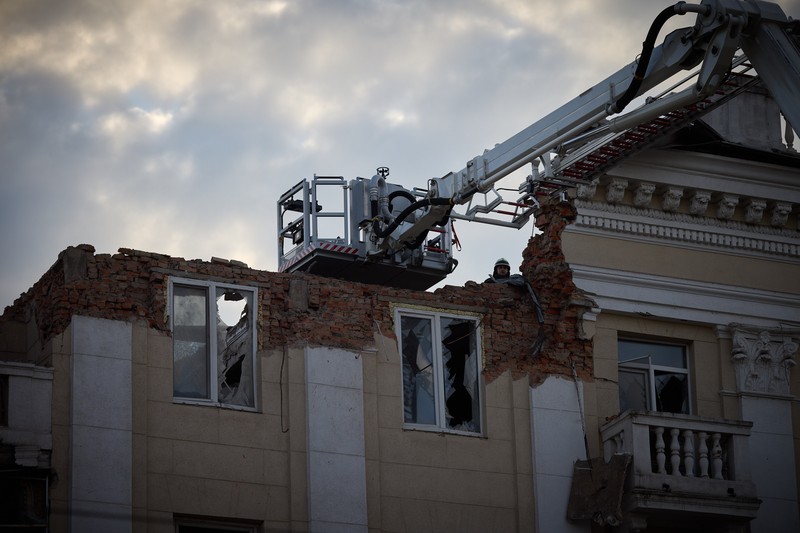
By dawn on Saturday, at least seven Ukrainians were dead and 57 wounded after one of Russia’s largest aerial assaults since the full-scale invasion began in 2022. The eastern city of Dnipro absorbed the worst of it — rescue teams spent the morning pulling survivors from the rubble of collapsed apartment blocks as fires burned across the city, and officials warned more people might still be buried.
Ten Hours Over Dnipro
Dnipro endured more than ten hours of continuous strikes overnight. A four-story residential building was destroyed, killing at least four people. A nine-year-old boy was among the dead. Fires spread across the city, damaging businesses, vehicles, and a shop, according to Dnipropetrovsk Oblast Governor Oleksandr Hanzha.
Then the bombers returned. A daytime strike on Saturday hit the same residential neighbourhood, killing one more person and wounding seven. Dnipro Mayor Borys Filatov said the deputy mayor, another city official, and specialists were “almost killed” in what appeared to be a double-tap attack — a tactic where the initial strike is followed by a second one targeting emergency responders.
Forty-six people were wounded in Dnipro in total, including a 17-year-old girl and three other children. Two women, aged 26 and 44, were in critical condition. Twenty-three people were hospitalised. Two police officers were among the injured, according to Interior Minister Ihor Klymenko.
Strikes Across the Country
The assault extended well beyond Dnipro. In Nizhyn, a city in the Chernihiv region, two men aged 30 and 60 were killed. In Kharkiv, a missile struck near a residential building in the Shevchenkivskyi district, destroying a public transport stop. A subsequent drone strike in the city’s Nemyshlianskyi district wounded a one-and-a-half-year-old boy, according to Mayor Ihor Terekhov.
Drone swarms targeted the Odesa region overnight, damaging residential buildings, port infrastructure, and a civilian vessel sailing under a Panamanian flag. In Mykolaiv Oblast, a power line was struck, cutting electricity to six settlements.
Ukraine’s Air Force said Russian forces deployed roughly 400 Shahed-type attack drones, 35 cruise missiles, and 12 ballistic missiles. Ukrainian air defences intercepted 580 drones and 30 missiles. But 13 missiles and 36 drones still struck their targets across 23 locations.
The Second Massive Barrage in Nine Days
The scale was extraordinary but not unprecedented. On April 16, Russia launched 659 drones alongside 44 missiles — an assault that killed 17 people and wounded over 100 in Kyiv, Dnipro, and Odesa, making it one of the deadliest Russian attacks on Ukrainian civilians of 2026.
Taken together, the two barrages — launched just nine days apart — suggest Moscow has escalated its aerial campaigns to overwhelm Ukraine’s air defences and exhaust its population. President Volodymyr Zelensky said Russia’s tactics were unchanged: “Attack drones, cruise missiles, and a significant number of ballistic missiles. Most targets are civilian infrastructure in cities.”
Ceasefire Talks in the Shadow of Bombardment
The overnight attack came hours after Russia and Ukraine completed a prisoner swap on Friday, exchanging 193 service members. Those periodic exchanges have been among the few tangible results of months of US-brokered negotiations, which have produced no breakthrough on the issues blocking a ceasefire. Diplomatic efforts are now at a standstill, with US mediation diverted by the outbreak of the Middle East war in February, according to France 24.
Speaking during a visit to Azerbaijan on Saturday, Zelensky said Ukraine was “ready for upcoming negotiations in Azerbaijan, if Russia is ready for diplomacy.” He urged the EU to impose a 21st sanctions package, days after the bloc approved its long-stalled 20th round — targeting Russia’s banking sector and restricting Russian oil exports. That package had been blocked for months by Hungary’s Prime Minister Viktor Orban, who was voted from power two weeks ago, according to France 24, though this has not been independently confirmed.
The EU also approved a €90 billion ($105 billion) loan to Ukraine for defence and state expenditures through 2026 and 2027.
Fallout Beyond Ukraine’s Borders
The bombardment reached beyond Ukraine. Drone fragments landed in the Romanian city of Galați, damaging a residential building and forcing the evacuation of more than 200 people. Two British Eurofighter Typhoons were scrambled; their pilots made radar contact with a drone over Ukrainian territory near the border but held fire when it did not enter Romanian airspace, Romania’s Defence Ministry said.
Romanian President Nicusor Dan called it “the first incident where Romanian property has actually been damaged, a threshold we take very seriously.” Poland scrambled its own fighter jets in response to the attacks.
Sources
- 7 killed, 57 injured as Russia launches mass strike on Dnipro, other cities across Ukraine — Kyiv Independent
- Russian attacks kill 5 and wound more than 40 in Ukraine’s Dnipro as 1 dies in Russia — Associated Press
- Major Russia drone and missile attack kills several, wounds dozens in Ukraine — France 24
- Russian strikes kill at least seven and injure dozens across Ukraine — Euronews
Discussion (9)