 lop News
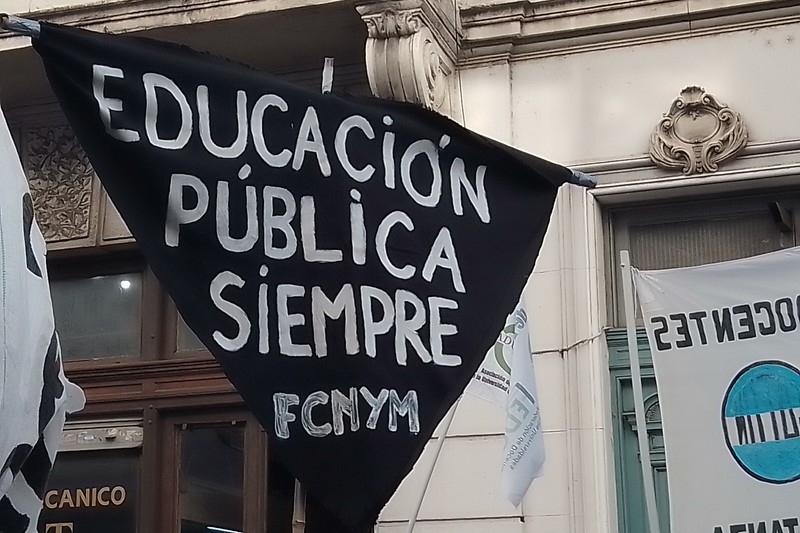
An 18-year-old literature student stood outside Argentina’s presidential palace on Tuesday holding a copy of Fahrenheit 451. The novel about a society that outlaws books, Renata López told reporters, “speaks to our current reality. Defunding education isn’t something alien, it isn’t dystopian. It’s something that’s happening.”
Behind her, a crowd filled the Plaza de Mayo and spilled into surrounding streets. Organizers estimated 600,000 marched in Buenos Aires alone, with 1.5 million taking part countrywide across cities including Córdoba, Mendoza, and Tucumán — if accurate, making the Marcha Federal Universitaria one of the largest protests of Javier Milei’s presidency. Police had not released their own count.
What the Cuts Actually Mean
Argentina’s roughly 60 public universities have been tuition-free since 1949. Government funding accounts for 80 to 90 percent of their total income, according to Marcelo Rabossi, a higher education policy professor at the University of Torcuato Di Tella in Buenos Aires. That makes the system acutely vulnerable to budget cuts.
Since Milei took office in late 2023, public university budgets have fallen by roughly 40 percent, according to a report from the Argentine-based Ibero-American Center for Research in Science, Technology and Innovation (CIICTI). Spending dropped from just over 0.7 percent of GDP in 2023 to slightly above 0.4 percent this year — the lowest level since 1989.
Professor salaries have declined about 33 percent after inflation, according to the main teachers’ federation. Ricardo Gelpi, rector of the University of Buenos Aires, said at least 580 research professors in engineering and science have left for private universities or better-paying jobs. The university’s Faculty of Exact and Natural Sciences has been on strike for three months. University hospital officials say they are on the verge of collapse.
A Constitutional Standoff
Congress passed laws in 2024 and 2025 requiring the government to fund university operating costs and adjust salaries for inflation. Milei vetoed the legislation. Parliament overrode the veto. The government still refused to implement the law, arguing it fails to specify funding sources during harsh austerity. The case is headed to the Supreme Court, which faces no deadline to rule.
“The only law we are going to comply with is the budget law,” Deputy Public Universities Secretary Alejandro Álvarez told reporters on Monday, calling the march “completely political.”
Milei’s La Libertad Avanza party said the government had transferred budget allocations on time, noting the 2026 budget increased university funding to 4.8 trillion pesos. The University Funding Act was suspended because Congress never identified funding sources for an estimated 1.9 trillion pesos in additional spending, the party argued.
The march came less than 24 hours after officials announced further reductions in education and health spending.
Who Pays for Fiscal Balance
For Milei, the cuts are the point, not a byproduct. Like his ally US President Donald Trump, he routinely frames universities as bastions of “woke” indoctrination — casting austerity as both fiscal necessity and cultural correction. His party reaffirmed his “unshakeable” commitment to fiscal balance.
For the protesters, the stakes are existential. Argentina’s public universities have produced five Nobel laureates and serve, as Rabossi put it, as “more than just educational institutions — they are symbols of social mobility and national pride.”
“It’s very clear this government is determined to defund public education,” said Sol Muñiz, a 24-year-old law student at the University of Buenos Aires. “University is a source of pride for us. It is the best thing we have.”
Buenos Aires Province Governor Axel Kicillof accused Milei of “beginning to destroy the future of the country.” The protest drew people across ages and political affiliations, with signs reading “The ignorant want us ignorant” and, in a jab at a corruption investigation into Milei’s cabinet chief: “How much does Adorni cost us?”
The Supreme Court will eventually rule. Until then, the question that filled the Plaza de Mayo is the same one running through Milei’s entire presidency: fiscal balance — but at whose expense?
Sources
- Mass protests in Argentina decry Milei’s funding cuts to prized public universities — Associated Press
- Tens of thousands demonstrate against Milei cuts to university budgets — Buenos Aires Times
Discussion (10)