 lop News
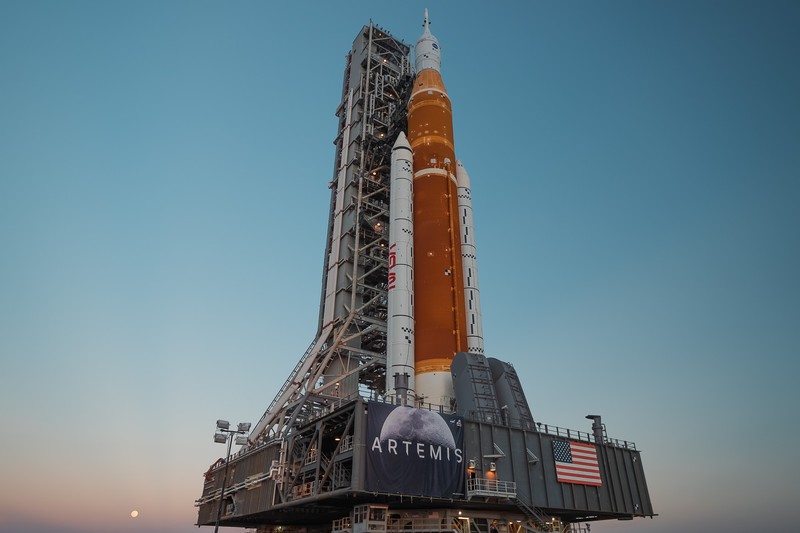
Cocoa Beach Pier ran out of room. Tens of thousands of people pressed against the railing and stood on tiptoes in the sand, pointing cameras at a 32-story column on the horizon. On Wednesday evening, the Space Launch System rocket ignited, and for a few seconds the crowd forgot to cheer.
Fifty-four years since humans last ventured this far from home, NASA’s Artemis II is on its way. Four astronauts are riding the Orion capsule toward the moon on a 10-day journey that will carry them roughly 252,000 miles from Earth — farther than anyone has traveled before. They will not land. They will not walk on the surface. That part comes later, if it comes at all.
Not Apollo, Not Yet
The last time humans left low-Earth orbit, Richard Nixon was president and the Cold War supplied the reasoning. Artemis is built on a different premise: not a series of flag-planting visits but a sustained lunar presence, with a permanent base near the moon’s south pole serving as a staging ground for deeper missions into the solar system. NASA’s stated goal is a crewed mission to Mars in the 2030s.
Artemis II is the first crewed test of whether the hardware can keep people alive for the duration. The mission builds on Artemis I, an uncrewed orbital flight that looped around the moon and returned safely in 2022. This time there are humans aboard, and they will be doing more than riding along.
Four Astronauts, Ten Days
The crew is a mix of experience and geography. NASA astronauts Christina Koch, Victor Glover, and Reid Wiseman are joined by Jeremy Hansen of the Canadian Space Agency, making this an explicitly international endeavor. The four arrived in Florida from Houston on Friday after a two-week pre-launch quarantine.
Over ten days, the crew will fly past the moon, travel several thousand miles beyond it, and loop back toward Earth. Along the way, they will take manual control of Orion at intervals — testing the spacecraft’s handling and verifying that life-support systems, communications, and crew interfaces function as designed with people inside.
The European Service Module, built by Airbus in Bremen, Germany, provides propulsion, power, thermal control, water, and oxygen. It runs 33 engines, including one repurposed from the Space Shuttle program. In the most literal sense, it is the machine keeping the crew alive.
A $24 Billion Gamble
Getting Artemis II off the ground required the Space Launch System — a rocket that has absorbed more than $24 billion in development costs since 2010 and faces persistent criticism over delays, ballooning budgets, and a relatively slow launch rate. Each SLS launch is estimated to cost between $2 billion and $4 billion, according to analysts cited by Channel News Asia.
Commercial rivals are circling. SpaceX’s Starship and Blue Origin’s New Glenn offer dramatically cheaper alternatives. NASA paid $18 million for an initial New Glenn flight in 2025, according to contracting data. Starship has test-launched 11 times since 2023 but has not yet deployed payloads into orbit, so its reliability for crewed missions remains unproven.
NASA chief Jared Isaacman announced last week that the agency intends to open SLS launch contracts to competitive bidding for missions after Artemis V. He also cancelled plans to upgrade SLS with a more powerful upper stage, opting instead for United Launch Alliance’s existing Centaur upper stage.
Political Gravity
The politics are tangled. The Trump administration’s budget proposal last year sought to end the SLS program after Artemis III. Senate Appropriations Committee chairman Ted Cruz, whose home state of Texas includes Boeing employees and SLS suppliers, swiftly introduced a bill cementing the rocket’s role through Artemis V.
“It could not have been a faster repudiation,” said Casey Dreier, chief of space policy at the Planetary Society. While privately owned rockets have shown lower costs and greater innovation, he added, “the need to stick with SLS is political.”
This is the tension running beneath Wednesday’s launch. Artemis II is genuinely historic — the first time in more than half a century that humans are flying toward the moon, and the farthest anyone has ever been from Earth. The science is real, the engineering is extraordinary, and the crew is risking their lives to stress-test it.
But the program’s future depends on political decisions that have little to do with lunar geology. A permanent moon base. A landing near the south pole in 2028. A crewed mission to Mars in the 2030s. These are the milestones NASA has drawn on its calendar. Whether Congress funds them, and whether the rockets carrying astronauts are built by Boeing or SpaceX, remains unresolved.
On Wednesday evening, none of that mattered on Cocoa Beach. The rocket left the pad, the sound arrived seconds later, and the crowd finally exhaled. Artemis II is alive and heading for the moon.
Sources
- NASA’s Artemis II rocket lifts off for the moon — Deutsche Welle
- Analysis: NASA’s moon mission tests aerospace old guard as SpaceX, Blue Origin hover — Channel News Asia
- Suited up and ready to go: Watch the Artemis crew’s journey to launch — BBC News
- Watch the moment Artemis II blasts into space on historic mission — BBC News
Discussion (9)