 lop News
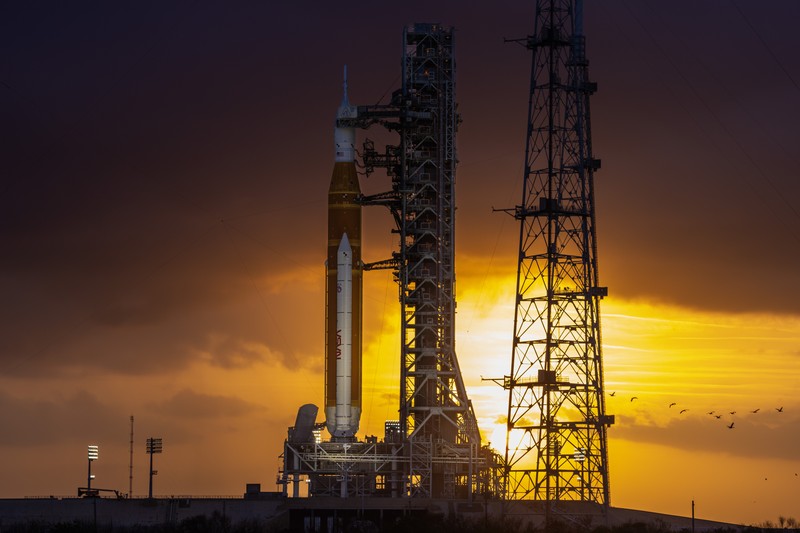
Hydrogen began flowing into a 32-story rocket at Cape Canaveral on Wednesday morning. By evening, four astronauts will climb aboard and leave for the moon — the first humans to travel that far since December 1972.
At 7:33 a.m. Eastern, Artemis Launch Director Charlie Blackwell-Thompson gave the official “go” for tanking, initiating the careful process of loading more than 700,000 gallons of super-cold liquid hydrogen and liquid oxygen into the Space Launch System rocket. By mid-morning, the process had reached its final replenish phase — a continuous, low-rate flow keeping the tanks topped off as the fuel naturally boils off.
No hydrogen leaks were reported. That mattered. A leak erupted during a countdown test earlier this year, forcing a lengthy flight delay.
The targeted launch time is 6:24 p.m. EDT from Kennedy Space Center’s Launch Pad 39B. Weather officers with the US Space Force’s Space Launch Delta 45 are forecasting an 80 percent chance of favorable conditions.
A Crew of Firsts
Commander Reid Wiseman, pilot Victor Glover, and mission specialist Christina Koch — all NASA veterans on their second spaceflights — will be joined by Jeremy Hansen of the Canadian Space Agency, on his first.
The crew composition is a quiet but unmistakable signal of how much has changed since the Apollo era, when every astronaut who flew to the moon was a white American man. Hansen will become the first non-US citizen to travel to the moon’s vicinity. Glover will be the first person of color to leave low Earth orbit. Koch will be the first woman to do so.
King Charles III sent a letter to Hansen ahead of the launch, writing: “In this historic moment, you stand as a bridge between nations and generations, and I commend you for your courage, discipline and vision that have brought you to this threshold.”
“It is time to fly,” Wiseman wrote on social media on the eve of launch.
What the Mission Actually Does
Artemis II will not land on the moon. The ten-day mission follows what engineers call a free-return trajectory — fly out, loop around the far side, and come straight back — similar in principle to the path flown by Apollo 13 in 1970.
Before the translunar injection burn that sends Orion on its way, the crew will spend roughly a day in high Earth orbit, testing life support systems and running a proximity operations demonstration — a rendezvous exercise using the rocket’s spent upper stage as a target, rehearsing skills future Artemis crews will need for docking.
After the moon flyby, the spacecraft will travel approximately 4,700 miles (7,600 km) beyond the far side before swinging back toward Earth, setting a new distance record for human spaceflight. The Orion capsule will reenter the atmosphere at roughly 25,000 mph (40,000 km/h) — faster than any crewed vehicle has returned — and splash down in the Pacific Ocean, where the US Navy will recover the crew.
A Road Paved With Setbacks
Getting to this launch day took years longer than anyone hoped. The mission was originally targeted for 2023, pushed to September 2025, and then delayed again to April 2026 after engineering investigations into the spacecraft’s life support system and heat shield.
During the uncrewed Artemis I test in November 2022, Orion’s heat shield showed unexpected erosion during reentry. An independent review completed in December 2024 cleared NASA to proceed with the existing shield, modifying the reentry trajectory by increasing the descent angle. Some former NASA engineers and astronauts criticized the disclosure level. NASA Administrator Jared Isaacman said in January he supported moving forward.
A wet dress rehearsal in February revealed a liquid hydrogen leak, forcing a postponement. A second rehearsal succeeded, but a helium flow issue triggered a rollback to the Vehicle Assembly Building. On March 12, a Flight Readiness Review cleared the mission for launch.
Why This Matters
Artemis II is the first crewed step in NASA’s plan to return humans to the lunar surface. A landing near the moon’s south pole is currently targeted for 2028, with the long-term goal of establishing a permanent base — a foothold from which to eventually reach Mars.
“The next era of exploration begins,” Isaacman posted on social media Wednesday.
That ambition is years and many billions of dollars from realization. For now, the task is more modest: prove that the spacecraft and the people inside it can survive the round trip. Fifty-four years after Gene Cernan left the last footprints on the lunar surface during Apollo 17, that is a reasonable place to start.
Discussion (10)