 lop News
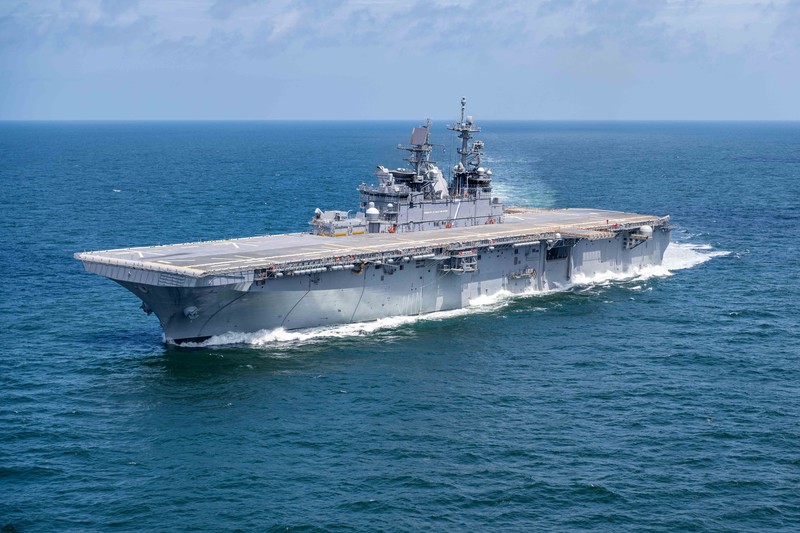
Secretary of State Marco Rubio says the United States can achieve its war aims “without any ground troops.” The Pentagon just put 3,500 sailors and Marines within striking distance of Iran’s coast.
The USS Tripoli, an America-class amphibious assault ship, entered the US Central Command area of responsibility on Friday carrying the 31st Marine Expeditionary Unit, F-35B stealth fighters, Osprey tiltrotor aircraft, and amphibious assault vehicles. A second amphibious group, centred on the USS Boxer, is steaming from San Diego. Two thousand paratroopers from the 82nd Airborne Division have been ordered to the region.
Nobody in Washington is calling it an invasion force. The composition of the troops suggests something more specific — and perhaps more imminent.
Built for raids, not occupation
Ruben Stewart, senior fellow for land warfare at the International Institute for Strategic Studies, told Al Jazeera that a ground invasion of Iran would require roughly 160,000 troops — the same number used to invade Iraq, a country roughly one-quarter Iran’s size. The combat force currently deploying amounts to about four battalions, or 3,600 troops.
“The force being deployed is consistent with discrete, time-limited operations, not a sustained ground campaign,” Stewart said. “Both are rapid-response, modular forces designed for raids, seizures of key terrain, and short-duration missions with limited follow-on presence.”
Three operational scenarios are under discussion among military analysts: seizing or blockading Kharg Island, the coral outcrop that handles roughly 90 percent of Iran’s oil exports; clearing Iran’s coastline to reopen the Strait of Hormuz; and, most ambitiously, securing Iran’s stockpile of highly enriched uranium.
James Jeffrey, a former deputy national security adviser to President George W. Bush, told the Associated Press that Iran retains more than 400 kilograms of highly enriched uranium. “It’s buried, but still it’s there,” he said.
Of these options, Stewart said reopening the Strait of Hormuz is the most realistic — limited helicopter-borne raids against Iranian missile sites, mine stockpiles, and fast-attack craft along the narrow waterway through which roughly 20 percent of the world’s traded oil once passed daily. Seizing Kharg Island is technically feasible but far more escalatory. Securing the nuclear material would require a substantially larger force.
The build-up also serves a diplomatic purpose. Stewart described it as “coercive leverage rather than a decision for war.” But he warned that as force levels grow, “the political and operational momentum becomes harder to reverse.”
Kuwait under fire
Even as Washington masses forces for its next move, Iran has been expanding the battlefield in the opposite direction — redrawing the map faster than any diplomatic track can follow.
Kuwait International Airport was struck by multiple drone attacks on Saturday that caused significant damage to its radar system, according to Reuters, citing Kuwait’s state news agency. The Civil Aviation Authority attributed the attacks to Iran, its proxies, and the armed factions it supports.
A fire that broke out in the airport’s fuel tanks on Wednesday — from an earlier drone strike — took 58 consecutive hours to extinguish.
Kuwait has already suffered the war’s single deadliest incident for American forces: six service members killed when an Iranian drone struck an operations center at a civilian port. On Wednesday, Kuwait said it had foiled a plot to assassinate state leaders and arrested six suspects linked to Hezbollah, according to The Guardian.
The targeting of Kuwait marks a significant expansion. Iran’s retaliatory campaign had previously focused on Israel and the Gulf states hosting the largest US military installations — chiefly Saudi Arabia and Bahrain.
A Saudi base under siege
Saudi Arabia’s Prince Sultan air base, roughly 60 miles from Riyadh, has been attacked three times in the past week alone. The most recent strike, on Friday, involved six ballistic missiles and 29 drones, wounding at least 15 US troops — five seriously — according to two people briefed on the matter who spoke to the Associated Press on condition of anonymity. Fourteen more American troops were injured in an earlier attack that week. In a third incident, no one was hurt but a US aircraft was damaged.
The war’s total American toll now stands at 13 dead and more than 300 wounded, according to Central Command. Thirty remain sidelined. Ten are classified as seriously wounded.
Jeffrey, now a scholar at the Washington Institute for Near East Policy, described the casualty figures as remarkably low given the volume of Iranian fire. But Iran’s objective, he said, is not primarily killing Americans — it is inflicting economic pain.
“We have not stopped Iran from its campaign against the Gulf,” Jeffrey said. “We have not eliminated all of their missiles.”
The Houthis open a new front
On Saturday, Yemen’s Houthi rebels formally entered the war. Brigadier General Yahya Saree, the group’s military spokesman, said the Houthis had launched strikes on southern Israel in coordination with Iran and Hezbollah. Israel said it intercepted the first salvo; a second strike was claimed without immediate Israeli comment, according to CBS News.
The Houthis’ involvement threatens a second global chokepoint. Between November 2023 and January 2025, the group attacked more than 100 merchant vessels and sank two, disrupting traffic through the Bab el-Mandeb Strait at the southern end of the Red Sea. Roughly 12 percent of world trade passes through that corridor.
With the Strait of Hormuz effectively closed, Saudi Arabia has been rerouting crude through Bab el-Mandeb. Saudi Arabia has been sending millions of barrels of crude oil a day through the corridor, bypassing Hormuz entirely. If the Houthis begin targeting that route, the world’s last redundancy vanishes.
Ahmed Nagi, a senior Yemen analyst at the International Crisis Group, warned that the effect “would not be limited to the energy market” and could destabilize “all of maritime security.”
The clock runs down
Trump has given Iran until April 6 to reopen the Strait of Hormuz. Iran says it has not engaged in any negotiations. Envoy Steve Witkoff delivered a 15-point proposal to Tehran covering a ceasefire and nuclear restrictions, according to CBS News. Iran rejected it and presented a five-point counter-proposal demanding reparations and recognition of its sovereignty over the strait.
Pakistan has offered to mediate. Pakistan’s army chief, Field Marshal Asim Munir, spoke with Trump, while Prime Minister Shehbaz Sharif held talks with Iranian President Masoud Pezeshkian. No date for talks has been set.
Meanwhile, the USS Gerald R. Ford, the Navy’s newest carrier, arrived in Split, Croatia, on Saturday for repairs after a laundry fire damaged multiple berthing compartments, according to USNI News. It has been deployed for 277 days — approaching the post-Vietnam record of 294 days. Should it remain at sea through mid-April, it will break that record.
The war is one month old. The Marines are in theatre. Two straits are threatened. The diplomatic clock is running, and nobody involved seems confident what happens when it stops.
Sources
- Iranian attack on Saudi base injures US troops. More American forces arrive in the Middle East — AP News
- More than 3,500 U.S. Troops arrive in Middle East as Iran war strikes intensify — CBS News
- USS Tripoli Operating in CENTCOM, USS Gerald R. Ford in Croatia — USNI News
- Kuwait airport hit by drones, radar system damaged, no casualties — Reuters
- Gulf countries warn of rising threat from Iran-backed militias and proxies — The Guardian
- War on Iran: What troops is the US moving to the Gulf? — Al Jazeera
Discussion (15)