 lop News
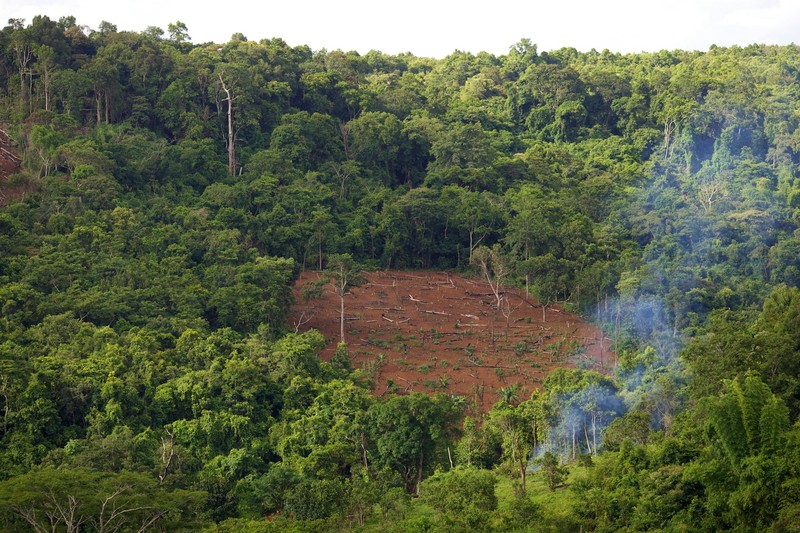
Every year, roughly 28,000 people die from heat made worse by the destruction of tropical rainforests. The chainsaws and fires clearing land across the Amazon, Congo Basin and Southeast Asia are not just dismantling ecosystems — they are directly killing the people who live nearby.
A study published in Nature Climate Change, described by its lead author as the first to isolate the health impacts of warming caused specifically by tropical deforestation, puts a number on a consequence long absent from global climate accounting. Between 2001 and 2020, tropical forest loss exposed 345 million people to additional local warming, contributing to an estimated 28,330 excess heat-related deaths annually. Over two decades, that surpasses half a million dead.
Those deaths represent 39 percent of all heat-related mortality in deforested regions — caused not by fossil fuel emissions alone, but by the removal of the canopy itself.
How trees cool — and what happens when they vanish
Tropical forests cool themselves through evapotranspiration: trees draw water from the soil and release it through their leaves, much as sweat cools human skin. A single large tropical tree provides as much cooling as several air conditioners running continuously. Billions of them working together moderate temperatures across entire regions.
When the trees go, the cooling goes with them. Using satellite data from NASA’s MODIS instrument, the researchers found that deforested areas across the tropics warmed by an average of 0.7°C between 2001 and 2020. Nearby regions that kept their forests warmed by just 0.2°C. After stripping out background warming from global climate change, deforestation alone accounted for 0.45°C — roughly two-thirds of total warming in cleared areas.
For millions of people, that margin is the difference between a tolerable day and a lethal one.
Who dies
The mortality burden falls unevenly. Southeast Asia recorded the highest death rate, with 8 to 11 deaths per 100,000 people living in deforested areas — and a striking 29 per 100,000 in Vietnam alone. The region accounted for 15,680 annual excess deaths, more than half the pan-tropical total, driven largely by Indonesia, where 49 million people were exposed to deforestation-driven heating.
Tropical Africa saw an estimated 9,890 annual deaths, with 42 million people exposed in the Democratic Republic of Congo. Central and South America, despite some of the sharpest local warming, had lower population exposure and recorded 2,520 annual deaths — though Brazil alone saw 22 million people affected.
Independent scientists praised the methodology but noted significant data gaps. No country-specific heat vulnerability indices exist for African nations; the researchers used averaged South American data as a proxy. Dr Carly Reddington of the University of Leeds, the study’s lead author, told Carbon Brief that Africa is the most uncertain region and that “more data is really crucial.”
Dr Nicholas Wolff, a climate scientist at the Nature Conservancy who was not involved in the research, described the paper as “sobering,” adding that it “reframes tropical deforestation as not only a carbon emissions and ecological issue, but also a critical public health concern.” He noted that many affected communities “depend on forest clearing for agriculture, income and survival, and are forced to make difficult choices between short-term economic needs and long-term health and environmental stability.”
A tightening loop
The findings arrive as deforestation accelerates. More than 6 million hectares of primary tropical forest — an area nearly the size of Panama — were destroyed in 2024 alone, the fastest rate since records began, according to data cited by the researchers. Every hectare cleared intensifies local warming while simultaneously eroding the planet’s capacity to absorb the carbon emissions driving global heating.
The result is a feedback loop with a body count: the more forest falls, the hotter it gets, and the less nature can do to slow the warming that follows.
Brazil is setting up a new fund to pay tropical nations for keeping their forests intact, recognising their role in regulating local climate. But beyond Norway, wealthy nations have been slow to commit money. The study suggests the cost of inaction is already being paid — not in abstract tonnes of carbon, but in human lives that precise data now allows us to count.
Sources
- Tropical deforestation is associated with considerable heat-related mortality — Nature Climate Change
- Warming due to tropical deforestation linked to 28,000 ‘excess’ deaths per year — Carbon Brief
- Chopping down areas of tropical rainforest is causing rising temperatures linked to thousands of deaths — The Conversation
Discussion (9)