 lop News
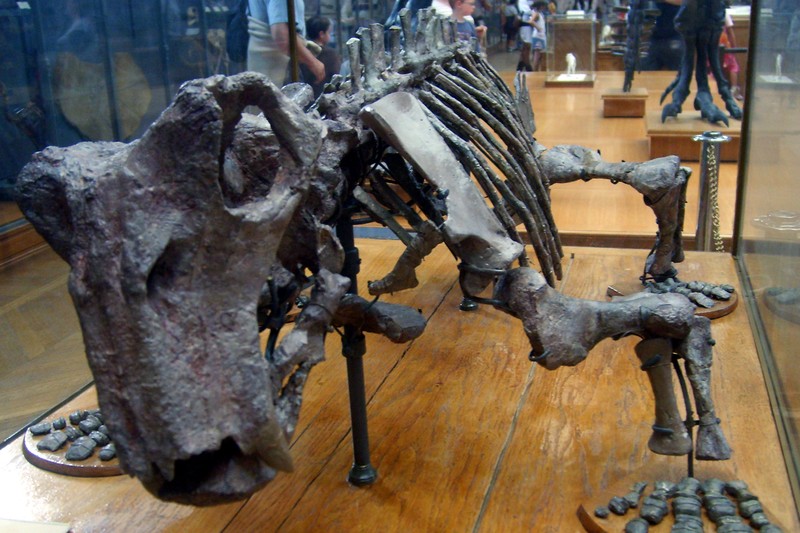
Somewhere in South Africa’s Karoo, 250 million years ago, a Lystrosaurus embryo curled tightly inside a leathery egg and died. It never hatched. But it waited — through the rise and fall of dinosaurs, through ice ages and continental drift — until a fossil hunter named John Nyaphuli cracked open a small nodule in 2008 and found tiny flecks of bone.
It took another 17 years to prove what that nodule actually was.
In a paper published in PLoS ONE, an international team led by Julien Benoit and Jennifer Botha of the University of the Witwatersrand, with Vincent Fernandez of the European Synchrotron Radiation Facility (ESRF), describes the first-ever egg containing an embryo of a mammal ancestor. The find settles a question that has nagged palaeontologists for decades: did therapsids — the ancient lineage that eventually produced mammals, including us — lay eggs?
Yes. They did.
The answer came from a particle accelerator. Using powerful X-rays at the ESRF in Grenoble, France, the team imaged the embryo’s bones at extraordinary resolution. The telltale clue was in the lower jaw: the two halves had not yet fused. In modern egg-layers like turtles and birds, this fusion happens before hatching so the beak is strong enough to feed. An unfused jaw meant this individual died in ovo — still inside its egg, which likely had a soft, leathery shell that never fossilized.
Lystrosaurus looked like a pig with a turtle’s beak and two downward-pointing tusks. It is famous for surviving the End-Permian mass extinction 252 million years ago — the worst biological catastrophe in Earth’s history, which killed roughly 90% of all living things. The egg offers a clue about how it pulled that off. Lystrosaurus laid relatively large eggs for its body size, suggesting well-developed young that hatched ready to feed themselves, run from predators, and reproduce early. In the brutal droughts that followed the extinction, that fast-maturing strategy was likely the difference between persistence and oblivion.
The fossil also implies Lystrosaurus did not produce milk — large, yolk-rich eggs suggest embryos developed without parental feeding after hatching. Lactation would come later, further down the road toward true mammals.
One curled-up embryo. Two unfused jaw bones. And a detail about our ancestry that had been hiding in rock for a quarter of a billion years.
Sources
- First-ever egg of a mammal ancestor discovered — European Synchrotron Radiation Facility
Discussion (6)