 lop News
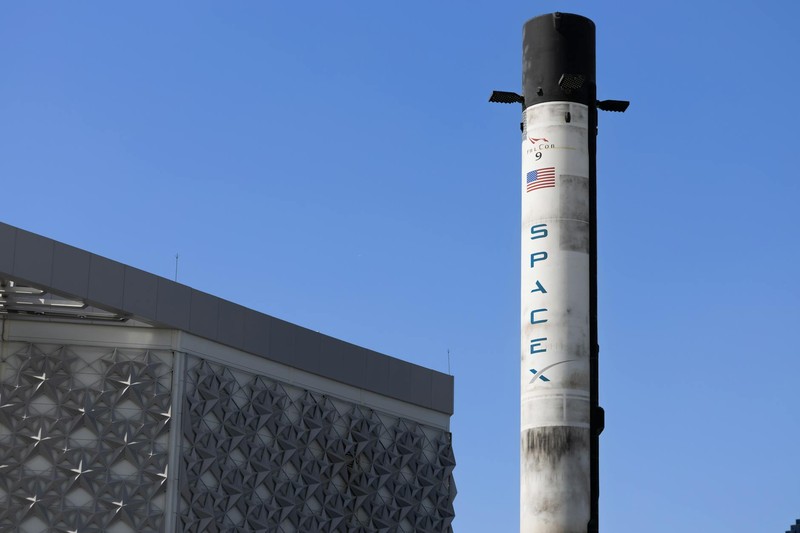
$970 billion separates what SpaceX thinks it’s worth from what Morningstar’s analysts calculated. One of those numbers is going to look very smart within a year.
SpaceX has told prospective investors it plans to target a $1.75 trillion valuation — including a greenshoe option — in the largest initial public offering in history, according to two people familiar with the matter who spoke to Reuters. The company aims to raise at least $75 billion on the Nasdaq under the ticker “SPCX,” potentially as early as June 12.
Morningstar’s equity research team ran the same company through a discounted cash flow model and arrived at $780 billion. That’s 55% below the IPO target and roughly 48% below the $1.5 trillion private-market valuation SpaceX carried before filing.
The roadshow begins Thursday. The gap between those two numbers is the entire story.
The Engine and the Money Pit
SpaceX’s first public financials paint a company that is simultaneously a cash-generating satellite monopoly and an AI spending machine burning through billions.
Starlink is the engine. The satellite internet business generated $11.3 billion in revenue in 2025 — roughly 70% of SpaceX’s total $18.67 billion — and posted operating income of $4.4 billion at a 39% margin, according to Morningstar’s analysis of the filing. It had 10.3 million subscribers across 164 countries by the end of Q1 2026, with more than 9,600 satellites deployed.
Then there is everything else. SpaceX’s AI division — the xAI business Musk folded into the company in February — burned $7.72 billion in capital expenditures in Q1 2026 alone and lost $2.5 billion in the same period, according to Morningstar’s analysis of the filing. The division lost $6.4 billion across all of 2025. SpaceX has also secured a deal to supply computing power to Anthropic for $1.25 billion a month, Bloomberg reported, though that revenue has yet to appear meaningfully in its financials.
Overall, SpaceX swung from a $791 million net profit in 2024 to a $4.94 billion net loss in 2025. In Q1 2026, it lost $4.30 billion on $4.70 billion in revenue. It carries $29.1 billion in debt. Cash fell from $24.75 billion at year-end to $15.85 billion by March.
The $970 Billion Question
Morningstar assigns SpaceX a “narrow” economic moat based on the cost advantages of reusable rocketry and orbital launch dominance — SpaceX delivered 83% of all mass sent to orbit in 2025. But the AI business receives an “indeterminate” moat rating and what Morningstar calls “a material threat of value destruction.”
The bull case rests on orbital data centers — servers in space, powered by Starship’s cheap lift capacity. Morningstar modeled three scenarios: a “Moonshot” where SpaceX captures 20% of global AI computing capacity, a “No Go” where the technology fails entirely, and a base case where orbital computing proves viable but constrained, capturing roughly 4% of global capacity outside Russia and China.
The technology has not been proven. SpaceX describes a $28.5 trillion total addressable market, mostly AI-related. Investors are being asked to pay today for outcomes that may not materialize until the 2030s, if at all.
The offering is expected to kick off a wave of mega-IPOs: SpaceX, OpenAI, and Anthropic together could add nearly $4 trillion in market capitalization to public markets, according to Reuters. Competition for investor dollars is about to intensify.
Musk’s Terms
The offering is all-primary — proceeds go to SpaceX, not to existing shareholders cashing out. Musk has said he won’t sell shares. He retains majority voting control through a dual-class structure, holding 85.1% of combined voting power.
Nasdaq’s fast-entry rule will add SpaceX to the Nasdaq-100 after 15 trading days, triggering automatic buying from index funds and ETFs — a built-in demand floor. But Morningstar warns that “max Q,” the moment of greatest aerodynamic stress on a launch vehicle, will come months later when employee and investor lockups expire and successive tranches of stock hit the open market.
Who Wins Either Way
Goldman Sachs, Morgan Stanley, Bank of America, Citigroup, and JPMorgan — leading a syndicate of 23 banks — will collect fees on the largest IPO in history. Early backers like Andreessen Horowitz, Sequoia Capital, and Founders Fund, some invested for more than two decades, will finally have a public exit.
Retail investors drawn by Musk’s name and Starlink’s growth story may find themselves holding shares at a price that reflects a decade of execution that hasn’t happened yet. Morningstar’s message is straightforward: “We think long-term investors eager to participate in SpaceX’s future endeavors and potential success will have opportunities to do so with a greater margin of safety than the initial offering is likely to provide.”
Wait for gravity.
Sources
- Exclusive: SpaceX targets $1.75 trillion valuation including greenshoe option in record IPO, sources say — Channel News Asia / Reuters
- How SpaceX’s Dream of a Record-Breaking IPO Stacks Up — Bloomberg
- SpaceX’s IPO Filing: Big Spending, Big Losses — Morningstar
- SpaceX: What Investors Need to Know About Its Enormous Upcoming IPO — Morningstar
Discussion (10)