 lop News
$1.5 trillion for the Pentagon. $73 billion stripped from domestic agencies. Zero plan to close a $39 trillion debt.
The Trump administration’s budget blueprint for fiscal year 2027, released Friday, is less a fiscal document than a declaration of national priorities. The United States, currently fighting a war against Iran, would pour nearly half a trillion additional dollars into its military while paring back nearly every other function of the federal government.
The proposed defense budget of $1.5 trillion represents a roughly 42 percent increase over 2026 levels — an additional $445 billion — according to budget documents. The White House boasted that the funding approaches “historic increases just prior to World War II.”
The request is separate from the $200 billion the Pentagon has sought specifically for the Iran war, which congressional Republicans are expected to fund through budget reconciliation, a procedural mechanism allowing passage with a simple Senate majority.
What Gets Cut
The defense increases are paired with a 10 percent reduction in non-defense discretionary spending — roughly $73 billion in cuts falling heavily on agencies the administration has long targeted.
The Environmental Protection Agency faces a 52 percent reduction. NASA, whose Artemis II mission launched astronauts toward the moon two days before the budget’s release, would see a 23 percent cut, including $3.6 billion from its science division and the cancellation of roughly 40 programs. The Department of Agriculture drops 19 percent. Health and Human Services loses 12.5 percent, including cuts to a low-income heating assistance program. The National Endowment for Democracy would be defunded entirely.
The administration said savings would come by “reducing or eliminating woke, weaponized, and wasteful programs, and by returning state and local responsibilities to their respective governments.”
At a private White House event this week, Trump was blunt. “It’s not possible for us to take care of day care, Medicaid, Medicare — all these individual things,” he said. “They can do it on a state basis.”
What Gets Built
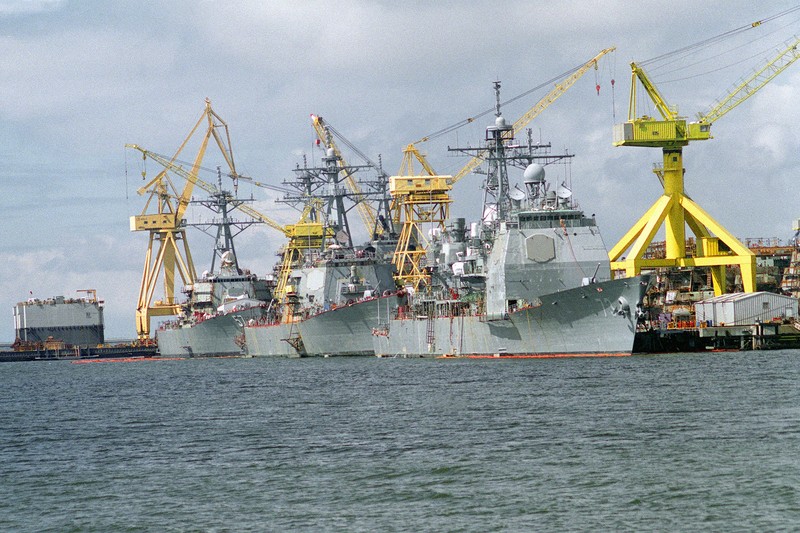
The defense request includes $65.8 billion for shipbuilding — covering 34 new combat and support vessels, including initial work on the Trump-class battleship. The first vessel, the USS Defiant, is expected to begin construction soon, with Trump saying the first ships could be operational within two and a half years.
The budget also funds the Golden Dome missile defense shield, a proposed multi-layered system of land, sea, and space-based interceptors. The administration has pegged the total project at $185 billion, but the Congressional Budget Office estimates space-based components alone could cost $542 billion over two decades — a sum that could eventually consume a significant share of the defense budget.
Not all the spending is military. The request includes $152 million to reopen the former Alcatraz prison, $481 million to hire air traffic controllers, and $10 billion for a “Presidential Capital Stewardship Program” to fund construction and beautification projects in Washington, DC.
The Math Problem
The budget does not include projections for how the new spending would affect the federal deficit. The nonpartisan Congressional Budget Office forecasts a $1.853 trillion shortfall for the current fiscal year, up from $1.775 trillion the year before. The national debt sits at $39 trillion.
The Committee for a Responsible Federal Budget called the proposal “light on details and heavy on borrowing,” saying it relies on a decade of optimistic economic assumptions.
About two-thirds of federal spending goes to mandatory programs like Social Security and Medicare, which the budget does not touch. The remaining discretionary third is where the administration has drawn its line.
What It Signals Abroad
The scale of the request carries weight well beyond Washington. Administration officials have repeatedly warned that the US lags behind China in shipbuilding capacity and output. Republican Senator Roger Wicker and Representative Mike Rogers, chairs of the House and Senate Armed Services committees, said the spending was needed because “America is facing the most dangerous global environment since World War II.”
The budget’s emphasis on naval expansion and next-generation missile defense suggests the administration is planning for a prolonged period of military readiness — spanning not just the Iran conflict but an era of strategic competition with Beijing. The Golden Dome system is designed to protect the US from next-generation missile and drone threats.
The Road Through Congress
The budget faces an uncertain path in Congress, where disagreement over Trump’s spending priorities recently triggered the longest government shutdown in US history. The partial shutdown of the Department of Homeland Security has now reached 49 days.
Top congressional Democrats declared the proposal dead on arrival. Oregon Senator Jeff Merkley, the ranking Democrat on the budget committee, called it “an out-of-touch plea for more money for guns and bombs, and less for the things people need.” Senate Minority Leader Chuck Schumer said Democrats “will make sure it never passes.”
The administration is counting on Republican majorities to push $350 billion of the defense spending through budget reconciliation, avoiding the need for Democratic votes. The remaining $1.1 trillion would go through the regular appropriations process, which typically requires bipartisan support.
The request arrives as the US public grapples with skyrocketing gas prices driven by the Iran conflict, and as Republicans prepare to defend narrow congressional majorities in November’s midterm elections.
Sources
- Trump proposes “historic” defense spending budget, eyes 10% cut to discretionary spending — Reuters
- Trump seeks $1.5tn for defence alongside domestic spending cuts — BBC News
- Trump budget seeks $1.5 trillion in defense spending alongside domestic program cuts — NPR
- US defense spending would rise $445bn under Trump budget plan, with cuts to domestic programs — The Guardian
Discussion (9)